Cellulose Insulation R-Value Calculator
Find the settled depth, total loose-fill volume, and number of bags needed to reach a target R-value in an attic or dense-pack wall, using real cellulose density and coverage assumptions.
🎯Real Cellulose Presets
📝Project Inputs
Attic uses settled loose-fill; wall uses dense-pack density.
Used when method is square feet.
Loose 3.2, standard 3.5, dense-pack up to 3.8.
Enter current R-value to add only the difference.
Attic settled ~2.2 to 2.7; dense-pack ~0.9 to 1.1.
Loose attic ~1.5; dense-pack walls ~3.5.
Extra blown depth added for loose-fill settling.
Added to bag count for gaps and compaction.
Common cellulose bags weigh about 25 to 33 lb.
🔢Formula Snapshot
📏Cellulose R per Inch
| Install Type | Density (lb/ft³) | R per Inch | Notes |
|---|---|---|---|
| Loose attic (fresh) | 1.3 – 1.5 | 3.2 – 3.4 | Blown, will settle over time |
| Loose attic (settled) | 1.5 – 1.8 | 3.4 – 3.6 | Common design value 3.5 |
| Dense-pack wall | 3.0 – 3.5 | 3.6 – 3.8 | No settling, fills cavities |
| Dense-pack cathedral | 3.5 – 4.0 | 3.7 – 3.8 | Sloped roof cavities |
📊Depth Needed by Target R-Value
| Target R | Depth at 3.5/in | Depth at 3.2/in | Volume / 1000 sqft | Bags / 1000 sqft |
|---|---|---|---|---|
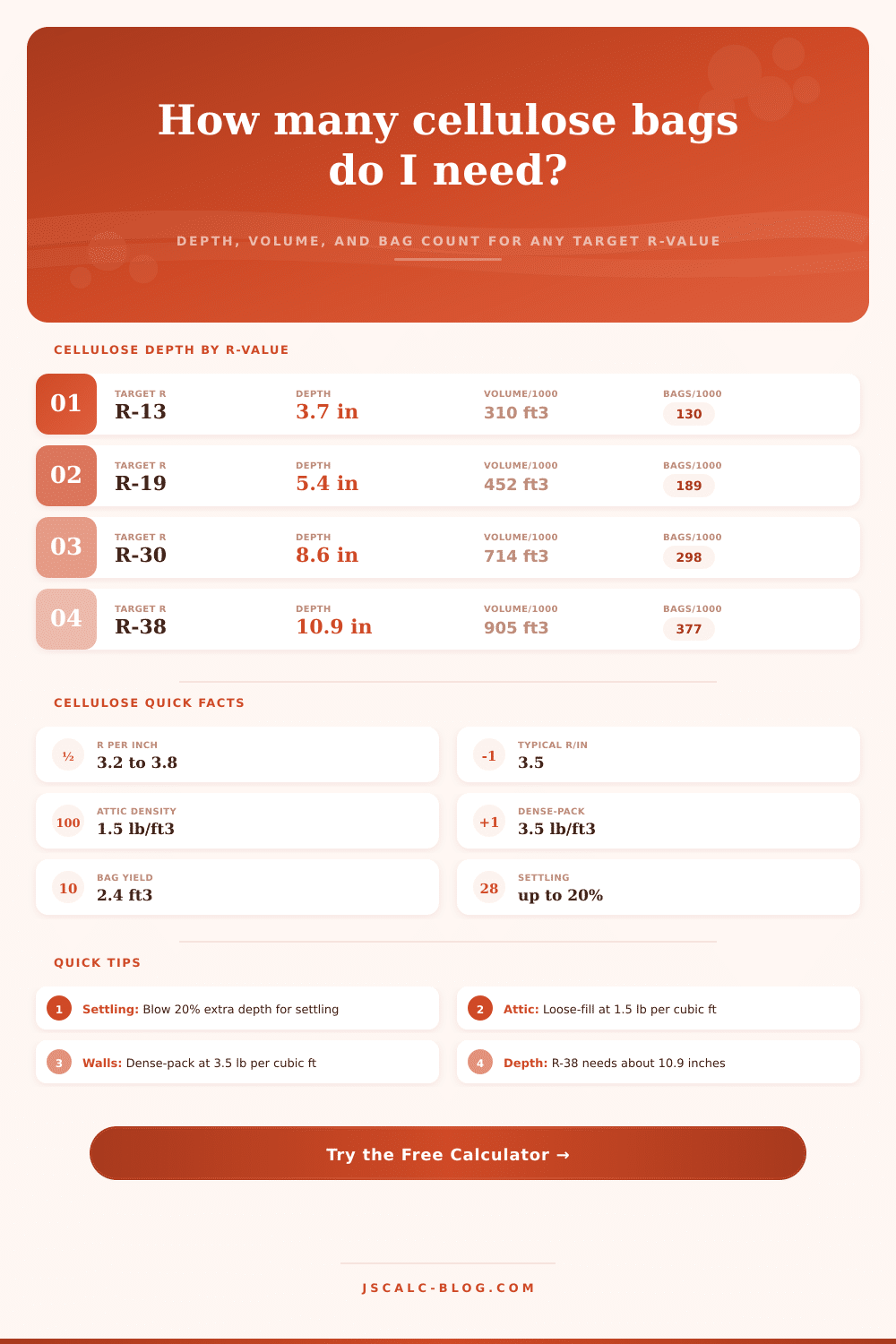
| R-13 | 3.7 in | 4.1 in | 310 ft³ | 130 bags |
| R-19 | 5.4 in | 5.9 in | 452 ft³ | 189 bags |
| R-30 | 8.6 in | 9.4 in | 714 ft³ | 298 bags |
| R-38 | 10.9 in | 11.9 in | 905 ft³ | 377 bags |
| R-49 | 14.0 in | 15.3 in | 1167 ft³ | 486 bags |
| R-60 | 17.1 in | 18.8 in | 1429 ft³ | 595 bags |
Volume and bag counts assume 3.5 R per inch and a 2.4 ft³ settled bag yield. Change the inputs above for your product.
🗺Recommended Attic R-Value by Zone
| Climate Zone | Example Regions | Attic Target R | Cellulose Depth |
|---|---|---|---|
| Zone 1 – 2 | Gulf Coast, Florida | R-30 to R-49 | 8.6 – 14.0 in |
| Zone 3 | Southern states | R-30 to R-49 | 8.6 – 14.0 in |
| Zone 4 | Mid-Atlantic | R-38 to R-60 | 10.9 – 17.1 in |
| Zone 5 | Lower Midwest | R-49 to R-60 | 14.0 – 17.1 in |
| Zone 6 – 7 | Upper Midwest, North | R-49 to R-60 | 14.0 – 17.1 in |
| Zone 8 | Alaska interior | R-60 and up | 17.1 in and up |
⚖Loose-Fill vs Dense-Pack Density
| Property | Attic Loose-Fill | Wall Dense-Pack |
|---|---|---|
| Typical density | 1.5 lb/ft³ | 3.5 lb/ft³ |
| R per inch | 3.4 – 3.6 | 3.6 – 3.8 |
| Settling | Up to 20% | Negligible |
| Bag settled yield | 2.2 – 2.7 ft³ | 0.9 – 1.1 ft³ |
| Best for | Open attic floors | Closed wall cavities |
| Air resistance | Good | Excellent |
🗂Target R vs Depth, Volume, and Bags
| Target R | Depth (in) | Depth (cm) | Volume / 1000 sqft | Bags / 1000 | Weight / 1000 |
|---|---|---|---|---|---|
| R-13 | 3.7 | 9.4 | 310 ft³ | 130 | 465 lb |
| R-19 | 5.4 | 13.8 | 452 ft³ | 189 | 679 lb |
| R-25 | 7.1 | 18.1 | 595 ft³ | 248 | 893 lb |
| R-30 | 8.6 | 21.8 | 714 ft³ | 298 | 1072 lb |
| R-38 | 10.9 | 27.6 | 905 ft³ | 377 | 1357 lb |
| R-49 | 14.0 | 35.6 | 1167 ft³ | 486 | 1750 lb |
| R-60 | 17.1 | 43.5 | 1429 ft³ | 595 | 2143 lb |
Based on 3.5 R per inch, 2.4 ft³ per bag, and 1.5 lb/ft³ installed density across 1000 sq ft.
⚙Full Formula Breakdown
💡Practical Cellulose Tips
Attic Insulation Most of us treat attic insulation as bulk commodity; you buy some bags at the store, look up your R-value on a generic chart, and cross your fingers. Why are your heating bills so high? The problem isnt necessarily the stuff.
Recycled paper becomes an excellent insulator called cellulose, but it’s unlike fiberglass or rigid foam. Because it settles. It squishes under its own weight. And it move over time. This literally changes everything. By the time spring comes, all that nice-thick cellulose you installed is going to be thinner. Gravitys doing its job. Luckily, the calculator above help with that.
How to Calculate Your Insulation Needs
You’ll note it questions whether you’re installing dense-pack (in a wall) versus loose-fill (in an attic). The former are denser. Up to 3.5 pounds per cubic foot, sometimes more, while latter is lighter (around 1.5 pounds per cubic foot), just heavy enough to sink into place without blowing away too easily. Get this one wrong, and many people do, and your calculations will be way off.
And what about those inputs? That’s where the choices come in. First you choose a target R-value, and this varies by climate zone. For instance, if you’re up north in a cold area, shooting for something like R-49 or even R-60 would be appropriate; there is big temperature difference. Warmer regions may only require R-30.
Did you already have insulation and are simply topping it off? Enter the existing R-value into the calculator. Chances are that’s how you ended up here: many older homes has thin layers of fiberglass that have degraded or settled over decades. Adding cellulose on top fill gaps between old batts and creates a tighter thermal barrier. Take existing resistance into account or you’ll end up buying to much.
The one thing you won’t remember till you pick up the hose: settling. To allow for settling, the calculator assume an additional amount and adds it as a “settling allowance” percentage. On loose-fill jobs, normal practice is to add 20 percent more thickness so that even after natural compaction of the material there’s enough depth to hit your thermal target. Better to be blowing a little bit more then to have a cold attic floor. Because dense-pack walls fill all the nooks under pressure, they don’t require such a buffer against settling.
You’ll get more or less out of each bag depending on your brand, so it’s a good idea to read the package info. Standard bags holds roughly 2.4 cubic feet (the amount of material a properly blown-in installation settles down to). Other sizes or better blends may be different. You can adjust this parameter in the tool, as well as waste factors.
We set our waste factor at five percent to account for waste like small gaps around electrical boxes and plumbing vents, plus extra material we inevitably blow into place when doing things manualy. Filling tiny corners and crevices always takes more than you think.
Because of that cellulose selection, though, you are also up to your elbows in moisture concerns. Unless you treat the material with borates (to make it resistant to pests and fire), cellulose will absorbs humidity… Which isn’t good. If you live in a really humid climate, proper attic ventilation is crucial: The insulation cannot be allowed to trap moist air next to the roof deck. It’s not a math issue the tool can address; but it’s something you need to pay attention to, because it affects the performance of the insulation and the structure of the roof itself. Proper installation keep your roof and your R-value protected.
And this ensures you don’t buy too many bags… Wasting money; and also makes sure you don’t under-insulate. So how do you figure out how much? Use the online calculator above by entering your area and desired density to find the baseline for the bags and volume you need. Now you know exactly what you need to achieve your goal (no guesswork).
The hard part comes after buying the materials: spreading it all out evenly. Don’t pile up the cellulose because piles don’t insulate as well as flat layers. Spread that stuff out evenly over the joists so there aren’t any thin spots with cold air bridging through. Sure, it seems easy when you’re reading this on your computer from a nice chair. But what if you get up there in someones dusty attic? Now it gets real.
Having something solid to compare to. Knowing exactly how thick you need to make it. Is a great reference point. No more guessing; you can gauge down while you work. It’s the difference between doing this as a tedious task vs. It would of been a money-saving way to reduce our heating bill. Get it flat, get it thick (enough), and trust that it will settle over time.