Stardate Moon Phase Calculator
Enter any date and time and this tool finds the Moon phase, its illuminated fraction, the age of the Moon in days, and how long until the next Full Moon and New Moon. It also prints a fun Star-Trek Next Generation style stardate so you can log the sky like a starship officer.
🚀Quick Date Presets
📅Date, Time and Location Inputs
The civil date you want the Moon phase for.
Local clock time; the Moon age shifts slightly through the day.
Example: New York is -5, London 0, Tokyo +9. Used to convert to UTC.
Flips which limb of the Moon appears lit in the glyph and notes.
A known New Moon epoch. Default is 6 Jan 2000, 18:14 UTC.
Average New-Moon-to-New-Moon period. Standard value 29.53059.
Both are entertainment approximations, not official time.
Controls rounding on age, illumination and stardate.
🔢Formula Snapshot
🌕Eight Moon Phases by Age and Illumination
| Phase Name | Moon Age Range | Illumination | What You See |
|---|---|---|---|
| New Moon | 0.0 to 1.8 days | 0 to 3% | Dark, rises with the Sun |
| Waxing Crescent | 1.8 to 5.5 days | 3 to 35% | Thin evening sliver in the west |
| First Quarter | 5.5 to 9.2 days | 35 to 65% | Right half lit, up at sunset |
| Waxing Gibbous | 9.2 to 12.9 days | 65 to 97% | More than half, brightening |
| Full Moon | 12.9 to 16.6 days | 97 to 100% | Whole disc, rises at sunset |
| Waning Gibbous | 16.6 to 20.3 days | 97 to 65% | Shrinking, rises late evening |
| Last Quarter | 20.3 to 24.0 days | 65 to 35% | Left half lit, up before dawn |
| Waning Crescent | 24.0 to 29.5 days | 35 to 0% | Thin morning sliver in the east |
📏Synodic vs Sidereal and Other Lunar Months
| Month Type | Length (days) | Measured Against | Why It Differs |
|---|---|---|---|
| Synodic (phase) | 29.53059 | The Sun, New to New | Drives the phases we see |
| Sidereal | 27.32166 | The distant stars | One true orbit of Earth |
| Tropical | 27.32158 | The vernal equinox | Nearly equal to sidereal |
| Anomalistic | 27.55455 | Perigee to perigee | Sets supermoon timing |
| Draconic (nodal) | 27.21222 | The orbital nodes | Controls eclipse seasons |
🔮Stardate Eras Used in Star Trek
| Era or Series | Approx Stardate Range | Roughly Which Years | Note |
|---|---|---|---|
| Original Series (TOS) | 1312 to 5928 | 2265 to 2269 | Numbers were loosely tracked |
| Motion Pictures | 7410 to 8454 | 2270s to 2280s | Continued the TOS style |
| Next Generation (TNG) | 41000 to 47999 | 2364 to 2370 | 1000 units equal one year |
| Deep Space Nine | 46000 to 52999 | 2369 to 2375 | Shares the TNG scale |
| Voyager | 48000 to 54999 | 2371 to 2378 | Also 1000 units per year |
| This calculator (TNG) | 1000 per year from 2323 | Any date you enter | Simplified fan approximation |
📡Full Phase Comparison Grid
| Phase | Age (days) | Illumination | Rough Rise / Set | Best Viewing | Symbol |
|---|---|---|---|---|---|
| New Moon | 0.0 | 0% | Rise 6am / Set 6pm | Deep-sky and stars | 🌑 |
| Waxing Crescent | 3.7 | 25% | Rise 9am / Set 9pm | Early evening, west | 🌒 |
| First Quarter | 7.4 | 50% | Rise noon / Set midnight | Evening, sharp craters | 🌓 |
| Waxing Gibbous | 11.1 | 78% | Rise 3pm / Set 3am | Late evening, bright | 🌔 |
| Full Moon | 14.8 | 100% | Rise 6pm / Set 6am | All night, low contrast | 🌕 |
| Waning Gibbous | 18.5 | 78% | Rise 9pm / Set 9am | Late night, east | 🌖 |
| Last Quarter | 22.1 | 50% | Rise midnight / Set noon | Pre-dawn sky | 🌗 |
| Waning Crescent | 25.8 | 18% | Rise 3am / Set 3pm | Dawn, low in east | 🌘 |
⚙How the Math Works
💡Stargazing and Stardate Tips
Two things are answered at once by this calculator on page. For the date you input, it displays Moon’s phase, how illuminated it is, and how many more (or less) days there are till the next New or Full Moon. Then it also gives that same date a Star Trek: The Next Generation-style stardate. That’s the kind of number you’d expect a starship officer to jot down when checking out some anomaly. Whether you are a science fiction fan who wishes to log your day like Captain Picard, or a skywatcher who wants to plan your night, this tool will serve both.
No server needed; all calculations is done instantaneously right in your browser. But what’s the point? Because the calculator starts at a fixed point (the reference epoch), it does not get out of phase which is important if you want an accurate result. Every New Moon bring us around to another one again; that average interval is 29.53059 days. Yes, the decimal is significant: it prevents the calculation from drifting over time.
How This Moon Calculator Works
First, the calculator takes each date, yours, plus the reference, and turns them into a type of day number called a Julian Date. This is how astronomers do all their calculations; it eliminates messy considerations like different-length month and leap years. Since it’s just a sequence of numbers representing days, you simply subtract one set from the other, and then you have your answer. The answer are the age of the moon, expressed in days.
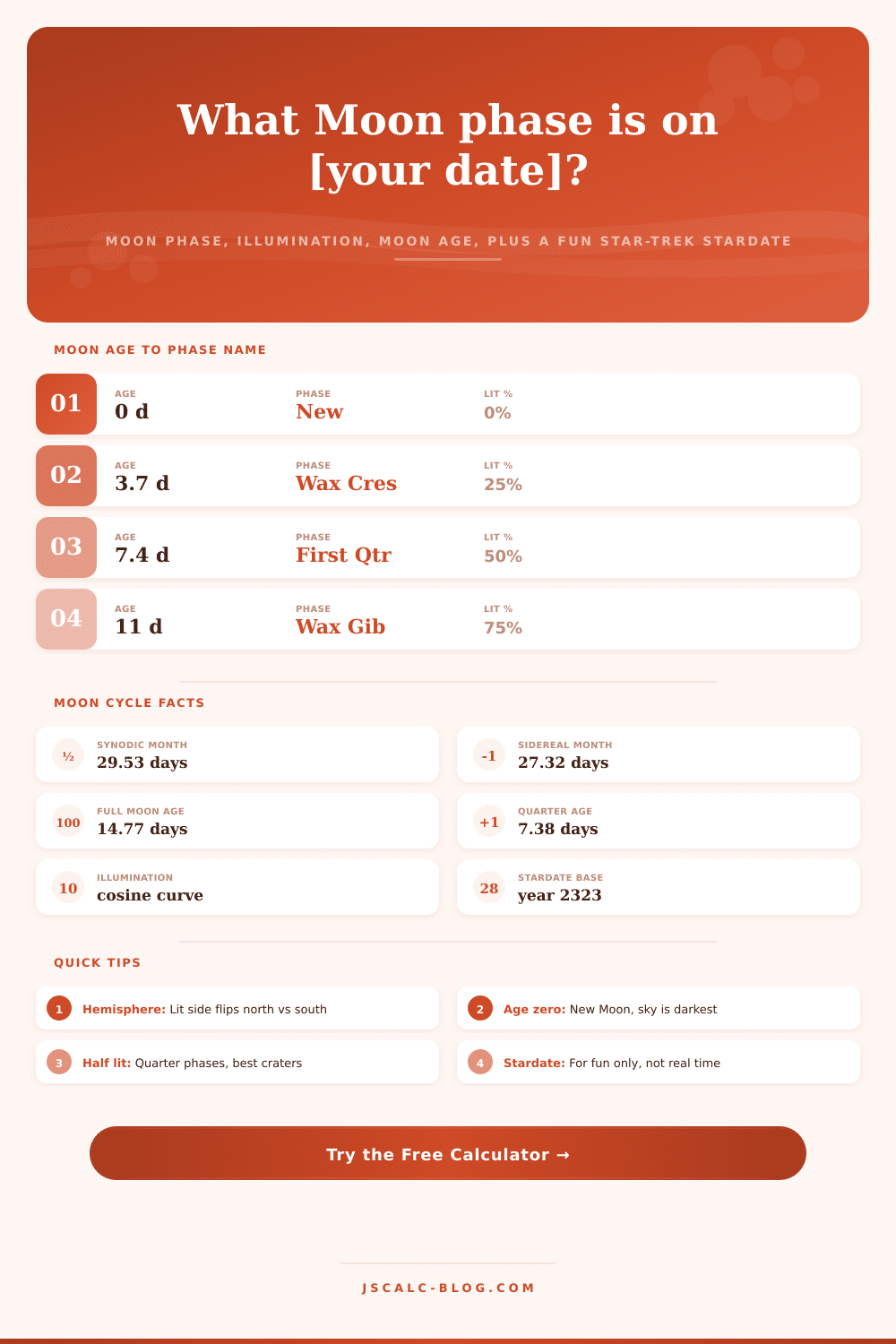
Once you have an idea of the age, the next step is simple: it’s just a matter of naming the phase. The entire cycle have eight parts, each being one-eighth. If the number is close to zero, it’s a New Moon. It turns to a First Quarter at around 7.4 days. Full Moon occurs at about 14.77 days. And Last Quarter are reached at roughly 22 days. The other phases, the crescents and gibbous. Fill the spaces inbetween. From this familiar pattern, the tool names the current phase correctly and displays its corresponding glyph.
This graphical guide helps you visualize what you should see when you look up. However, this isn’t because the lit fraction of the Moon increases in a straight line. It doesn’t; it’s more like a smooth cosine curve. Here is the formula: illumination = 1, [cosine of (2pi times age divided by synodic month)]/2. At New Moon, result is zero. At Full Moon, it climbs to one hundred percent. So the moon looks like it grows rapidly near the quarters, whereas around New and Full Moons it changes relatively slowely. The number you see onscreen comes close to matching what your eye sees.
Need to know when the next Full Moon is coming? You might also want to know how many days are left before the next New Moon to plan a night hike or photo shoot. Since the Full Moon happens exactly halfway through the synodic month, the number of days left until the next Full Moon is that halfway target minus the current age. The days left until the next New Moon is the synodic month minus the number of days since the last New Moon. These counts automatically adjust whenever you enter a new time and date. So you can plan your activities accordingly: either under light or dark skies.
Because the Moon doesn’t match our local time zones, it converts your local time zone to Universal Time (using the timezone offset you provide) to maintain an accurate Julian Date and age (within a fraction of a day). What you will see depends off which hemisphere you select as well. A waxing Moon is always lit on the right-hand side if you are in the Northern Hemisphere; in the Southern Hemisphere, that same phase will be lit up on the left. Toggling between hemispheres reverses the glyph accordingly, making it match the one you observe in the sky.
The fun aspect here is the stardate converter. It’s based on a slightly more user-friendly variation of the Next Generation stardate system in which there are one thousand stardate units per calendar year. To get the result, the equation takes the difference between the current and base years, multiplies it by one thousand, and adds the portion of the year that has passed divided by one thousand. For example, fans of Deep Space Nine know that stardates in the 47000 range would represents around mid-2360s. Note that these are entertainment guesses; actual Star Trek stardates were not always entirely consistent from episode to episode. This one’s just for fun (amusement, not navigation).
Exploring is made easy thanks to a set of presets that add just one click. Leap to next Full Moon, or to today. Jump forward (or backwards) to historic moments like the Great American Eclipse from 2017 or the launch of Apollo 11 on 16 July 1969. You can also jump to its moon landing four days later. There’s also a preset for Y2K midnight and more. When you select a preset, it automatically calculates and fills in the date, time, timezone, and stardate style. This lets you see how the Moon would of appeared on those famous dates within seconds.
The stardate, New Moon and Full Moon countdown, current Moon age, and illumination are the four results from every calculation. Below that is a table of reference listings all eight phases, including their illumination level and age range. It even compares the sidereal and other lunar months with the synodic month. If you’re a Star Trek fan who likes to keep a log as a captain of a starship, this is for you. Or, perhaps you just want to know what’s going on in the heavens when planning an observing night. Either way, it will transform a date into a little science fiction fun and some serious lunar science.
Out there in the sky, it waits patiently for you to look up.