Orbital Period Calculator
Find how long a satellite or planet takes to complete one orbit using Kepler's Third Law, T = 2 pi times the square root of a cubed divided by G times M. Pick a central body, enter the semi-major axis or altitude, and read the period in seconds, minutes, hours, days and years along with the circular orbital velocity.
🚀Real Orbit Presets
🔭Orbit Inputs
Sets the gravitational parameter G times M.
Used only when central body is Custom.
Altitude adds the body radius to get axis a.
Center distance for axis mode, height for altitude mode.
1 AU = 1.496e8 km, 1 Earth radius = 6371 km.
Controls rounding on every result card.
🔢Formula Snapshot
🌎Planet Masses and Radii
| Central Body | Mass (kg) | Radius (km) | Surface Gravity |
|---|---|---|---|
| Sun | 1.989e30 | 696340 | 274 m/s2 |
| Earth | 5.972e24 | 6371 | 9.81 m/s2 |
| Mars | 6.417e23 | 3390 | 3.72 m/s2 |
| Jupiter | 1.898e27 | 69911 | 24.8 m/s2 |
| Moon | 7.342e22 | 1737 | 1.62 m/s2 |
| Venus | 4.867e24 | 6052 | 8.87 m/s2 |
| Saturn | 5.683e26 | 58232 | 10.4 m/s2 |
🪐Planet Orbital Periods Around the Sun
| Planet | Semi-Major Axis | Period (years) | Period (days) | Mean Velocity |
|---|---|---|---|---|
| Mercury | 0.387 AU | 0.241 | 88.0 | 47.4 km/s |
| Venus | 0.723 AU | 0.615 | 224.7 | 35.0 km/s |
| Earth | 1.000 AU | 1.000 | 365.2 | 29.8 km/s |
| Mars | 1.524 AU | 1.881 | 687.0 | 24.1 km/s |
| Jupiter | 5.204 AU | 11.87 | 4335 | 13.1 km/s |
| Saturn | 9.583 AU | 29.46 | 10759 | 9.7 km/s |
| Uranus | 19.19 AU | 84.02 | 30687 | 6.8 km/s |
| Neptune | 30.07 AU | 164.8 | 60190 | 5.4 km/s |
🛰Common Earth Orbits LEO / MEO / GEO
| Orbit Class | Altitude | Semi-Major Axis | Period | Example |
|---|---|---|---|---|
| LEO low | 300 km | 6671 km | 90.4 min | Early crewed flights |
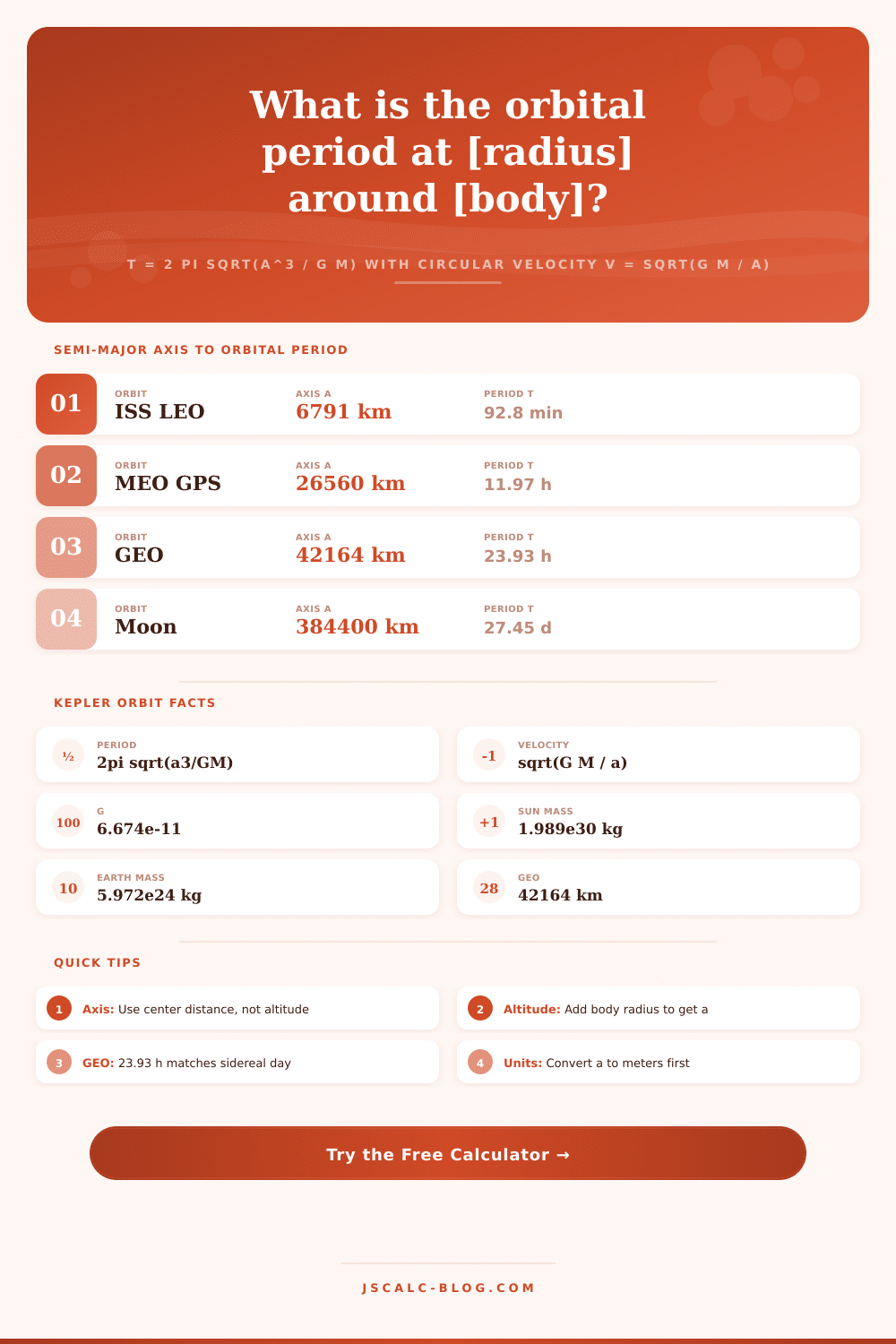
| ISS LEO | 420 km | 6791 km | 92.8 min | Space Station |
| Hubble LEO | 540 km | 6911 km | 95.4 min | Hubble Telescope |
| Sun-sync | 700 km | 7071 km | 98.6 min | Landsat imaging |
| MEO GPS | 20180 km | 26560 km | 11.97 h | GPS navigation |
| GEO | 35786 km | 42164 km | 23.93 h | TV and weather |
| Lunar dist | 378029 km | 384400 km | 27.45 d | The Moon |
🗃Orbit Comparison Grid
| Orbit / Body | Central Body | Body Radius | Central Mass (kg) | Semi-Major Axis | Period | Velocity |
|---|---|---|---|---|---|---|
| ISS station | Earth | 6371 km | 5.972e24 | 6791 km | 92.8 min | 7.66 km/s |
| Hubble | Earth | 6371 km | 5.972e24 | 6911 km | 95.4 min | 7.59 km/s |
| GPS sat | Earth | 6371 km | 5.972e24 | 26560 km | 11.97 h | 3.87 km/s |
| GEO sat | Earth | 6371 km | 5.972e24 | 42164 km | 23.93 h | 3.07 km/s |
| The Moon | Earth | 6371 km | 5.972e24 | 384400 km | 27.45 d | 1.02 km/s |
| Planet Earth | Sun | 696340 km | 1.989e30 | 1 AU | 365.2 d | 29.79 km/s |
| Planet Mars | Sun | 696340 km | 1.989e30 | 1.524 AU | 1.881 yr | 24.1 km/s |
| Jupiter | Sun | 696340 km | 1.989e30 | 5.204 AU | 11.87 yr | 13.1 km/s |
| Phobos | Mars | 3390 km | 6.417e23 | 9376 km | 7.66 h | 2.14 km/s |
| Low lunar | Moon | 1737 km | 7.342e22 | 1837 km | 1.96 h | 1.63 km/s |
⚙Formula Breakdown
💡Orbit Planning Tips
One of the oldest questions in astronomy is “how long does it take for something to go around?” That’s what my orbital period calculator above calculates. Use it to determine how long it takes a communications satellite to reach its position. You can also use it to follow location of International Space Station or to compare how long distant planets take.
All are answered by a relationship that was first described by Kepler and then understood by Newton: how orbits behave. Specifically, it uses Kepler’s Third Law directly. It outputs the period in various units of time (seconds, minutes, hours, days, years) and also provides circular orbital velocity at those times. From abstract gravitational physics you get some actual numbers, and they’re useful ones you can apply.
What Is an Orbital Period?
And that brings us to orbital period, which is nothing more than how long it takes an object to finish its orbit. For example, low Earth orbit (LEO) satellites completes their orbit every ~90 minutes or so. Neptune take almost 165 years to make one lap of the Sun. Why? There are two factors at play here, regardless of size of the object being orbited: the mass of the central body and distance from the center of mass.
First, there’s the mass of the central body being orbited. Second, there’s the distance between the object and center of mass. They’re connected by the gravitational constant which makes for a very accurate prediction. You don’t have to memorize the equation; just understand what variables are so you can trust the result.
The third law of Kepler (yes, there are more) is that the cube of semi-major axis is proportional to square of the period. What does that mean in practical terms? It means that if you move your satellite out twice as much, it will take almost three times longer. This means that distance is important, but not as important than it appears. Moving a satellite twice as far away doesn’t make it appear to move half as fast; it actualy takes almost three times longer to complete an orbit. The three-halves factor is what makes the planets outside the Earth go slow compared with ones inside: Because they’re farther away, their periods are longer.
The calculator can figure all that out for you, too. You pick the central body and enter semi-major axis, and it handles all the conversions so you don’t have to divide by 86400 yourself. Don’t let that simplicity fool you; behind the scenes, we’re doing a ton of complicated math for you.
The one thing that trips people up more than anything else is the distinction between semi-major axis and altitude. Typically, mission fact sheets will cite a satellite’s height above surface. But Kepler’s Law requires the distance from the planet’s center. The calculator allows for both types of entries. Leave the mode set to semi-major axis to enter the center distance directly. Switch to altitude mode and tool will include radius of the body for you. For Earth, the radius is 6371 km. This means that when we say the ISS is at a 420 km altitude, it actualy has an orbit with a semi-major axis of 6791 km. Failure to account for the radius are the most frequent error, making lower orbits appear absurdly rapid.
It also gives the period and circular orbital velocity, which turns out to be a counter-intuitive property of space flight: further out means slower around. A geostationary satellite coasting in its four-times-farther-out orbit is moving only at 3.07 km per second, but ISS is racing along at 7.66 km per second. To confirm that the physics is holding up, there’s another method of computing the period: orbit circumference divided by velocity. Since it’s a circular orbit, the two methods has to yield the same answer. It’s a built-in sanity check.
When it’s around Earth, the numbers make more sense if you know about GEO, MEO, and LEO: GEO (geostationary orbit) refers to geostationary orbit at a particular height above Earth where the period matches one sidereal day, or 23.93 hours. From this distance away, a satellite seems to hover still over single spot on Earth’s surface on the equator. It’s used by weather and television satellites; they plant their feet in space and stay anchored relative to ground beneath them. LEO, short for low earth orbit, encompasses ninety-minute-or-so periods of Hubble and the space station. MEO (medium earth orbit) contains GPS satellites with periods closer to twelve hours.
For those who want to explore quickly, the calculator comes with mission presets. Press one button and you have the Moon, planets (Jupiter, Mars), Hubble, ISS, GPS, GEO … all filled in and ready to go. Just hit “Go” and see how velocity and period change when you go from a skim around Earth to a sweeping interplanetary mission. The presets make for great starting points for your own customized data entry.
Nothing builds confidence in a new tool like having its results checked, and these match what’s on the books to the letter. A geostationary satellite shows 23.93 hours; Earth at one AU shows a year of 365.2 days. These anchors give you confidence that your engine is firing properly before you enter your own custom data.
The science may seem daunting, but it all boils down to a simple pair of inputs for a single clean formula that unlocks orbital mechanics. Using both velocity relationships and Kepler’s Third Law, this calculator transform mass and distance into a complete motion profile. Pick your starting point (a preloaded option), select altitude/axis, and get a detailed breakdown of everything that was plugged in. If you’re a satellite spotter or a student studying gravitation, knowing how long something will take to orbit is the start of understanding the pattern of heavens. Everything runs on repeatable patterns in space; now you can quantify them for yourself.