Age on a Future Date Calculator
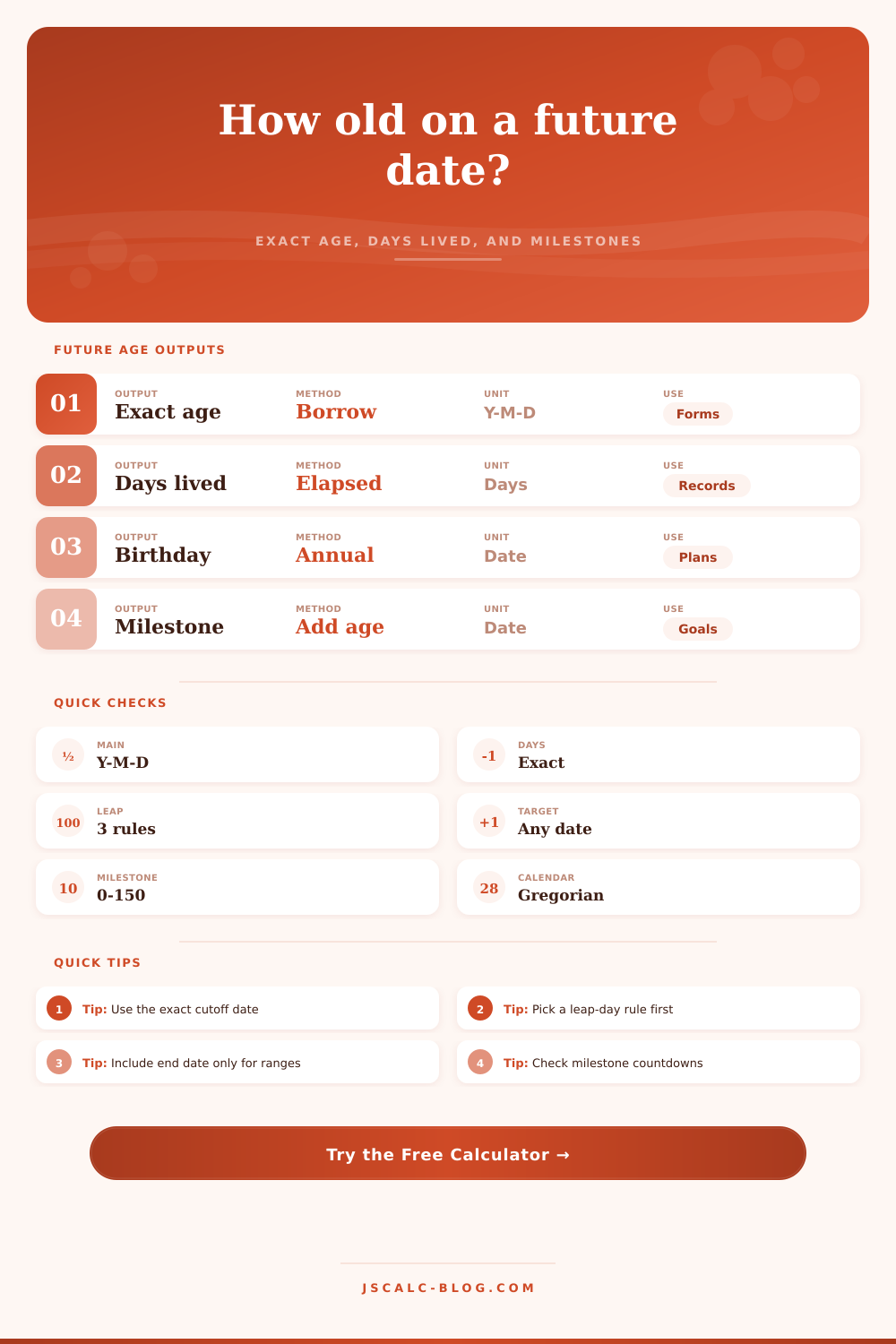
Find exact age on any future date with full years, months, and days, total days lived, next birthday timing, milestone dates, and leap-day handling.
| Upcoming birthday | Date | Weekday | Age reached | Days from target |
|---|---|---|---|---|
| Next birthday | Sep 2, 2026 | Wednesday | 5 | 1 |
| Milestone | Date reached | Age on target | Days until or since | Status |
|---|---|---|---|---|
| Age 5 | Sep 2, 2026 | 4y 11m 30d | 1 | Upcoming |
| Scenario | Leap rule | Exact age | Next birthday | Milestone date |
|---|---|---|---|---|
| Current inputs | Mar 1 | 4y 11m 30d | Sep 2, 2026 | Sep 2, 2026 |
| Leap-day option | Non-leap birthday used | Best use | Calculator effect |
|---|---|---|---|
| Feb 28 rule | February 28 | Policies that recognize the birthday before March | May make the age one day earlier |
| Mar 1 rule | March 1 | Policies that wait until after February | Common conservative default |
| Actual Feb 29 only | Next leap-year Feb 29 | Birthday event planning | Next birthday can be years away |
| Non-leap birth dates | Actual month and day | Most age calculations | Leap option does not change results |
| Step | Formula or method | Output | Why it matters |
|---|---|---|---|
| Validate dates | Birth date must be on or before target date | Usable range | Prevents negative age results |
| Full years | Target year minus birth year, adjusted by birthday | Completed years | Matches calendar age rules |
| Full months | Count complete months after the last birthday anchor | Remaining months | Avoids average-month errors |
| Day borrowing | If target day is earlier, borrow days from the prior month | Remaining days | Explains month boundary cases |
| Total days lived | (target date - birth date) / 86,400,000 | Elapsed days | Includes leap years exactly |
| Milestone | Birth year plus milestone age | Milestone date | Shows countdown or days since |
How do you determine someone’s age? Simply subtract their birth year from today’s year? Nope.
A year isn’t an equal amount of time; it can be 365 or 366 days long depending on leap years. And then there are months, which range between 28, 31 days. Days matter! Years aren’t consistent, so how could they possibly help you know if your kid was born on October 1st and is 5-years and 11-months-old vs. Or were they born on June 2nd and are 6 years old?
Why Accurate Age Calculation Matters
This is why we built an accurate date calculator, especially when accuracy counts: insurance, school enrollment, etc. Typicaly, we ballpark age and disregard which day it is. However, when precision matters, this approach won’t work. Who can use their head to figure out whether or not an individual was 18 on a certain day? You need a system that accounts for borrowing those days. A system must exist for the situation where the person’s birthday occurs later in the month than their intended target date. That’s where precise calculators excels. They take guesswork out of a question that stumps both legal professionals and parents alike.
You can see the complexities at work if you consider this: If you were born on February 29, what do you think happens? Your birthday is either placed as being on February 28 or March 1 in non-leap years. The date varys between February 28 and March 1. It depends on which jurisdiction you live in. And depending on whether there was a strict cut-off for a policy, that extra day could mean a difference in age. The logic can all happen behind the scenes with a calculator. This will let you pick whichever rule apply to you.
Another twist on aging is days. Most people measure their age in years, but days represent another way to think about total life lived. Our bodies and experiences accumulates in days, not just years. A five-year-old kid has actualy lived 1,825 days. And it remind us tangibly how much time has passed. It can also help with planning goals: if your goal is to save up for a retirement account at a certain age, or get a driver’s license, knowing exactly how many days until you hit that goal gives you a more precise path different than guesstimating based on months.
Think of milestones as set-in-stone events along the timeline: “I’ll retire at 65,” “My kid starts kindergarten next fall” and so on. They’re the fixed point; your age on that day is the variable. If you lock down the future date, then it’s just a matter of calculating exactly what age you’ll be. It flips our traditional birthday mindset, instead of wondering how many years you’ve lived up to this point, wonder what age you’ll be when something significant happens.
Our brains aren’t great at translating spans of time across multiple calendars. Events sticks in our minds, not spans of time. I can remember that party but I don’t remember how many days have passed since my birthday. That’s what tools are for: they help with the math so that we can think about the decision, not the math itself. The point is to take the number and let it inform your choice.
Is it time? Are you ready? Answering that question require accurate data. You have rights, responsibilities, and opportunities. They come with age. Respect the calendar’s rules. Face reality.
If you get it right, no one will care that you’re 52, they’ll just want to know when the party is! Whether your number is for a school cutoff or your retirement party, the details matters: make the math easy so you can focus on the celebration or deadline. Precision replaces vagueness with concreteness. It provides an answer where there was only a question. Now you can proceed comfortabley.