Mortgage Extra Payment Savings Calculator
See exactly how much interest you save and how many years you shave off your mortgage by paying extra principal each month or applying a one-time lump sum. This tool compares your baseline loan side by side with an accelerated payoff.
🎯Real Accelerate Scenarios
📝Your Mortgage Details
The principal still owed on the mortgage.
Annual percentage rate on the loan.
Years left on the original schedule.
Added to every scheduled payment.
Applied to principal at month 1.
Biweekly adds one extra monthly payment per year.
🔢Formula Snapshot
📊Extra Monthly Payment Comparison Grid
| Extra / Month | New Payment | New Payoff | Time Saved | Interest Saved | % Interest Cut |
|---|---|---|---|---|---|
| $0 | $1,896 | 30y 0m | 0y 0m | $0 | 0% |
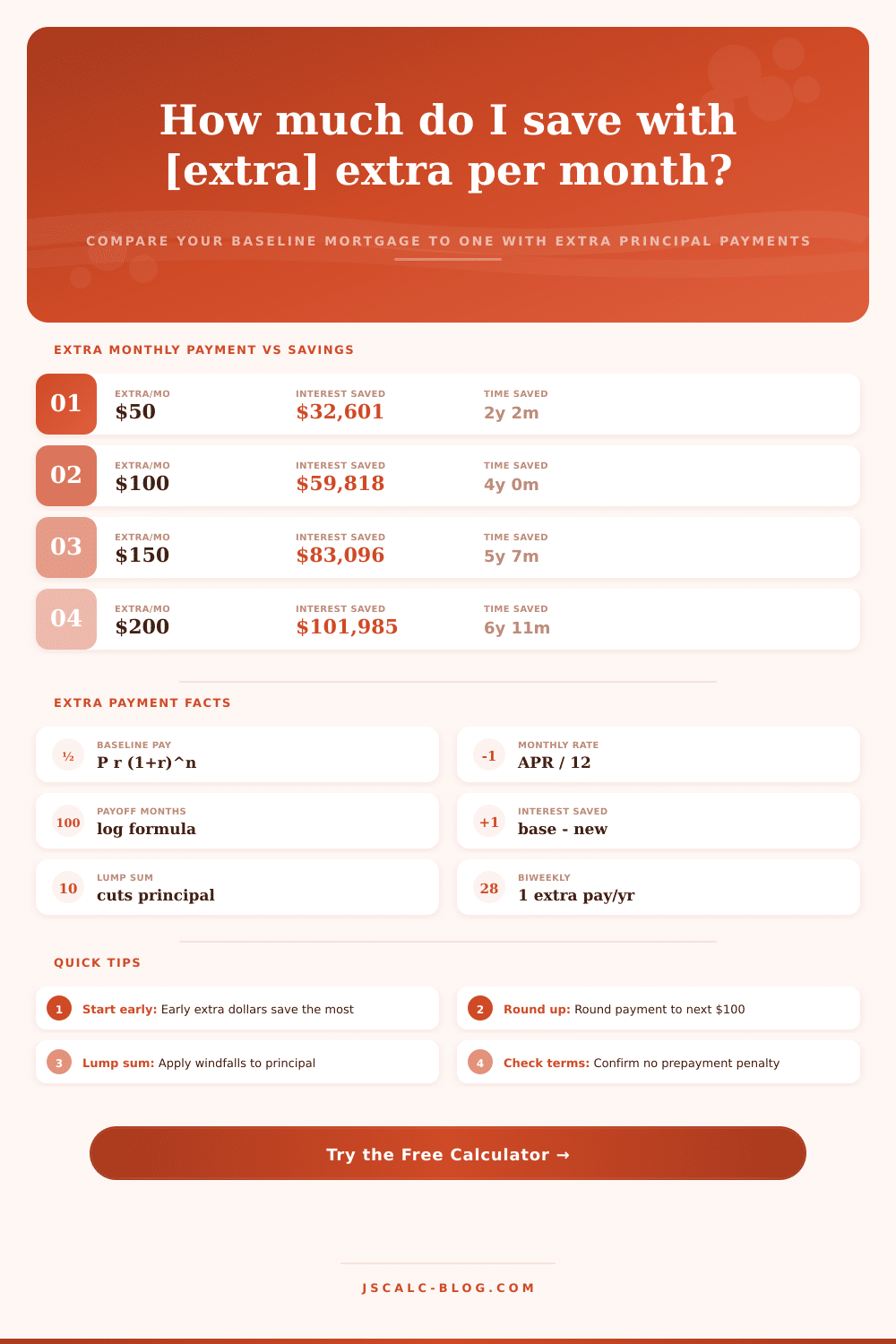
| $50 | $1,946 | 27y 10m | 2y 2m | $32,601 | 9% |
| $100 | $1,996 | 26y 0m | 4y 0m | $59,818 | 16% |
| $150 | $2,046 | 24y 5m | 5y 7m | $83,096 | 22% |
| $200 | $2,096 | 23y 1m | 6y 11m | $101,985 | 27% |
| $300 | $2,196 | 20y 10m | 9y 2m | $133,582 | 35% |
| $500 | $2,396 | 17y 6m | 12y 6m | $179,431 | 47% |
| $750 | $2,646 | 14y 9m | 15y 3m | $214,255 | 56% |
| $1,000 | $2,896 | 12y 9m | 17y 3m | $239,514 | 63% |
Based on a $300,000 loan at 6.5% APR over a 30-year term. Interest saved is baseline total interest minus new total interest.
💵Savings by Loan Size (+$200/mo, 6.5%, 30yr)
| Loan Amount | Base Payment | Baseline Interest | Interest Saved | Time Saved |
|---|---|---|---|---|
| $150,000 | $948 | $191,317 | $66,306 | 8y 5m |
| $200,000 | $1,264 | $255,089 | $81,470 | 7y 6m |
| $250,000 | $1,580 | $318,861 | $92,489 | 6y 9m |
| $300,000 | $1,896 | $382,633 | $101,985 | 6y 11m |
| $400,000 | $2,528 | $510,178 | $115,331 | 5y 4m |
| $500,000 | $3,160 | $637,722 | $124,861 | 4y 6m |
📈Impact of Interest Rate ($300k, +$200/mo, 30yr)
| APR | Base Payment | Baseline Interest | Interest Saved | Time Saved |
|---|---|---|---|---|
| 4.0% | $1,432 | $215,609 | $56,988 | 6y 6m |
| 5.0% | $1,610 | $279,767 | $74,539 | 6y 8m |
| 6.0% | $1,799 | $347,515 | $93,043 | 6y 10m |
| 6.5% | $1,896 | $382,633 | $101,985 | 6y 11m |
| 7.0% | $1,996 | $418,527 | $111,483 | 7y 0m |
| 8.0% | $2,201 | $492,545 | $129,596 | 7y 1m |
⚙Formula Breakdown
📋Lump-Sum vs Monthly Extra ($300k, 6.5%, 30yr)
| Strategy | Extra Applied | Interest Saved | Time Saved |
|---|---|---|---|
| Lump sum today | $10,000 once | $41,872 | 1y 9m |
| Lump sum today | $25,000 once | $92,908 | 4y 1m |
| Monthly extra | $100 / month | $59,818 | 4y 0m |
| Monthly extra | $200 / month | $101,985 | 6y 11m |
| Biweekly plan | ~$158 / month | $85,000 | 5y 8m |
| Round up payment | $104 / month | $61,700 | 4y 2m |
💡Extra Payment Strategy Tips
Many people see their mortgage as a 30-year bill, and there’s nothing wrong with that perspective. However, it overlooks the nature of the loan: Interest is charged against the outstanding balance, not initial balance. Paying down your mortgage decreases this starting figure from which interest builds up. Over the long run, this make an enormous difference.
You don’t need to fight with logarithms; the calculator does all that amortization math for you. It presents a “normal” loan schedule alongside an accelerated one. Just enter your starting balance, your interest rate, and how much extra you want to pay each month. Four important metrics pop out.
How to Pay Off Your Mortgage Faster
Time Saved reveals when you’ll escape this burden. Interest Saved is typically the headline-grabber (the numbers adds up quickly). New Total Interest helps you see what it costs to borrow money under these two different scenarios. New Payoff Term shows new finish line.
To see why this works with early payments, let’s consider how mortgages are paid off: most of your initial payments go toward interest (since there’s a massive principal balance). Over time, as the principal balance decrease, more of every payment will applied to the principal. If you wait 15 years before making an extra payment, you lose the advantage. The dollar you pay in year one do much more heavy lifting then the same dollar you’d pay in year 15. Attack the balance while it’s largest.
But, you know what? It’s okay if you’re using both. You can take a lump sum AND make extra payments each month. Apply your tax refund (or bonus) straight toward principal. That decreases beginning principal. And therefore it shrink the interest calculation for all future payments. To play with this scenario, enter an additional one-time payment into the calculator.
See how just dropping $25,000 up-front saves almost $93,000 in interest… Even when borrowing a typical high-balance loan. That’s a return on capital few investments get without great risk.
Other borrowers choose to accelerate their repayment using different method: switching to biweekly payments. Rather than increasing your payment by a flat amount, you’d pay half of your monthly mortgage amount every other week (since there are 52 weeks in a year, that’s equivalent to 26 half-payments). That results in 13 full payments annually, rather then 12. Each check is only half the size of your usual amount, so it doesn’t feel like such a big deal. The calculator assumes a biweekly payment schedule and translates that into an effective monthly bump.
Double-check these two things before implementing this plan: first, make sure extra money will go directly toward principal instead of being used for prepayments; second, confirm there is no penalty for prepaying on your loan. A few old loans features a clause that penalizes you for accelerating payments, negating the entire benefit!
If these boxes are both ticked off, then begin by rounding up your payment to a clean number like $2,000 or $3,000 if your current bill is lower. Set it and forget it. The goal isn’t just to pay off the house sooner. It’s about taking back control over your money. You are stopping the bleeding on interest. Once you lay it out, the math is easy: Reduce the base. Reduce the interest. Pay down the loan faster than expected.
One of the best financial decisions a homeowner could of make is adding a couple more bucks per month. It shortens that thirty year wall to something far easier to handle. One should of considered how luxurios life becomes once debt dissapears.