Biweekly Mortgage Payment Calculator
Pay half of your monthly mortgage every two weeks and you make 26 half-payments a year, which equals 13 full monthly payments, one extra payment every year. See your biweekly amount, the interest you save, and how many years earlier your loan is paid off compared with standard monthly payments.
🎯Real Biweekly Scenarios
📝Mortgage Inputs
The principal borrowed at the start of the mortgage.
Fixed yearly rate; monthly rate r = APR / 12 / 100.
Original schedule length, so n = years × 12 months.
Payoff is figured from this balance; leave equal to loan if new.
Added to each of the 26 payments for even faster payoff.
Used to estimate your projected payoff month and year.
🔢Biweekly Snapshot
⚙Formula Breakdown
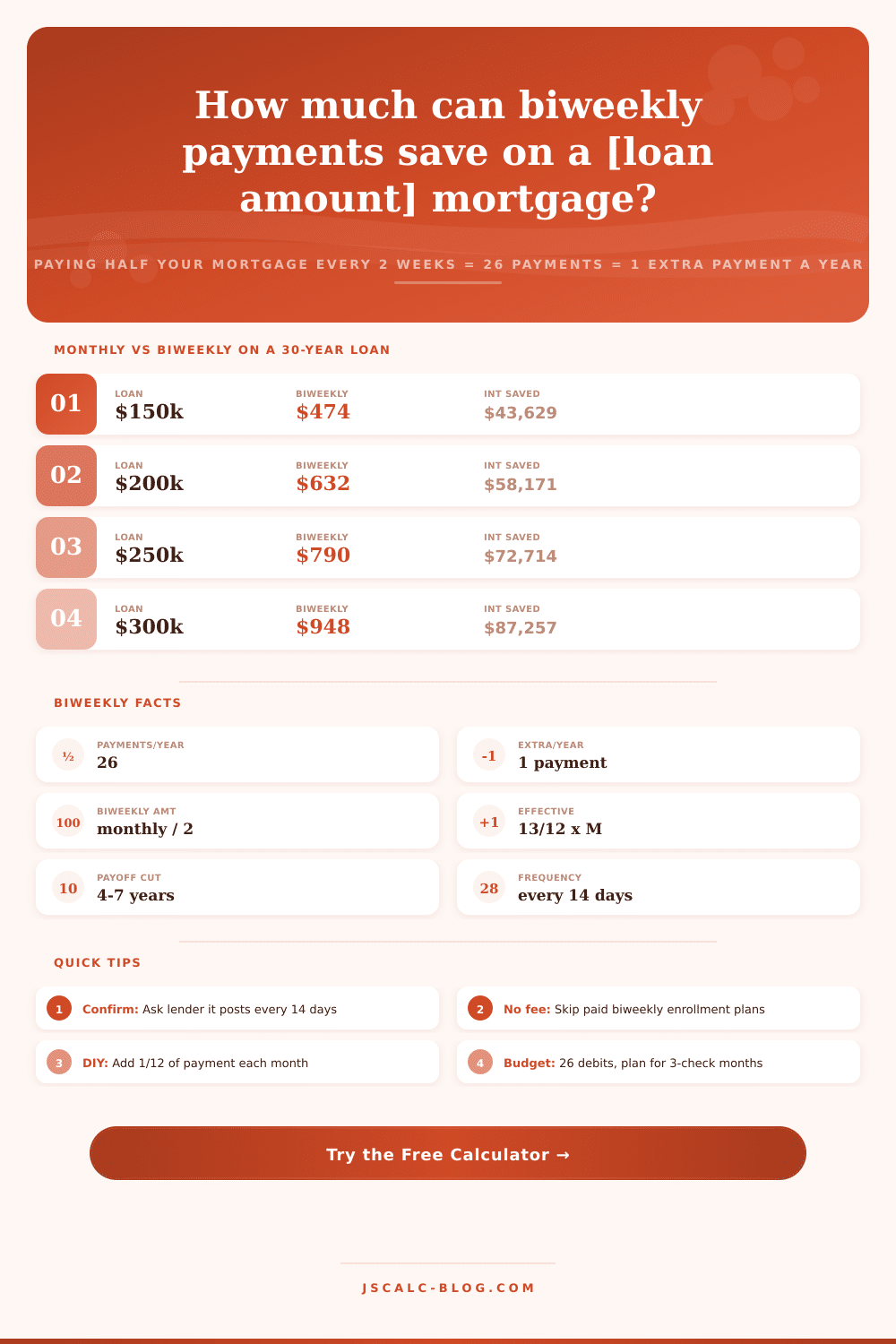
📊Monthly vs Biweekly on a 30-Year Loan at 6.5%
| Loan Amount | Monthly Payment | Biweekly Payment | Interest Monthly | Interest Biweekly | Interest Saved | Time Saved |
|---|---|---|---|---|---|---|
| $150,000 | $948 | $474 | $191,317 | $147,688 | $43,629 | 5.8 yr |
| $200,000 | $1,264 | $632 | $255,089 | $196,918 | $58,171 | 5.8 yr |
| $250,000 | $1,580 | $790 | $318,861 | $246,147 | $72,714 | 5.8 yr |
| $300,000 | $1,896 | $948 | $382,633 | $295,376 | $87,257 | 5.8 yr |
| $350,000 | $2,212 | $1,106 | $446,406 | $344,606 | $101,800 | 5.8 yr |
| $400,000 | $2,528 | $1,264 | $510,178 | $393,835 | $116,343 | 5.8 yr |
| $450,000 | $2,844 | $1,422 | $573,950 | $443,065 | $130,886 | 5.8 yr |
| $500,000 | $3,160 | $1,580 | $637,722 | $492,294 | $145,428 | 5.8 yr |
📅Payment Frequency Comparison
| Frequency | Payments / Year | Per Payment | Paid per Year | Effect on Payoff |
|---|---|---|---|---|
| Monthly | 12 | M | 12 M | Full term, 30 years |
| Semi-monthly | 24 | M / 2 | 12 M | Same as monthly |
| Biweekly | 26 | M / 2 | 13 M | About 6 years sooner |
| Weekly | 52 | M / 4 | 13 M | Slightly faster than biweekly |
| Monthly + 1/12 | 12 | 13M / 12 | 13 M | Matches biweekly savings |
| 13 payments/yr | 13 | M | 13 M | One extra lump per year |
📈How Rate Changes Biweekly Savings ($300k, 30yr)
| APR | Monthly M | Biweekly | Interest Saved | Time Saved |
|---|---|---|---|---|
| 4.0% | $1,432 | $716 | $33,398 | 4.1 yr |
| 5.0% | $1,610 | $805 | $50,900 | 4.7 yr |
| 6.0% | $1,799 | $899 | $73,667 | 5.5 yr |
| 6.5% | $1,896 | $948 | $87,257 | 5.9 yr |
| 7.0% | $1,996 | $998 | $102,425 | 6.3 yr |
| 7.5% | $2,098 | $1,049 | $119,232 | 6.7 yr |
| 8.0% | $2,201 | $1,101 | $137,726 | 7.1 yr |
📚Biweekly Mortgage Terms
| Term | Meaning | Why It Matters |
|---|---|---|
| Biweekly | Payment every 14 days | Produces 26 payments a year |
| Semi-monthly | Twice a month, on set dates | Only 24 per year, no extra payment |
| Principal | The balance you still owe | Extra payments cut it faster |
| Amortization | Schedule of principal and interest | Front-loaded with interest |
| Effective payment | (13/12) of the monthly amount | Drives the accelerated payoff |
| Enrollment fee | Charge some servicers add | Avoid it by paying extra yourself |
💡Biweekly Payoff Tips
With a biweekly mortgage, you repay your house loan years faster. With this approach, you avoid refinancing and save tens of thousands of dollars in interest. Your actual budget isn’t very different. Instead, you’re paying down the loan with one extra full payment each year via 26 half-payments. This page has a calculator to show how this works.
Here’s the math: A year contains 52 weeks. If you pay half at once, twice per month, you’ll make 26 half-payments. Those 26 halves equal 13 full months. So you’ve made one more payment than usual. You paid 13 times instead of 12. That extra payment goes directly toward principal. That’s why this works, it’s a tiny little mathematical trick that generates huge financial results.
How Biweekly Mortgage Payments Save Money
Let’s begin with the basic mortgage math. This is formula for computing M (the periodic payments) given your loan size P, interest rate r expressed as an annual percentage, and number of periods n. If you take out a $300,000, 6.5 percent, 30-year mortgage, that formula will spit back monthly payment of roughly $1,896.20. A biweekly schedule divide this by two. Your payment would be $948.10 every other week. There are 26 such two-week spans during a year. Not 24. By paying every two weeks, you’re essentially making 13 monthly payments. Each year, you’ll tack on a complete payment to principal.
The secret is that what’s different isn’t how much money you’re paying; it’s when. Interest is front-loaded on mortgages. Early on, most of each mortgage payment go toward interest. A tiny sliver of it goes toward reducing the balance. If you tack an extra payment onto the end of every year, all of it will go toward principal. That lowers the balance. Future interest will be calculated based off the reduced balance. The compounding effect kicks in. Over the course of a 30-year loan, the effect is dramatic.
On our $300,000 example, we shave more than six years from the timeline. We pay off house in ~24.2 years rather than 30 years. Total interest drops from approximately $382,633 to around $295,376. That’s a savings of almost $87,257. It costs only the price of adjusting your schedule. It requires no larger check. It is just a different scheduling tweak. Plug in your own numbers and calculator figures out the rest. No need for you to guess at the conversions or the coefficients. Because the calculator considers the biweekly plan to be equivalent to a “monthly” payment, it computes its estimate for the new payoff based on 13/12 times M. That’s approximately $2,054.22 per month in our case. Plug that higher figure back into the amortization equation, and presto: The length of time until payoff is cut a lot.
If you choose to include an additional amount with every biweekly payment, the calculator combines it with your effective payment. That speeds up the timeline, too.) The table below provides a clear view of what happens in such scenarios. You see how much more money you save as you increase the size of your loan. With a fixed-rate 30-year mortgage at 6.5 percent, the biweekly payment reduces your loan term by around the same 5.8 years regardless of balance. Your dollar savings will grow with your loan size.
Many of us confuse semi-monthly (twice a month) with biweekly (every other week). That’s easy to do. This means if you make 24 payments per year, it is semi-monthly (which gets you exactly 12 full payments since there are 24 half-payments). Biweekly, however, is every two weeks, whatever day of the week. It will land 26 times per year. Let’s put those in the comparison table. The table also contains a weekly payment plan and an “every month plus one-twelfth” plan. As you’ll notice, only plans that amount to 13 payments per year gets you the payoff bump.
Some lenders and other third parties offer these biweekly plans as a service. Expect a $300-$400 upfront setup fee with very modest transaction fees on top of that. In most cases, you don’t need to pay this at all. You can get the same benefits by having your servicer apply extra money toward the principal. The simplest DIY option is to take your monthly payment, divide by 12, then add that amount into every check. This puts an extra full payment into the pot over the course of a year. Or, if you prefer, send an extra payment whenever you’d like. Just double-check that the servicer’s applying it right away, rather than holding onto both payments for next month. (They shouldn’t.)
The size of the loan isn’t as important as interest rate in determining the savings. On a $300,000 loan at 4 percent, the strategy saves almost $33,000. At 8 percent, it saves more than $137,000. The bigger the interest rate, the more interest you save by applying extra payments to your principal. Even 15-year loans (shorter than typical) save money, but not as much, they tend to pay off rapidly anyway.
Don’t commit unless your cash flow can handle the biweekly rhythm. If you do this, there’ll be 26 debits per year. Each month with three weeks has three mortgage payments, twice as many than every other month. Plan accordingly during those heavy months. Check for prepayment penalties; most moddern fixed-rate mortgages don’t have them. Load the calculator with your loan details: amount, rate, term, balance (or starting balance if you’re beginning from scratch), and optional extras. Hit “start from a real scenario” to start with one of our presets and immediately see the numbers. Sometimes the time and interest saved make the biweekly flip an easy choice. Twenty-six halves = a whole new future.