Months to Days Converter
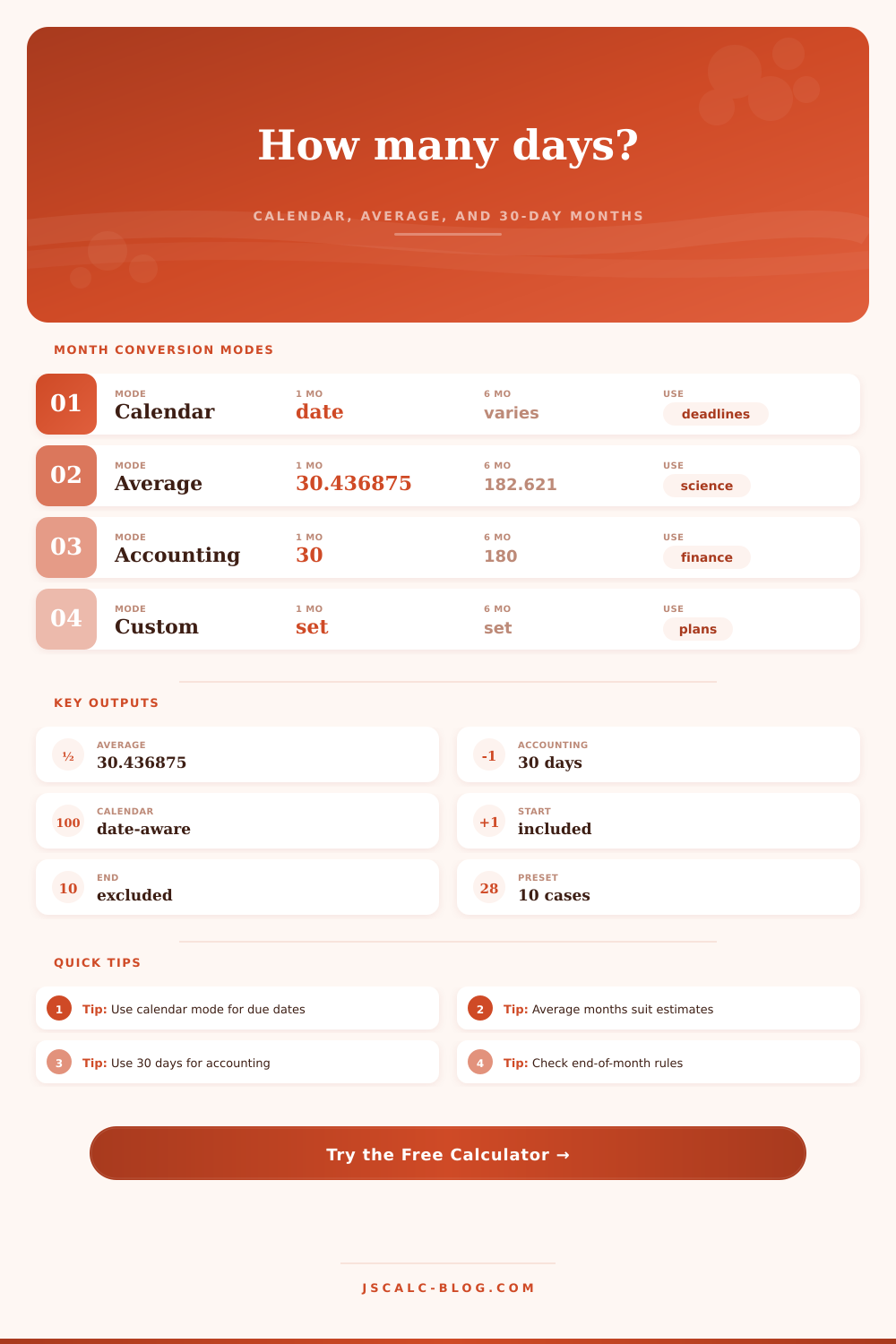
Convert months to days using real calendar date spans, the Gregorian average month of 365.2425 / 12 = 30.436875 days, 30-day accounting months, or a custom days-per-month factor.
Actual date span from start to end.
Uses 365.2425 / 12 days per month.
Uses a fixed 30-day month.
Uses your custom days-per-month value.
| Months | Average days | 30-day days | Common use |
|---|---|---|---|
| 0.5 | 15.218438 | 15 | Half month estimate |
| 1 | 30.436875 | 30 | Monthly cycle |
| 2 | 60.87375 | 60 | Two-month window |
| 3 | 91.310625 | 90 | Quarter |
| 6 | 182.62125 | 180 | Half year |
| 9 | 273.931875 | 270 | Nine-month plan |
| 12 | 365.2425 | 360 | One average year |
| 18 | 547.86375 | 540 | 18-month term |
| Start date | Months | Clip result | Calendar days |
|---|---|---|---|
| 2026-01-31 | 1 | 2026-02-28 | 28 |
| 2026-02-28 | 1 | 2026-03-28 | 28 |
| 2026-03-31 | 1 | 2026-04-30 | 30 |
| 2026-04-30 | 1 | 2026-05-30 | 30 |
| 2026-07-28 | 1 | 2026-08-28 | 31 |
| 2026-08-31 | 6 | 2027-02-28 | 181 |
| 2027-02-28 | 12 | 2028-02-28 | 365 |
| 2028-02-29 | 12 | 2029-02-28 | 365 |
| Method | Definition | Best for | Watch out for |
|---|---|---|---|
| Date-aware | Start date to start plus months | Contracts, deadlines | Month lengths vary |
| Average | 365.2425 / 12 | Long estimates | Not a due date rule |
| Accounting | 30 days each month | Finance shorthand | 360-day year basis |
| Custom | User-set factor | Sprints, schools | Document your factor |
| Clip end day | Invalid dates move to month end | Most date pickers | Jan 31 becomes Feb 28 |
| Preserve last day | Last day stays last day | Rent and billing | Only if start is month end |
| Roll overflow | Invalid dates spill forward | Spreadsheet checks | Can skip a month label |
| Inclusive count | Adds both endpoints | Range reports | Not elapsed days |
| Offset | Calendar end | Calendar days | Average days | 30-day days |
|---|---|---|---|---|
| 1 mo | 2026-08-28 | 31 | 30.44 | 30 |
| Scenario | Mode | Months | Days | End date or basis | Difference vs calendar |
|---|---|---|---|---|---|
| Current inputs | Date-aware | 1 | 31 | 2026-08-28 | 0 |
The calendar software shrugs. “Sure,” it says, “you can add one month to January thirty-first.” And then it hands you February twenty-eighth, or perhaps February twenty-ninth if it’s a leap year. What you asked for was a month; what you’ve got is twenty-eight days.
Or maybe you had a plan that began on the first day of the month and concluded on the first day of the month a year later. You figured: there are exactly three hundred and sixty-five days here, so I’ll be charged for a three-hundred-and-sixty-five-day month, and somehow in the middle you find out you’re being billed for a thirty-six-day month.
Why Measuring Months Is Hard
Time is not like a smooth river. It’s more like a jagged rock face made of uneven slices. The trouble is that months isn’t a unit of time at all, as hours or seconds are. Months are political inventions, a rough approximation of some other cycle (the lunar) that’s been stretched and squeezed into the solar year.
It’s trickier than it appears, converting between months and days. There’s no one right answer. It all depends based off your goal. Do you want the date-aware calendar span? In that case, you want the exact start and end dates, not just the abstract duration. When does the commitment expire? For this, use the calculator above, which runs the numbers for you (and covers the nitty-gritty edge cases like the fact that January thirty-first spill over into February).
Let it know how you’d like to handle such spillover days. Would you prefer to cut off the last day of the month (that’s the default behavior in most legal contracts)? Or would you rather roll that day over to the following month? Perhaps you’d like to keep the “last day of the month” quality. Every such rule shifts the effective number of days being measured.
The calendar does not matter if you’re making financial models. Standardization matters. That’s why accountants has a thirty-day month, so that the math works. One year is three hundred and sixty days. One quarter is precisely ninety days. Which is to say: they’re lying. There aren’t any months with exactly thirty days, unless you count the second half of the year.
But when you want to compare interest rates or predict your cash flow, the lie helps. It gets rid of the noise of shorter Februarys and longer Julys. And as the reference table on the page shows, the lie moves further from reality the longer you look.
And then there’s the average. The Gregorian calendar has, on average, three hundred and sixty-five point two four two five days per year. That divided by twelve gets you thirty point four three six eight seven five days per month. This number is precise but almost entirely useless when it comes to scheduling: I can’t have a meeting thirty point four days from today.
On the other hand, it’s hugely useful for longer estimates. If I’m scheduling a project that will take two years, my average is far more useful than any estimate of “thirty.” Thirty doesn’t account for leap year. And it doesn’t account for how unevenly days are distributed across the calendar.
Fractional months are tricky. If you’re talking about two and a half months, then how do you count that? Use an average? Number of days in current month? Number of days in the target month? Each will nudge your end date by one or two days. That’s little; yet significant. Those days matter when you’re making plans at the highest level.
The reason most people get it wrong is because they think of the month as some sort of fixed quantity. It isn’t. Pick your poison: are you working toward a deadline? Measure time on the calendar. For a balance sheet? Measure time in thirty days. For a statistical projection? Measure time with an average.
The tool will handle the arithmetic. But you need to supply the context. The tool doesn’t know if what you’re doing is predicting rainfall or paying rent. It just knows the rules you fed it. The number isn’t as critical as understanding what rule generated it.
Next time you look at something, ask yourself how that result was created. If the calendar and the average differ by a few days, that’s not an error. That’s a feature. That’s the distinction between a schedule and a moddern model for how time works. They both are needed, and neither is complete without the other. So know which one you’re looking at before making a decision.
The math is simple. The decision is difficult. Once the decision is made, the rest of the plan flows from there.
Yes, time is uneven. But if you know which tool to use, you can smooth it out.