Weeks to Days Converter
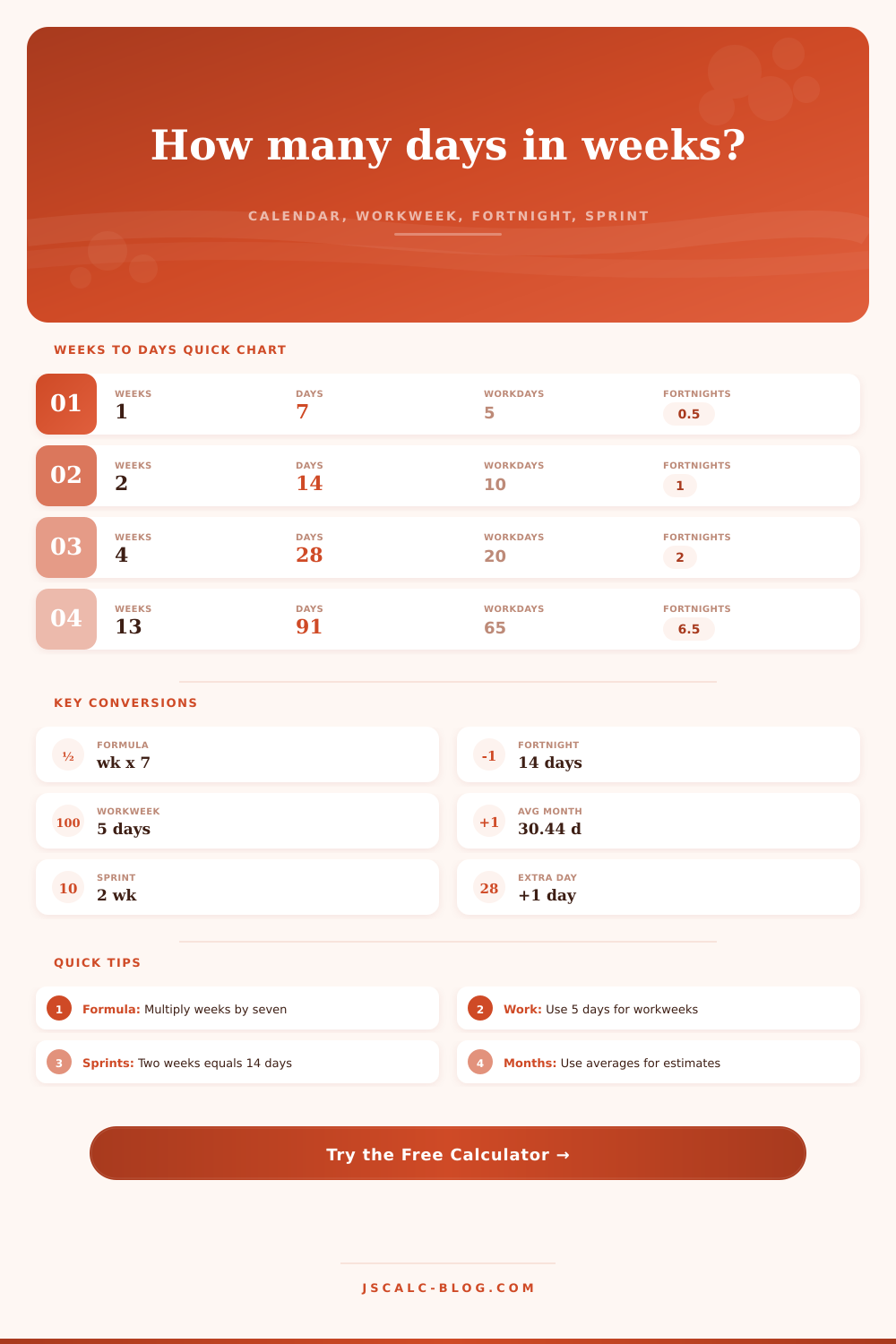
Convert weeks into calendar days with days = weeks × 7, then compare workweeks, fortnights, average months, and project sprint equivalents.
🎯Presets
⚙Converter Inputs
Decimal weeks are allowed. Example: 1.5 weeks = 10.5 days.
Use this for "6 weeks and 2 days" style entries.
Five is the common Monday through Friday workweek.
Sprint mode can convert a stack of sprints into days.
Useful when both the start date and end date are counted.
Formula: 1 week x 7 = 7 days.
🗂Key Conversion Facts
📊Weeks to Days Tables
| Weeks | Formula | Calendar Days | Fortnights |
|---|---|---|---|
| 0.5 | 0.5 × 7 | 3.5 | 0.25 |
| 1 | 1 × 7 | 7 | 0.5 |
| 2 | 2 × 7 | 14 | 1 |
| 4 | 4 × 7 | 28 | 2 |
| 6 | 6 × 7 | 42 | 3 |
| 8 | 8 × 7 | 56 | 4 |
| 12 | 12 × 7 | 84 | 6 |
| 13 | 13 × 7 | 91 | 6.5 |
| 26 | 26 × 7 | 182 | 13 |
| 52 | 52 × 7 | 364 | 26 |
| Calendar Weeks | Calendar Days | 5-Day Workweeks | Weekend Days |
|---|---|---|---|
| 1 | 7 | 5 | 2 |
| 2 | 14 | 10 | 4 |
| 3 | 21 | 15 | 6 |
| 4 | 28 | 20 | 8 |
| 8 | 56 | 40 | 16 |
| 10 | 70 | 50 | 20 |
| 13 | 91 | 65 | 26 |
| 52 | 364 | 260 | 104 |
| Sprint Plan | Weeks | Calendar Days | 5-Day Workdays |
|---|---|---|---|
| 1 one-week sprint | 1 | 7 | 5 |
| 1 two-week sprint | 2 | 14 | 10 |
| 2 two-week sprints | 4 | 28 | 20 |
| 3 two-week sprints | 6 | 42 | 30 |
| 4 two-week sprints | 8 | 56 | 40 |
| 6 two-week sprints | 12 | 84 | 60 |
| 3 three-week sprints | 9 | 63 | 45 |
| 4 three-week sprints | 12 | 84 | 60 |
| Weeks | Days | Average Months | 30-Day Months |
|---|---|---|---|
| 4 | 28 | 0.92 | 0.93 |
| 4.345 | 30.42 | 1.00 | 1.01 |
| 8 | 56 | 1.84 | 1.87 |
| 12 | 84 | 2.76 | 2.80 |
| 13 | 91 | 2.99 | 3.03 |
| 26 | 182 | 5.98 | 6.07 |
| 39 | 273 | 8.97 | 9.10 |
| 52 | 364 | 11.96 | 12.13 |
🧭Comparison Grid
Best for date spans, events, schedules, subscriptions, and general time conversion.
Best for staffing, business timelines, school weeks, and weekday-only planning.
Best for pay cycles, two-week periods, and every-other-week schedules.
Best for rough monthly comparisons when months are not specified.
Best for Agile planning, release trains, delivery windows, and roadmap estimates.
⚒Formula and Method Breakdown
💡Tips
Here is a good example: how do you know if two weeks is a tight deadline? Is it generous? Generous or not depends entirely on whether you’re counting the days where you work, or counting all days.
That’s the core issue with managing time. Weeks is a reasonable slice of time for planning, which is why we use them to talk about deadlines. Days are the only unit of time that ever realy ticks by; that’s why they are what we plan with. Mixing the two units make projects drag along.
The Difference Between Calendar Days and Work Days
It’s just basic math. Take the amount of weeks and then multiply it times seven. That will give you total number of calendar days. This is raw elapsed time. A four week contract equals 28 days no matter what days of the week are on which side of the weekend or holiday.
The calculator above multiplies out the number of days for you, so you don’t have to double-check your math work. Now that you know total number of days, you want to know how many of those days you can use. This is why we have the workweek. You take five days to get stuff done and then spend two days recovering from it.
When you’re estimating how many clients you can see or how much code you can write, calendar days don’t count. They only care about workdays. On a typical wall calendar, a four week timeblock appear big. It is twenty-eight days. If you cross out the weekends, however, you’ve got just twenty days. It is just a twenty percent difference. Yet, that is enough to make a timeline look optimistic on paper but hard to pull off in real life.
You can control this ratio via the tool. As a freelancer, you may work a six day week or perhaps a four day week. Model your own capacity by entering how many days you work each week. That avoids error of assuming everybody works five days per week.
You can also tack on extra days to your week count. That’s useful if you work three weeks and two days. The system include those days in the total. That gives you an exact length that typical rounding hides.
And then there are Fortnights. Two week span exactly fourteen days. There’s no arguing with that. It’s a rigid duration that doesn’t care about your work schedule at all. School terms, pay cycles, they’re often on a fortnightly rhythm.
In calendar time, a two week period lines up perfectly against a fortnight. Not against a workweek. While the sprint covers fourteen days, the equivalent number of days in a workweek could be as little as ten or even twelve. That’s where the reference table comes into play, so you don’t have to do the math yourself.
The most unpredictable unit of time is the month. Twenty-eight days equals one month, or at least four weeks. That’s less than nearly all months on the Gregorian calendar. Estimate a project at four weeks and odds are it will bleed into next month (week five).
On average, a month have around thirty point four days. Estimating a month as a flat number (thirty days) is better for vague planning. It is not as good when you are trying to schedule something using a smaller chunk of time (twenty eight days).
The months on the converter allow you to plug this hole. Either select a basic thirty-day average month or if you want to get a bit more exact use the thirty point four four option. Pick whichever model best suits how precise your estimates should of been.
The other variable comes from project sprints. A sprint is a set amount of work in an agile world. It is typically two weeks. It has a distinct goal, not merely a chunk of time. Translating weeks into sprints allow you to calculate how many sprints you can complete within your timeframe. This is key for planning roadmaps. It switches the emphasis from time to delivery rhythm.
Why? Because that’s when you learn to understand the differences between deadlines. Calendar time is different than work time. It is different from rest time. This means that knowing how you divide those things help you know whether or not you’re being realistic.
Knowing which part of the day you separate from the week makes it clear what you can achieve. You are measuring instead of guessing. When you get given a timeline, ask who counts what kind of days. What they tell you reveals how confident they are about the project.