Years Married Calculator
Calculate the exact marriage duration from a wedding date to any target date, then see total days, weeks, calendar months, next anniversary, and milestone dates.
Marriage duration result
| Anniversary | Date | Days away | Reminder date | Leap rule note |
|---|---|---|---|---|
| 11th | June 18, 2027 | 325 | May 19, 2027 | Regular date |
| Year | Name | Milestone date | Status | Days from target |
|---|---|---|---|---|
| 25 | Silver | June 18, 2041 | Future | 5,438 |
| Measure | Wedding to target | Comparison A | Comparison B |
|---|---|---|---|
| Exact age | 10y 1m 10d | 11y 0m 0d | 15y 0m 0d |
| Step | Formula | Purpose | Calendar detail |
|---|---|---|---|
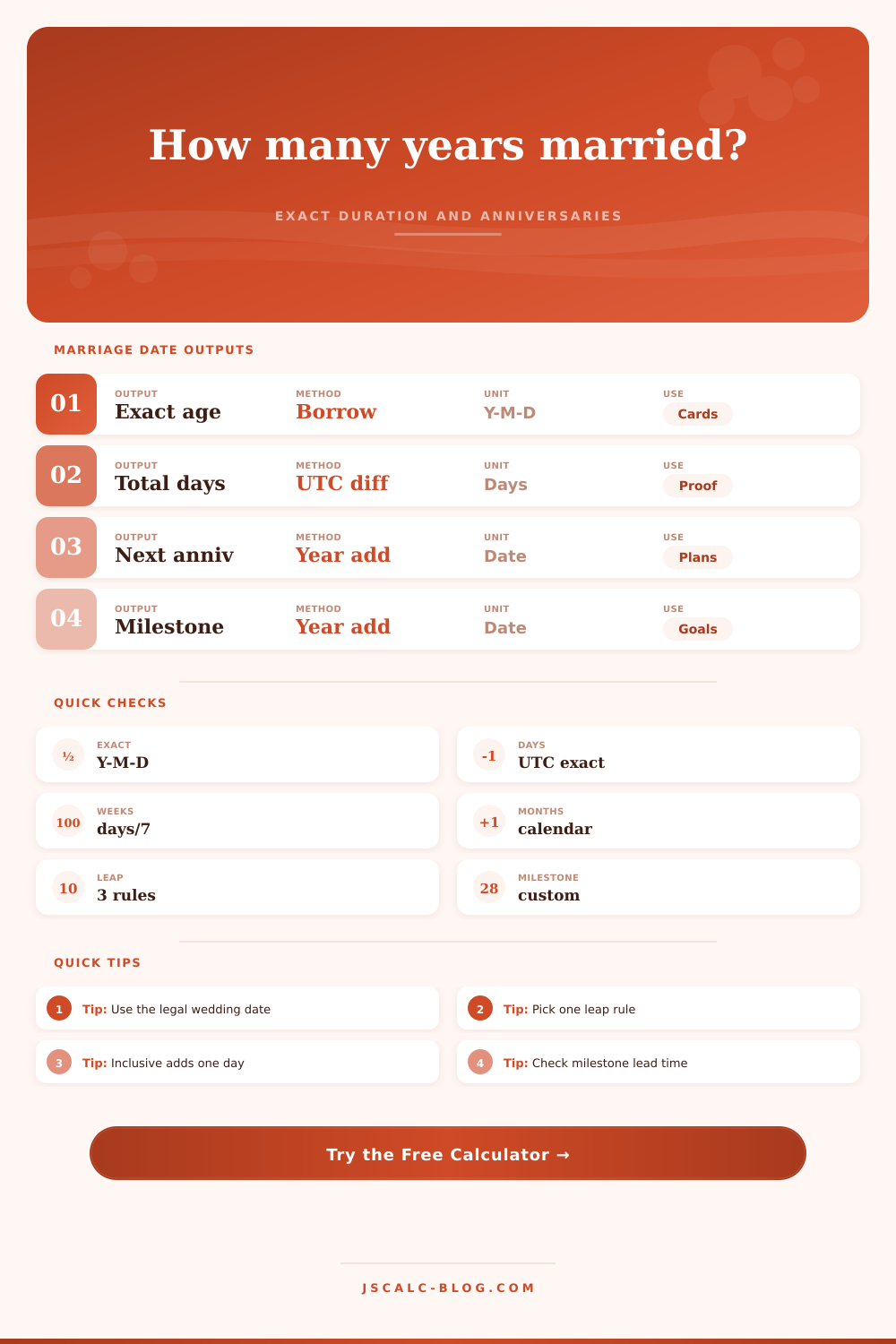
| Exact Y-M-D | Borrow months/days | Human age | Uses real month lengths |
| Total days | (Target - wedding) / day | Elapsed count | UTC avoids DST drift |
| Months | Years x 12 + months | Calendar months | Partial month kept separate |
| Anniversary | Wedding + N years | Next date | Feb. 29 uses selected rule |
| Inclusive | Total days + 1 | Day-count lists | Does not change anniversaries |
Live your life one day at a time, marking time by years because they are convenient. Live your marriage one day at a time too. It is just a moment in time, a point in time marked with light and noise and emotion: a wedding ceremony. But once that’s done, then what? Then the calendar pick up the pace, serving as a quiet counter ticking away and never pausing. You may assume you have good idea about how long you’ve been married. But how many times does that number end up being exacty divisible by 365 to be the right answer?
This calculator will convert your wedding date to an exact age (in calendar terms) and total number of elapsed units, plus all milestone dates in between. That way there isn’t any ambiguity when you hit those round numbers. Just let tool do the math, and worry about the rest of it.
Calculate Your Exact Marriage Age
Most people mistakenly think of every year as having three hundred and sixty-five days. That’s wrong: Leap years is necessary to maintain seasonal alignment with sun. And those additional days mess up the math when calculating anniversaries. Got a February twenty-ninth wedding? Then congratulations: you have special scheduling dilemma. It only shows up once every four years, which means that during common years that date doesn’t exist at all (on regular ol’ calendar). In those instances, the calculator ask you to select a rule. Do you want to celebrate on February twenty-eighth, or do you want to delay until March first? Nobody’s got a legal leg to stand on here; it makes perfect sense to go with whichever rule match your family tradition. For social rituals, consistency trumps accuracy. The calculator will remember your decision and stick to it.
The number of days matter more then just the day itself. You say “years,” but it’s really all about cumulative number of days. A decade might be an accomplishment, but three thousand six hundred and fifty days are a lifetime. That’s so many mornings together. There were so many nights of arguing and fixing things. There were so many peaceful evenings in silence. When you see the total days and weeks displayed, it stops being abstract. Not anymore. The time become something concrete. That many days ago, you chose one another.
There are moments when responsibility of children, the stress of money, gets in the way and make you lose sight of what you’ve done. Of how long you’ve been doing it. But then you look at the number and you are reminded. You are reminded of size of your commitment.
Milestones are good indicators, but they’re arbitrary. You celebrate 1st anniversary with paper, 5th with wood, 25th with silver. Those labels is taken from past eras; the time periods were selected because it was easy. The 5th birthday isn’t necessarily any more solid then the 4th. With this tool, you can create your own milestones, and that’s where planning kicks in. Perhaps your 10th anniversary are on the horizon, or perhaps you know your parents retire in 3 years. Or maybe you’d like to catch up with some friends from college in 2 years. That’s what the calculator do: it plots your unique markers against regular calendar. It reveals when those moments occur so that you aren’t surprised by a milestone moment.
Keep inclusive counting in mind. When tallying up your days together, you may wish to include wedding day as day number one if you’re creating a guest list or scrap book. Regular elapsed time doesn’t include starting date and only counts actual time passed. By using inclusive counting, we adds the day right back in. This sounds like a small adjustment but it’s the difference of adding a one to the total. Maybe the scrap book title is “Our First Year”. Including wedding day closes out the story fully. It sets the stage from when you said, “I do.” It’s a subtle shift but meaningful in sentiment.
Look ahead. Plan ahead. That’s what upcoming anniversaries table does. Set a reminder for 30 days out or 60 or 90. A reminder is lead time. And that makes sense. When you plan a nice dinner for your anniversary you don’t do it the day before. You need time. The tool uses your lead time to mark the reminder date, nudging you along to get started planning. It converts a future date into present task.
All this math…is scaffolding. Scaffolding’s good. But scaffolding isn’t the house. What happens on all those other days in-between milestones builds the marriage. That’s where the value lie: In what you do with your time. It’s one long journey of thousands of days. And the next ones awaits.