Work and Power Calculator
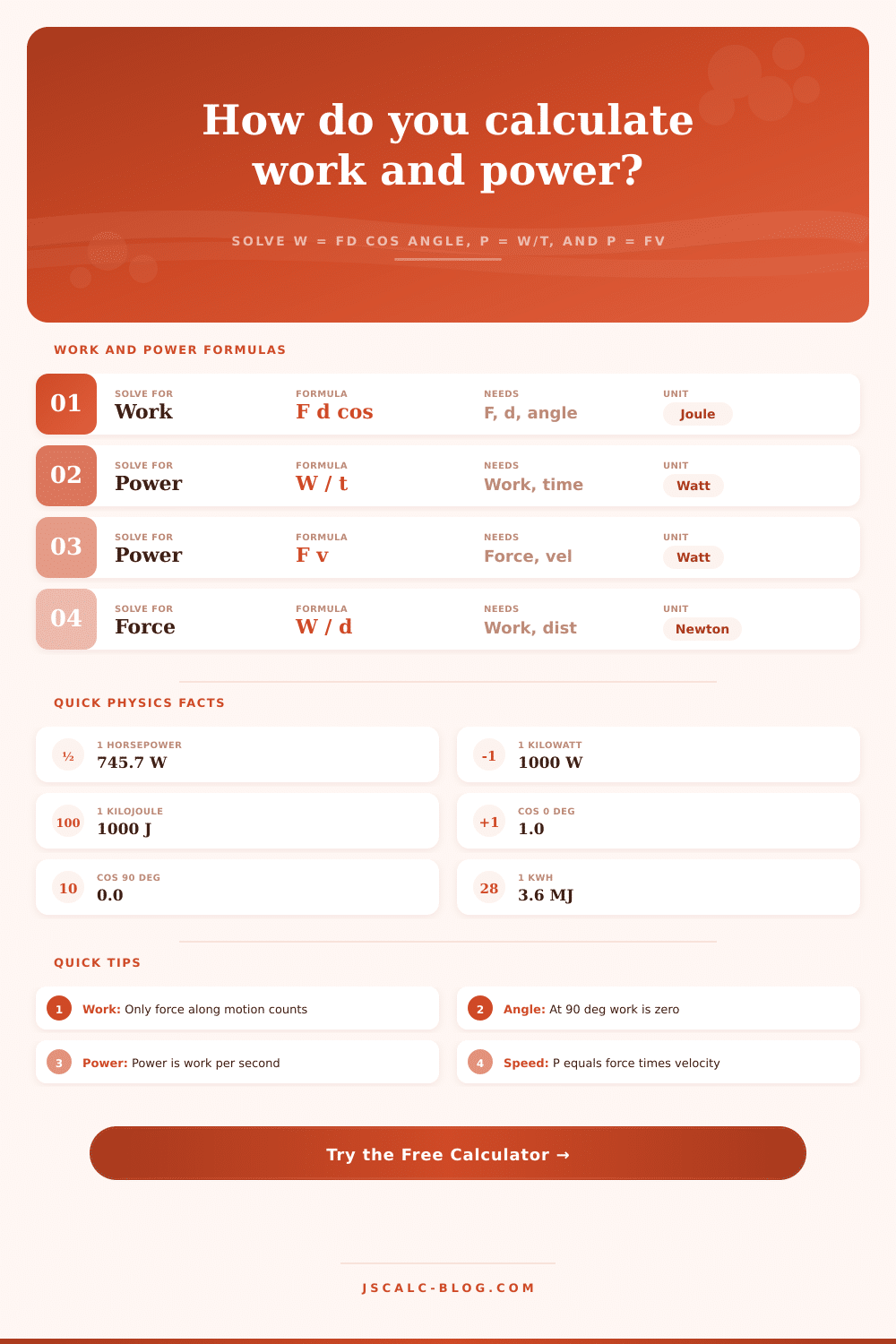
Solve mechanical work W = F × d × cosθ and power P = W / t = F × v. Rearrange the solver to find work, power, force, distance, or time with newton, foot, hour, and horsepower unit options.
💪Real Work and Power Presets
📝Work and Power Inputs
The highlighted field is calculated; the rest are your inputs.
0° = force fully along motion; 90° = no work.
🔢Formula Snapshot
⚡Full Formula Breakdown
📏Angle Effect on Work (cosθ)
| Angle θ | cosθ | Work Kept | Example (100 N, 5 m) |
|---|---|---|---|
| 0° | 1.000 | 100% | 500 J |
| 30° | 0.866 | 86.6% | 433 J |
| 45° | 0.707 | 70.7% | 354 J |
| 60° | 0.500 | 50.0% | 250 J |
| 90° | 0.000 | 0% | 0 J |
| 120° | -0.500 | Negative | -250 J |
| 180° | -1.000 | Opposing | -500 J |
🗂Work & Power Comparison Grid
| Task | Force | Distance | Angle | Work | Time | Power |
|---|---|---|---|---|---|---|
| Lift 10 kg box 1 m | 98 N | 1 m | 0° | 98 J | 2 s | 49 W |
| Push cart on floor | 200 N | 10 m | 0° | 2,000 J | 8 s | 250 W |
| Climb stairs (70 kg) | 687 N | 4 m | 0° | 2,747 J | 6 s | 458 W |
| Crane lifts 500 kg | 4,905 N | 12 m | 0° | 58,860 J | 30 s | 1,962 W |
| Angled rope pull | 150 N | 20 m | 30° | 2,598 J | 15 s | 173 W |
| Weightlifter press | 1,000 N | 0.7 m | 0° | 700 J | 1.2 s | 583 W |
| Elevator motor run | 7,000 N | 25 m | 0° | 175,000 J | 20 s | 8,750 W |
| Carry load level | 250 N | 15 m | 90° | 0 J | 10 s | 0 W |
🔄Power Unit Conversions
| From | Watts (W) | Kilowatts (kW) | Horsepower (hp) |
|---|---|---|---|
| 1 W | 1 W | 0.001 kW | 0.00134 hp |
| 100 W | 100 W | 0.1 kW | 0.134 hp |
| 745.7 W | 745.7 W | 0.7457 kW | 1 hp |
| 1,000 W | 1,000 W | 1 kW | 1.341 hp |
| 5,000 W | 5,000 W | 5 kW | 6.705 hp |
| 75,000 W | 75,000 W | 75 kW | 100.6 hp |
📋Unit Conversion Reference
| Quantity | Unit | Equals in SI | Notes |
|---|---|---|---|
| Force | 1 lbf | 4.4482 N | Pound-force to newtons |
| Force | 1 kgf | 9.80665 N | Kilogram-force (weight of 1 kg) |
| Distance | 1 ft | 0.3048 m | Foot to meters |
| Energy | 1 cal | 4.184 J | Thermochemical calorie |
| Energy | 1 kWh | 3,600,000 J | Kilowatt-hour to joules |
| Time | 1 h | 3,600 s | Hour to seconds |
💡Practical Work and Power Tips
To put it another way: if you have to haul a heavy suitcase up a long staircase, do you notice the difference between efficiency and effort? Do you use all of your energy but, from the perspective of physics, care only about the movement of mass against gravity? The work we perform… Represented in the equation as W equals F d cos theta, is simply the force exerted in the direction of displacement, times the distance traveled.
Pulling with any angle will waste much of your effort as tension, which does nothing to help move object upward. This is why the cosine term in this equation matters. It strips away all wasted effort and allows us to isolate portion of force that’s doing something productive. Most of us know instinctively that when we pull on a rope at a thirty degree angle instead of straight back, we’re going to be working harder, but math tells us precisely how much energy goes toward that angle.
How Force, Work, and Power Work Together
This is where power adds another caveat: time. If I lift a hundred kilos slowly, I’ll have done the same amount of work as if I jerked it upward in an instant, but metabolic cost and muscular demand would be worlds apart. Power measure how fast that energy gets transferred, changing static effort into active ability. Give a tiny engine enough hours and it might move a heavy load, but give it massive amounts of horsepower and it will race away in seconds.
These abstract relationships gets converted into concrete units of joules or watts by the calculator above; just plug in your numbers and let it run the math for you. It’ll handle the unit conversions without skipping a beat, allowing you to concentrate on physical tradeoffs instead of arithmetic.
The tricky bit here… Whether you’re an engineer or a student, is getting your head around relationship between angle (cosine) and force/motion. If direction of the force and direction of motion are parallel, all of the effort goes into pushing it along; the cosine is one. But if the angle increase, the amount of work you do plummets rapidly. If the two are at right angles, the work that gravity can accomplishes is zero.
For example, imagine you have a very heavy backpack. Instead of carrying it up or down, where gravity would do some of the work, you just walk horizontally. Because in that case, when you take those steps, the backpack isn’t moving up or down. That’s where the “what am I getting for my effort” idea becomes odd: because answer is nothing. Direction has as much to do with how hard something moves than its magnitude. And there’s the table to prove it from the page, making clear how a slight change in angle can knock off more than 10% of your actualy effectiveness.
Real-world applications rarely involve perfect alignment or constant speeds, so engineers building something like an elevator or crane must plan for mechanical inefficiencies, air resistance, and even some friction. The classic formula give you the theoretical minimum amount of energy needed… And it’s used as a benchmark to compare how well (or poorly) whatever you’re engineering performs. If your motor is rated for one horsepower, then in perfect conditions it produces about seven hundred forty-six watts. In reality, it will produce less than that because there’s always going to be some slippage in gears and some loss through heat. That distinction between the practical and the theoretical are the difference between a working machine and a textbook exercise.
And yet time is still the great equalizer here. By stretching out how long something lasts, you can decrease amount of power needed to accomplish it. That’s why a hybrid car has such a small engine and a big buffer of batteries. It trades off having to provide maximum power only when necessary (at top speed) for higher overall efficiency over longer periods. Athletic performance usually require pushing out as much power as possible as fast as possible, so hard that our bodies goes well past their sustainable limits.
The inputs you select are a reflection of your priorities: do you want to transport a load fast but at a high cost? Do you want to move it slowly without straining yourself? At its core, learning mastery over force and power is understanding the limits of energy transfer. It’s recognizing that not everything pushes us forward, and it never costs less to go faster. Whether we’re carrying groceries, building machines, or heaving weight plates in a gym, the rules stays constant.
What is physically possible is evident through the numbers. Nothing changes: pulling directly backward will still be more effective than pulling off to the side. Using high amounts of effort will always require greater amounts of power compared to using low efforts. It’s all about converting force into movement while overcoming resistance of our surroundings.