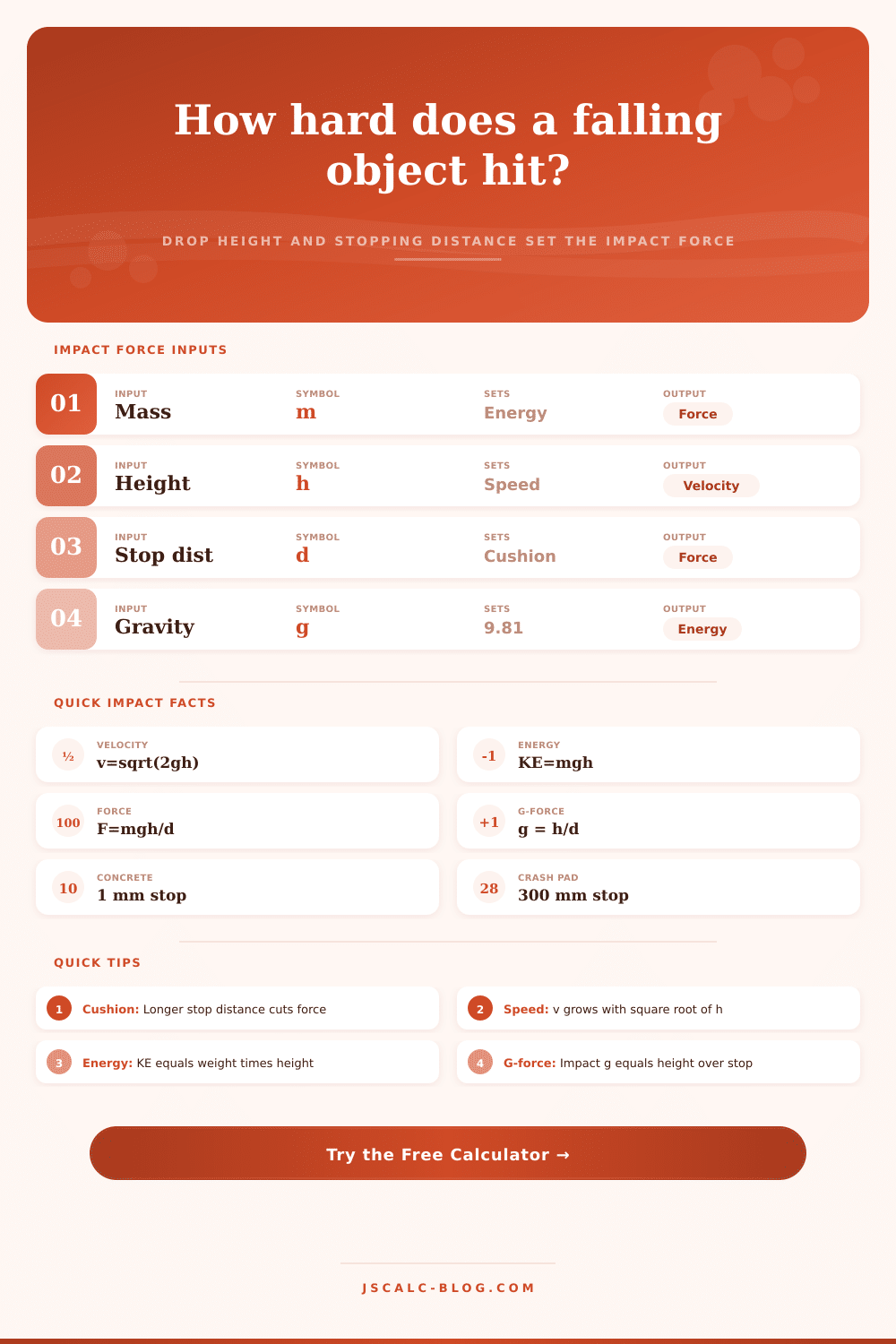
Free Fall Impact Force Calculator
Enter a drop height and stopping distance to find impact velocity, kinetic energy, peak g-force, and the average impact force a falling object delivers when it hits and deforms a surface.
💥Real Drop Scenarios
📝Fall & Impact Inputs
How far the object or surface crushes while stopping.
🔢Formula Snapshot
🛠Stopping Distance by Surface
| Surface | Typical Stop d | Behavior | Relative Force |
|---|---|---|---|
| Concrete / steel | ~1 mm | Almost no give | Extreme |
| Hardwood floor | ~5 mm | Slight flex | Very high |
| Carpet / gym mat | ~15 mm | Soft compression | High |
| Packed soil / gravel | ~20 mm | Digs in a little | Moderate |
| Soft soil / turf | ~50 mm | Sinks and spreads | Lower |
| Crash pad / foam | ~300 mm | Long crush zone | Very low |
📈Drop Height → Impact Velocity
| Drop Height | Fall Time | Impact Velocity | Velocity (km/h) |
|---|---|---|---|
| 0.5 m | 0.32 s | 3.13 m/s | 11.3 km/h |
| 1 m | 0.45 s | 4.43 m/s | 15.9 km/h |
| 2 m | 0.64 s | 6.26 m/s | 22.6 km/h |
| 3 m | 0.78 s | 7.67 m/s | 27.6 km/h |
| 5 m | 1.01 s | 9.90 m/s | 35.6 km/h |
| 10 m | 1.43 s | 14.0 m/s | 50.4 km/h |
| 20 m | 2.02 s | 19.8 m/s | 71.3 km/h |
⚖Force by Stopping Distance (10 kg, 2 m Drop)
| Stopping Distance | Surface Type | Impact Force | Peak G-force |
|---|---|---|---|
| 1 mm | Concrete | 196,200 N | 2000 g |
| 5 mm | Wood floor | 39,240 N | 400 g |
| 15 mm | Carpet / mat | 13,080 N | 133 g |
| 50 mm | Soft soil | 3,924 N | 40 g |
| 150 mm | Deep bark | 1,308 N | 13 g |
| 300 mm | Crash pad | 654 N | 6.7 g |
📊Height vs Force Comparison Grid
| Drop Height | Impact Velocity | Energy (10 kg) | Force Concrete 1 mm | Force Wood 5 mm | Force Soil 50 mm |
|---|---|---|---|---|---|
| 0.5 m | 3.13 m/s | 49 J | 49,050 N | 9,810 N | 981 N |
| 1 m | 4.43 m/s | 98 J | 98,100 N | 19,620 N | 1,962 N |
| 2 m | 6.26 m/s | 196 J | 196,200 N | 39,240 N | 3,924 N |
| 3 m | 7.67 m/s | 294 J | 294,300 N | 58,860 N | 5,886 N |
| 5 m | 9.90 m/s | 491 J | 490,500 N | 98,100 N | 9,810 N |
| 10 m | 14.0 m/s | 981 J | 981,000 N | 196,200 N | 19,620 N |
| 20 m | 19.8 m/s | 1,962 J | 1,962,000 N | 392,400 N | 39,240 N |
🧠G-force Effects Reference
| Peak G-force | Comparable To | On the Body | On Equipment |
|---|---|---|---|
| 1 – 5 g | Roller coaster | Fully survivable | No damage |
| 5 – 20 g | Hard landing | Bruising possible | Rugged gear fine |
| 20 – 50 g | Car crash pulse | Injury likely | Phones may crack |
| 50 – 100 g | Severe crash | Serious injury | Most electronics fail |
| 100 – 500 g | Dropped tool | Not survivable | Housings shatter |
| 500 g and up | Hammer on steel | Instant fatal | Metal deforms |
⚙Full Formula Breakdown
📋Input Reference Values
| Input | Symbol | Common Range | Effect on Force |
|---|---|---|---|
| Object mass | m | 0.1 to 500 kg | Force scales directly with mass |
| Drop height | h | 0.1 to 30 m | Force scales directly with height |
| Stopping distance | d | 1 mm to 500 mm | Force scales inversely with d |
| Gravity | g | 1.62 to 24.79 | Sets both velocity and energy |
| Impact velocity | v | 1 to 25 m/s | Result, not an input here |
💡Practical Impact Tips
Drop your phone off your shoulder. On contact with the ground, it smashes into pieces on the concrete floor. But if you think it’s the toughness of the concrete that did it, well, yes and no.
It’s not just how fast an object travels through space; it’s how suddenly it stops moving. That makes all the difference in the world; particularly if you’re attempting to safeguard delicate equipment, or just want to know why one drop is survivable while another isn’t. But it’s all pretty straightforward physics.
Why Stopping Distance Matters More Than Height
On earth, gravity accelerates everything at about nine point eight meters per second squared. In a vacuum, a feather falls just as fast as a hammer. But when you hit the ground with it? Well, that’s another story. It takes some time for energy the object acquired on the way down to release, and it does so by deforming.
If the object is stopped within a millimeter of the surface, well, things don’t end well. If the object can be crushed across a span of, say, thirty centimeters, that same amount of energy spreads into something that won’t kill you. People misinterpret this. They think, “Oh yeah, I’ll jump off this bridge!” but they don’t consider the distance it would take for their body to stop.
So, all you have to do is enter your own weight and fall distance into the calculator up top, and it’ll do all of the math for you. You don’t have to remember all those formulas about deceleration and kinetic energy. You just have to know that impact force is directly proportional to height, but inversely proportional to stopping distance. So, if you double the drop height, you double the impact force. But if you can double the cushioning distance instead, you cut the force in half.
Engineers use this trade-off every day with packaging foam and car crumple zones. Take the example of a 10 kilo box falling from two meters height. It will stop on concrete perhaps just a millimetre away. This creates almost two-hundred-thousand Newtons of force. This is enough to smash the box into pieces and probably crack the floor underneath.
Contrast this with same box crashing onto deep soil or a crash pad. In these cases, the stopping distance increases by five centimetres or more. The force decreases to a couple of thousand Newtons. The amount of energy involved is identical; the variation is simply geometrical. The ground deformed, making the collision last from milliseconds to a fraction of a second longer. Collisions is won in the dimension of time.
The same is true for our safety. We bend our knees when we jump from a curb. Why? Because it increases stopping distance. Stiff-legged jumping will send very high g-forces directly up the bones of your skeleton; it provides virtually zero cushioning. Bending your knees allows that jarring shock to transform into a slowed-down stop. It’s how the body is made to work: it absorbs force across time and space. If we ignore why it does this, we get hurt.
Most of the time when we’re dealing with small things that are dense, air resistance doesn’t matter. That’s why you don’t see it factored in on most simple calculators. Drag matters a lot if you’re talking about something as light as a balloon falling a long distance or someone skydiving. But if you’re talking about a package tumbling off a moving truck or a tool slipping out of your hand off a ladder, gravity is going to be the main event.
The amount of energy being delivered into an impact is based off both the mass and the fall distance of what you’re throwing. More mass equals more energy at the table. If you drop a 1-pound item and a 10-pound item both from the same height, the 10-pound item will do more damage because it is harder to stop.
The type of material makes less difference than you’d think. It’s not that concrete is evil and foam is good. Nope. Concrete doesn’t move. Foam will compress. Steel may bend safely. Rigidity in wood may be bad. Consider how much the thing you land on deforms. If it won’t then you’re going to make something else deform. Why don’t things break when they hit glass on a floor but maybe do when they drop on carpet? Because the carpet takes the penalty.
Stop Distance. When guessing the stopping distance, always err on the side of caution. It is easier to overestimate the hardness of a surface than to underestimate it. What seems like a soft floor may be sitting on top of a hard floor. That “harmless” looking drop could hit you with hundreds of Gs when the cushion gives way.
The numbers do not lie about energy. They’re just waiting for you to tell them where to spend the energy. Long stop distance equals low force. It is a simple equation with huge implications.