Free Fall Calculator With Air Resistance
Model a real drag-limited drop from rest. Get terminal velocity, speed at any moment, distance fallen, and time to reach the ground using the hyperbolic tangent solution for quadratic air resistance.
🪂Real Fall Presets
📝Object & Fall Inputs
Sphere ≈ 0.47, skydiver belly ≈ 0.9–1.3.
Used when input mode is area.
A = π(d/2)² when input mode is diameter.
Used when solving from time.
Used when solving from height.
🔢Formula Symbols
📉Speed & Distance Vs Time
| Time (s) | Drag v (m/s) | No-drag v (m/s) | Distance (m) | No-drag y (m) | % of vt |
|---|---|---|---|---|---|
| Enter values above to build the fall curve. | |||||
🌍Terminal Velocity Of Common Objects
| Object | Mass | Cd | Frontal Area | Terminal Velocity |
|---|---|---|---|---|
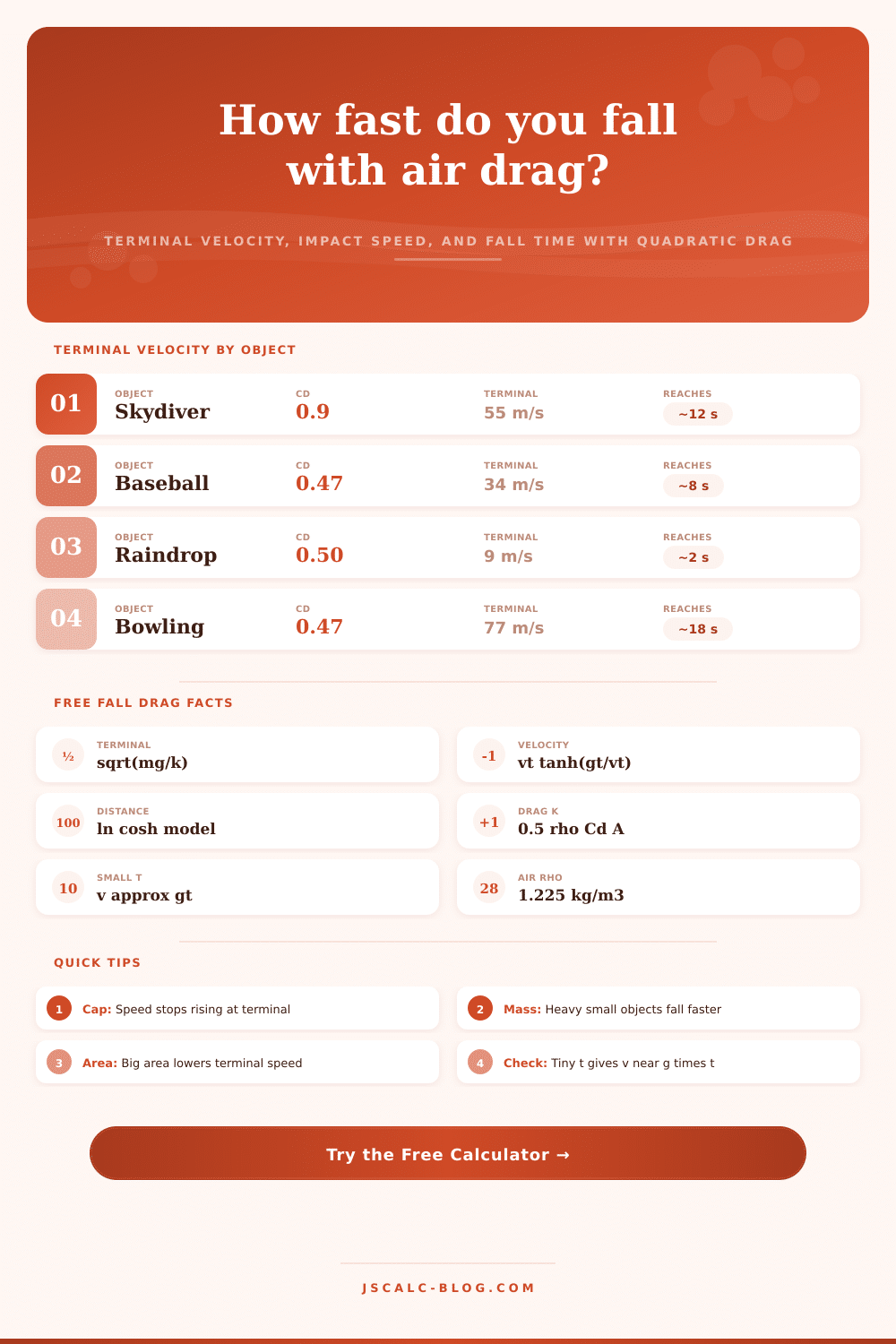
| Skydiver belly-to-earth | 85 kg | 0.90 | 0.50 m² | ≈ 55 m/s (198 km/h) |
| Skydiver head-down | 85 kg | 0.70 | 0.24 m² | ≈ 78 m/s (281 km/h) |
| Bowling ball | 6.35 kg | 0.47 | 0.037 m² | ≈ 77 m/s (277 km/h) |
| Baseball | 0.145 kg | 0.47 | 0.0042 m² | ≈ 34 m/s (122 km/h) |
| Golf ball | 0.046 kg | 0.35 | 0.0014 m² | ≈ 38 m/s (137 km/h) |
| Hailstone (2 cm) | 3.8 g | 0.50 | 0.00031 m² | ≈ 20 m/s (72 km/h) |
| Raindrop (4 mm) | 0.034 g | 0.50 | 0.0000126 m² | ≈ 9 m/s (32 km/h) |
| Feather | 1 g | 1.50 | 0.010 m² | ≈ 1 m/s (3.7 km/h) |
📊Drag Coefficient Reference
| Shape | Typical Cd | Notes | Effect On Terminal |
|---|---|---|---|
| Smooth sphere | 0.47 | Ball, marble, bearing | Baseline round-object drag |
| Rough sphere | 0.40–0.50 | Dimples delay separation | Slightly higher terminal |
| Skydiver belly | 0.90–1.30 | Arched spread-eagle pose | Lowers terminal to ~55 m/s |
| Skydiver head-down | 0.70 | Streamlined vertical dive | Raises terminal to ~78 m/s |
| Flat plate face-on | 1.28 | Card, sheet, parachute-like | Strongly caps the speed |
| Streamlined body | 0.04–0.10 | Airfoil, teardrop | Very high terminal velocity |
⚙Full Formula Breakdown
📋Approach To Terminal Velocity
| Multiple Of g·t/vt | tanh Value | Speed As % Of vt | Meaning |
|---|---|---|---|
| 0.5 | 0.462 | 46% | Still accelerating hard |
| 1.0 | 0.762 | 76% | One time constant reached |
| 2.0 | 0.964 | 96% | Nearly at terminal speed |
| 3.0 | 0.995 | 99.5% | Practically terminal |
| 4.0 | 0.9993 | 99.9% | Treated as terminal |
💡Air Resistance Tips
In high school physics class, we solved a lot of problems about dropping a ball in vacuum. But the real world has an atmosphere that resists any object falling into it. This alters the object’s path and creates a point where the downward pull of gravity are balanced by air resistance… What we call terminal velocity.
Whether you want to know why a coin falls but a feather floats, or design a parachute or drop a payload from a drone, you must understand that balance is important. It’s not just multiply-it-and-go-math. Drag depends on the shape of object, which is shown in the equation by the drag coefficient. It also depend on its frontal area and its mass.
What Is Terminal Velocity
An arced skydiver is going to have one drag profile; a flat plate another. A smooth sphere does, too. The mathematical equations describes this with things like hyperbolic tangent function. This function show how velocity initially goes up fast but slows as it reaches its maximum. That maximum, which is called terminal velocity, is when the force exerted downwards by gravity match the force exerted upwards against gravity from air resistance.
The calculator does all of this math for you. Above, it asks: How do you know your top falling speed? Run some numbers into this handy calculator, which calculates how much force is being exerted downwards and upwards by air resistance and gravity to see at what point they’re equal.
That means it’s all about the size (area) versus the weight (mass). Things that is heavy but small across will cut through the air well, like a dense hail stone or a bowling ball. Those things take a long time to accelerate to their terminal velocity. Things that are light but big across will hit a lot of resistance pretty quickly, like a feather or even a skydiver lying belly down towards earth. Their terminal velocity is much lower, meaning they don’t get very fast.
This drag coefficient measures how slippery the shape of an object is. For a sphere, it’s roughly 0.47, and for a spread-eagle human it might be more like 1.3. Your body position make a huge difference in how fast you’re going. That’s why skydivers tuck into a head-first dive when accelerating (they’re reducing their area), and making their profile smoother.
What’s also valuable to realize is that we’re talking about a timescale for fall. Because no, you don’t begin at terminal velocity. No. Not at all. At the beginning of your fall, you are in fact speeding up towards the ground (at around 9.8 meters per second squared). However, air resistance increases by the square of the velocity, so once you start moving, it catches up. Double how fast you are going? Air resistance will quadruple. Air resistance will double. It is quadratic.
In other words: drag takes over rapidly. This is why the distance equation use hyperbolic cosine terms and logarithms instead of the simple half-g-t-squared equation of vacuum physics. That’s laid out on the page in the reference table. If you look, you’ll see that a raindrop reaches its terminal speed in only two seconds; a skydiver take a dozen or more.
That’s the part where I say “science” again. Terminal velocity will come pretty fast and people is always shocked by that. After falling long enough, you’ll reach terminal velocity where the speed won’t continue increasing forever. That’s capped so we don’t end up falling faster than gravity allows. But it also depends on the medium.
The air is denser in certain types of weather or depending on altitude. Thicker air creates more drag. The air at sea level is thicker and more resistant different than the air higher up in the atmosphere. If you jumped out of a plane at say 30,000 feet, the initial jump has less drag because the air is thinner. As you start to descend, the air thickens and creates more drag, which lets you hit supersonic speeds earlier.
These are the kinds of tools that help visualise both the safety and design trade-off. They’re also what engineers use to calculate impact forces, or decide on a safe height to test their equipment by dropping it. You should of seen the data first. It’s one thing to fall, but another to control your fall. The difference between making something fall faster or slower can be tiny. Tweak any mass or area input slightly and watch: the result could be half the speed of impact or double the amount of time before you’re on the ground.
That’s the beauty of having a model that respects aerodynamics. And all that falls back on the idea that free fall is a dance between air and gravity. Air wants you to come to a halt, while gravity want to keep accelerating. They reach a compromise at terminal velocity, a moment when gravity and air shake hands. Understanding where that handshake occurs makes for safer design and more accurate prediction. It converts a general question of physics into a real limit of engineering.
Next time something drops in front of you, don’t think about it falling. Think about it fighting with the air, trying to slow itself down. When it stops fighting, that’s your answer. And that answer decides everything, from how fast you’ll hit water to what chance you have of surviving. The math describes that fight. It is actualy quite moddern.