Total Momentum Calculator
Add the signed momentum of every object in a system to find total momentum p = Σ mᵢvᵢ, total mass, net direction, and the center-of-mass velocity for 2 to 4 bodies.
🎯Real System Presets
📝System Setup
Use a minus sign on any velocity moving the other way.
Object 1
Object 2
Object 3 (optional)
Blank or zero mass is skipped in the sum.
Object 4 (optional)
Blank or zero mass is skipped in the sum.
🔢Formula Snapshot
⚖Sign Convention Guide
| Direction | Enter As | Example Velocity | Effect on Total |
|---|---|---|---|
| Right / east | Positive value | +3 m/s | Adds to the sum |
| Left / west | Negative value | −1 m/s | Subtracts from the sum |
| Up (1-D vertical) | Positive value | +5 m/s | Adds to the sum |
| Down (1-D vertical) | Negative value | −5 m/s | Subtracts from the sum |
| At rest | Zero value | 0 m/s | No momentum added |
🧪Example Systems
| System | Object 1 | Object 2 | Object 3 | Setup Note |
|---|---|---|---|---|
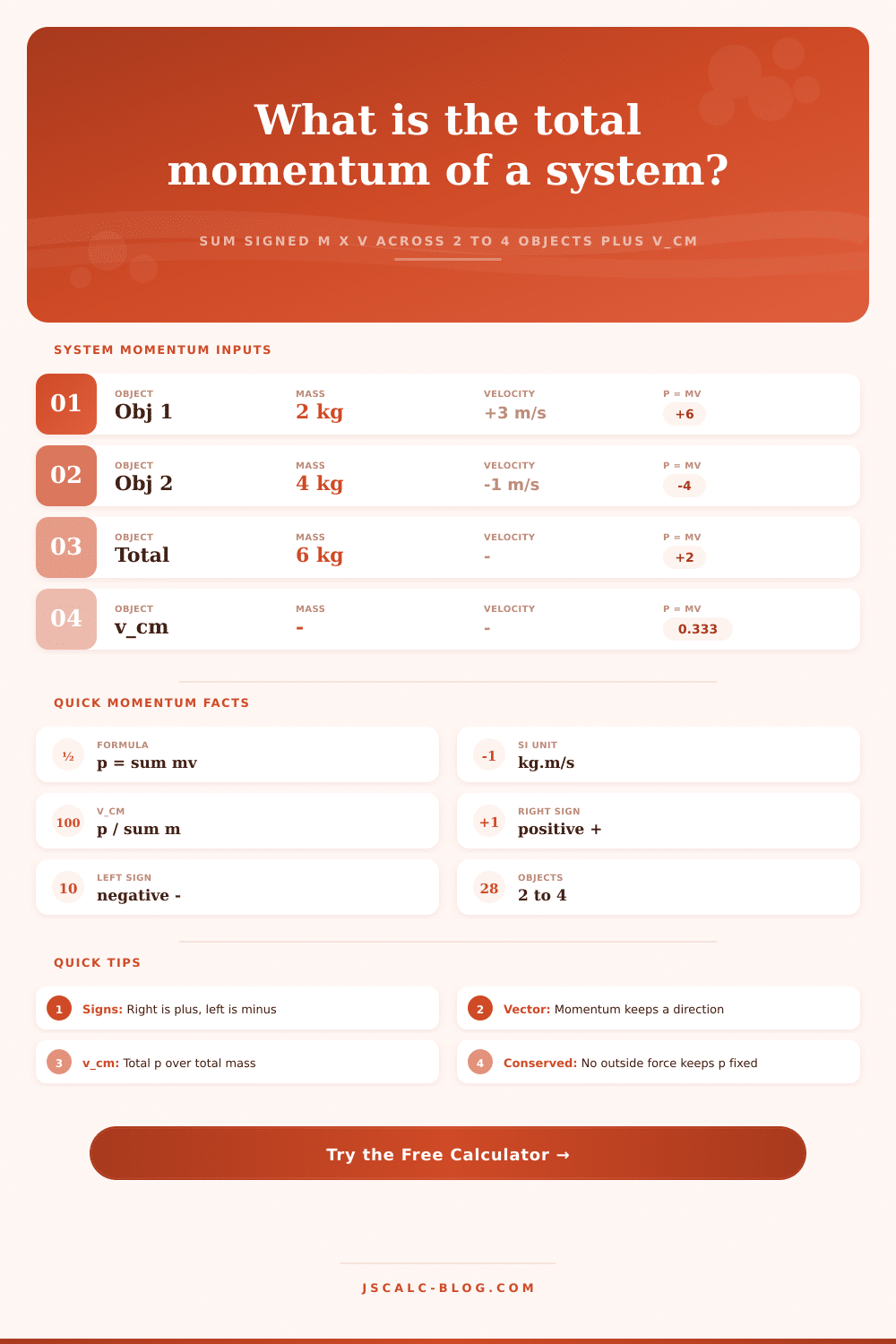
| Two carts opposite | 2 kg @ +3 | 4 kg @ −1 | – | Signs cancel partly |
| Head-on pair | 1500 kg @ +20 | 1200 kg @ −15 | – | Cars closing in |
| Same-direction convoy | 1000 kg @ +25 | 1000 kg @ +25 | – | Momentum adds up |
| Recoil gun and bullet | 4 kg @ −5 | 0.02 kg @ +1000 | – | Starts near zero |
| 3-ball break | 0.17 kg @ +2 | 0.17 kg @ −1.5 | 0.17 kg @ +0.5 | Pool table spread |
| Explosion fragments | 3 kg @ −6 | 2 kg @ +9 | – | From rest, p stays 0 |
🔄Momentum Unit Conversions
| Quantity | From | Multiply By | To Base Unit |
|---|---|---|---|
| Mass | 1 g | 0.001 | 0.001 kg |
| Mass | 1 lb | 0.45359237 | 0.4536 kg |
| Velocity | 1 km/h | 0.27778 | 0.2778 m/s |
| Velocity | 1 mph | 0.44704 | 0.4470 m/s |
| Momentum | 1 kg·m/s | 1 | 1 kg·m/s |
| Momentum | 1 g·cm/s | 0.00001 | 1e−5 kg·m/s |
🗂System Comparison Grid
| System | Obj 1 p | Obj 2 p | Obj 3 p | Total p | v_cm |
|---|---|---|---|---|---|
| Two carts opposite | +6 | −4 | – | +2 | 0.333 |
| Head-on pair | +30000 | −18000 | – | +12000 | 4.444 |
| Same-direction convoy | +25000 | +25000 | – | +50000 | 25.000 |
| Recoil gun and bullet | −20 | +20 | – | 0 | 0.000 |
| 3-ball break | +0.34 | −0.255 | +0.085 | +0.17 | 0.333 |
| Explosion fragments | −18 | +18 | – | 0 | 0.000 |
| Stationary pair | 0 | 0 | – | 0 | 0.000 |
| Elastic pair | +12 | −8 | – | +4 | 0.571 |
⚙Full Formula Breakdown
📋Conservation Notes
| Situation | What Happens to p | Why | Check |
|---|---|---|---|
| No external force | Total p stays constant | Internal forces cancel in pairs | p before = p after |
| Elastic collision | p conserved | No outside push during impact | Sum both objects |
| Inelastic collision | p conserved | Momentum is a vector total | Combined mass moves |
| Explosion from rest | Total p stays 0 | Fragments split equal and opposite | Signed sum is 0 |
| External force acts | p can change | Impulse F×t adds momentum | Account for the push |
💡Practical Momentum Tips
If you know about momentum then you can tell what is going to happen when two pool balls collid. Momentum combines an object’s resistance to stopping into a single number. If more than one object are at play, the momenta of all the individual objects combine to give you an overall description of entire system. The above calculator does this math for you, given only that you input the velocity and mass of each. You don’t have to guess and convert with coefficients (just enough to make the physics right).
First understand this: Momentum is a vector quantity (not a scalar quantity like mass). That means it includes not only its magnitude (how fast) but also its direction. Two equally weighted trucks traveling toward each other at equal speeds but from opposite directions has no net momentum between them. They will cancel exactly. When you put your velocities into whatever tool you are using for the calculation, be sure to assign a sign to each velocity so that you know which direction is positive and which direction is negative. This may seem trivial until the day you don’t do it correctly and wind up with an answer that can not possibly work. In the table of references on the page above, notice that rightward movement add to the sum; leftward movement subtracts.
What is Momentum?
Imagine a light-weight car zipping past or a heavy-duty truck chugging along. Who has greater momentum? Multiply their mass and velocity to figure it out. A speeding bullet doesn’t have nearly as much momentum than a giant freight train chugging along at a snail’s pace. That is what makes stopping force difficult to understand. To play with it yourself, use the calculator and change only one factor at a time. You’ll notice that doubling the mass and doubling the momentum have exactly the same impact as doubling the speed. Mass is sneaky in its control, while people get caught up on the sexy-appeal of speed.
Two or four objects becomes complicated very fast. For example, take the case of billiards: you have three balls in play. It would of been crazy to track them all individually. You can add up their momenta, keeping their sign, to get a net momentum. This net momentum tell you how the center of mass moves. And this is important, if that number is positive, the entire system will tend to drift in the positive direction. Negative? It will drift back. What about the center-of-mass velocity output? That tells you average speed of that collective drift. Even though individual things might be bouncing around wildly, this is a useful metric for figuring out where the system as a whole is heading.
The golden rule is conservation of momentum. If you have a closed system without any outside forces acting on it, then net momentum before anything happens should equal the net momentum after. That includes explosions and collisions and everything else in-between. How does that explain what happens to a gun firing a bullet? Well, the gun recoils as it shoots the bullet forward. Why? Because the bullet has forward momentum, so the gun needs to have equal and opposite (backward) momentum. The total is 0, assuming you started at rest. Try it out! Type in numbers both before and after and see that the total doesn’t change. It is a good way to check if your gut feeling are right.
Some common pitfalls involve direction and unit mixing. Newton-seconds and kilogram-meters per second use the same units as kilograms and meters per second. If you use kilograms and kilometers then you’ll need to convert to get the result back into standard metric units. The good news is the tool does this for you, but knowing how it works will avoid other problems down the line. Always be sure that the sign of your velocity match whatever direction you define as positive. Velocity includes direction, which is why you should always input a positive mass, because negative mass do not make physical sense.
This applies to everything from sports analysis to crash test engineering. For example, engineers designing for car safety determine momentum (to know what force will be transferred during an impact). Then they aim to spread that momentum out over as much distance and time as possible to cushion occupants. Similarly, athletes (often without knowing) is using similar principles in their mechanics. For example, on a soccer kick or swing of a baseball bat, they’re maximizing velocity times mass in motion at impact. That insight can improve their technique, not just raw strength.
Physics is beautiful because it works everywhere. From the planets to their moons to the atoms within them, momentum conservation apply. In an ever-changing world, it’s a steady guide. Take a bunch of objects, add up the signed values, and suddenly the signal emerges from the static. Plug in the values carefully and let the calculator above do the rest. It turns complex ideas into real numbers.
Ultimately, momentum is all about balance. Momentum tells us that for every action there is an equal and opposite reaction. It is mass times velocity. It also tells us that things don’t come free; there is always a price to pay for motion. Remember to keep your units straight and your signs correct, and the rest just falls into place. Look at the entire system, the same way those pool balls is connected.