Initial Momentum Calculator
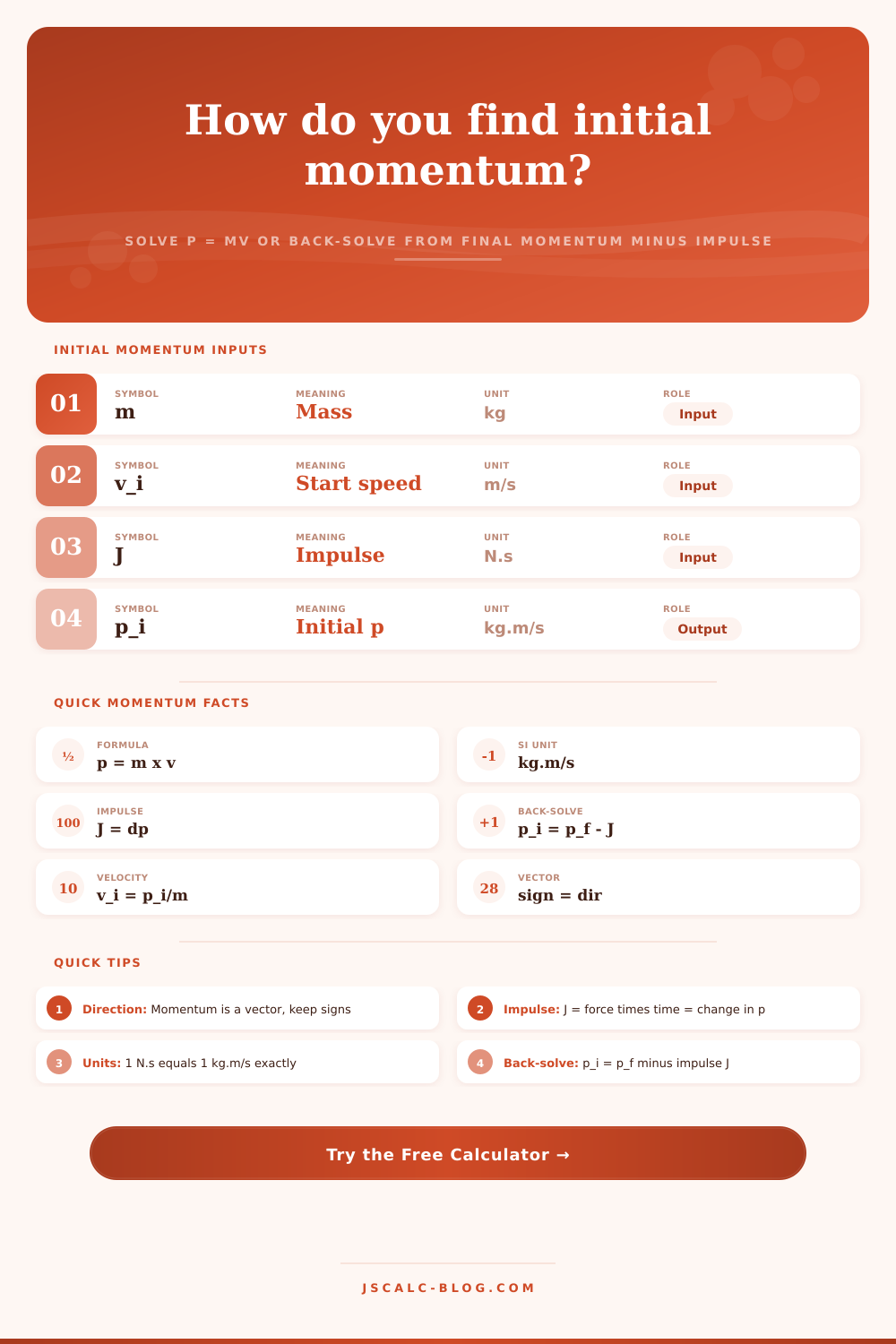
Find the initial momentum of a single object from mass × initial velocity, or back-solve it from a final velocity and an impulse using p₁ = p₂ – J. Includes initial velocity, impulse, and full sign-aware breakdown.
🎯Real Momentum Presets
📝Object & Motion Inputs
Used in Mode A. Sign gives direction (+ or –).
Used in Mode B to build final momentum p₂.
Net force applied during the time interval.
Used when impulse source is set to direct J.
🔢Formula Snapshot
🚗Momentum of Common Objects
| Object | Mass | Speed | Momentum p | Notes |
|---|---|---|---|---|
| Rifle bullet | 0.010 kg | 900 m/s | 9 kg·m/s | Tiny mass, huge speed |
| Baseball pitch | 0.145 kg | 40 m/s | 5.8 kg·m/s | Fast ball throw |
| Sprinter | 75 kg | 10 m/s | 750 kg·m/s | Elite 100 m pace |
| Road cyclist | 85 kg | 12 m/s | 1,020 kg·m/s | Rider plus bike |
| Compact car | 1,000 kg | 20 m/s | 20,000 kg·m/s | City driving speed |
| Loaded truck | 18,000 kg | 25 m/s | 450,000 kg·m/s | Highway freight |
💥Impulse Examples (J = F × t)
| Scenario | Force F | Time t | Impulse J | Effect on p |
|---|---|---|---|---|
| Car braking | 5,000 N | 1.0 s | 5,000 N·s | Reduces p by 5,000 |
| Rocket thrust | 2,000 N | 10 s | 20,000 N·s | Adds p forward |
| Bat on ball | 3,000 N | 0.002 s | 6 N·s | Short, sharp change |
| Skater push | 150 N | 0.8 s | 120 N·s | Builds start momentum |
| Airbag stop | 8,000 N | 0.15 s | 1,200 N·s | Softens the Δp |
🔄Momentum Unit Conversions
| From | To | Multiply By | Example |
|---|---|---|---|
| g·m/s | kg·m/s | 0.001 | 500 → 0.5 |
| kg·km/h | kg·m/s | 0.2778 | 72 → 20 |
| N·s | kg·m/s | 1 (equal) | 5,000 → 5,000 |
| lb·ft/s | kg·m/s | 0.1383 | 100 → 13.83 |
| slug·ft/s | kg·m/s | 4.4482 | 10 → 44.48 |
🗂Initial Momentum Comparison Grid
| Scenario | Mass | Initial v₁ | Initial p₁ | Impulse J | Final p₂ |
|---|---|---|---|---|---|
| Car cruising | 1,000 kg | 20 m/s | 20,000 | +5,000 | 25,000 |
| Truck slowing | 18,000 kg | 25 m/s | 450,000 | –90,000 | 360,000 |
| Ball pre-bounce | 0.6 kg | –8 m/s | –4.8 | +9.6 | +4.8 |
| Rocket pre-burn | 500 kg | 100 m/s | 50,000 | +20,000 | 70,000 |
| Skater push-off | 60 kg | 0 m/s | 0 | +120 | 120 |
| Cyclist coasting | 85 kg | 12 m/s | 1,020 | –170 | 850 |
| Bullet initial | 0.010 kg | 900 m/s | 9 | –9 | 0 |
| Bowling roll | 6.35 kg | 6 m/s | 38.1 | –12.7 | 25.4 |
⚙Full Formula Breakdown
📋Reference Values
| Quantity | Symbol | SI Unit | Relationship |
|---|---|---|---|
| Momentum | p | kg·m/s | p = m × v |
| Initial momentum | p₁ | kg·m/s | p₁ = m × v₁ |
| Final momentum | p₂ | kg·m/s | p₂ = p₁ + J |
| Impulse | J | N·s | J = F × t = Δp |
| Initial velocity | v₁ | m/s | v₁ = p₁ / m |
| Average force | F | N | F = Δp / t |
💡Practical Momentum Tips
Physics problems start most of the time with a who-cares question: Where was something when it all went pear shaped? The answer is starting momentum. Momentum is a vector quantity. It’s not just a number; it has both direction and magnitude (speed multiplied by mass). Before some outside force act on something, that’s its momentum.
Momentum is easy enough: just multiply velocity by mass, and you have yourself some $p$. Here’s where things get tricky. Suppose you have a situation where you know how much force was exerted and where an object ended up. That information should of be enough to work backward to the initial scenario. Enter impulse. Think of impulse as force x time. It tells you how hard something has been pushed or pulled for how long. And it connects all of this through Newton’s second law… Specifically, that impulse equals change in momentum. That’s a pretty straightforward math equation, but you have to pay close attention to your units and signs.
How to Use the Calculator
After selecting one of the paths for your scenario, the calculator will do the math for you. If you have an initial velocity and mass, enter them and it’ll calculate starting momentum. This is direct way to find the starting condition. Use this as a sanity check on a homework problem, or verify your own assumption about a starting condition prior to running a collision simulation.
If you know what impulse was applied and what the final state looks like, then go ahead and use the back-solve mode. This applies more to an engineering context where sensors measure force profiles and final velocities without knowing initial conditions. It’s particularly handy in engineering contexts where sensors record final velocities and force profiles, but initial conditions are unknown.
It also automatically converts between different units. That way you don’t have to worry about doing any math yourself. This saves you from the inevitable math errors we all make when writing things down by hand.
The inputs is important too. Your mass needs to match the unit of your velocity (e.g., kilograms and meters per second). And velocity is signed, meaning it has a directional component. This is where folks mess up most frequently: Negative velocity isn’t slow motion. It’s the opposite direction along the axis you said was “positive.” So if you drop the sign, your momentum calculation will be correct in size but incorrect in direction, making any later impulse analysis useless.
That’s because it makes sense when applied to real-life situations. Take for example a car braking. You know how long it takes to stop, what force the brakes apply and the final velocity (which may be zero). Now calculate the impulse imparted to the car during its braking. Subtract that from the final momentum and you have original momentum just prior to the driver pressing on the brake. Divide that by mass of the car and you have the original speed. That kind of backward engineering is routine in safety tests and accident reconstructions.
And sports? For example, when a baseball player hits a ball with their bat, they may want to know just how hard they hit it. By measuring the exit velocity and estimating the force and duration of contact, they can calculate change in momentum. Compare that to the momentum of the incoming pitch and you have the true picture of what happened during impact. What you discover is that very slight variations in contact time make a big difference in the force needed to produce a given result. Longer contact time equals lower peak force, which explains why all of today’s equipment is built for maximum dwell time at impact.
Another pitfall is unit conversion. Units of momentum are a combination of both velocity and mass: kilogram-meters per second. Impulse is expressed in Newton-seconds. While they appear different, they are physically equal. A Newton-second is identical to a kilogram-meter per second. Knowing this makes the mental model so much easier. Because impulse and momentum change are really just two sides of the same coin, there’s no need to remember two equations for them. The reference tables provided with the calculator explain it all neatly. That way you can check that what you put into the equation is dimensionally correct before performing any calculation.
The last piece then is directionality. Momentum has not only magnitude but also direction. In one-dimensional problems, this translates to plus or minus signs. When there are multiple dimensions, you have to break into component pieces of momentum along each axis. To make the math tractable without losing the key concepts, the calculator deals with the simplest case of just one object in linear motion. Net force is assumed to be along the line of motion. It is a decent approximation for many practical and intro-level examples.
And in the end, it’s all about setting the table for the rest of the story. Be it building a safety cushion, studying a high speed crash, or simply wondering how fast an object was traveling prior to its stop… half the battle is finding your starting point. And once you have those tools to do the leg work, you know what to make of them because you understand the physics behind it all. It’s the beginning, a time when everything has changed and you’re still trying to catch up.