Sound Wavelength Frequency Calculator
Convert between wavelength and frequency using λ = v / f, with the speed of sound set by medium and air temperature. Get wavelength, frequency, speed of sound, and period in one solve.
🎵Real Sound Presets
📝Wave Inputs
Used when solving for wavelength or speed.
Used when solving for frequency or speed.
Only used when medium is temperature-based air.
Only used when medium is set to custom speed.
🔢Wave Relation Snapshot
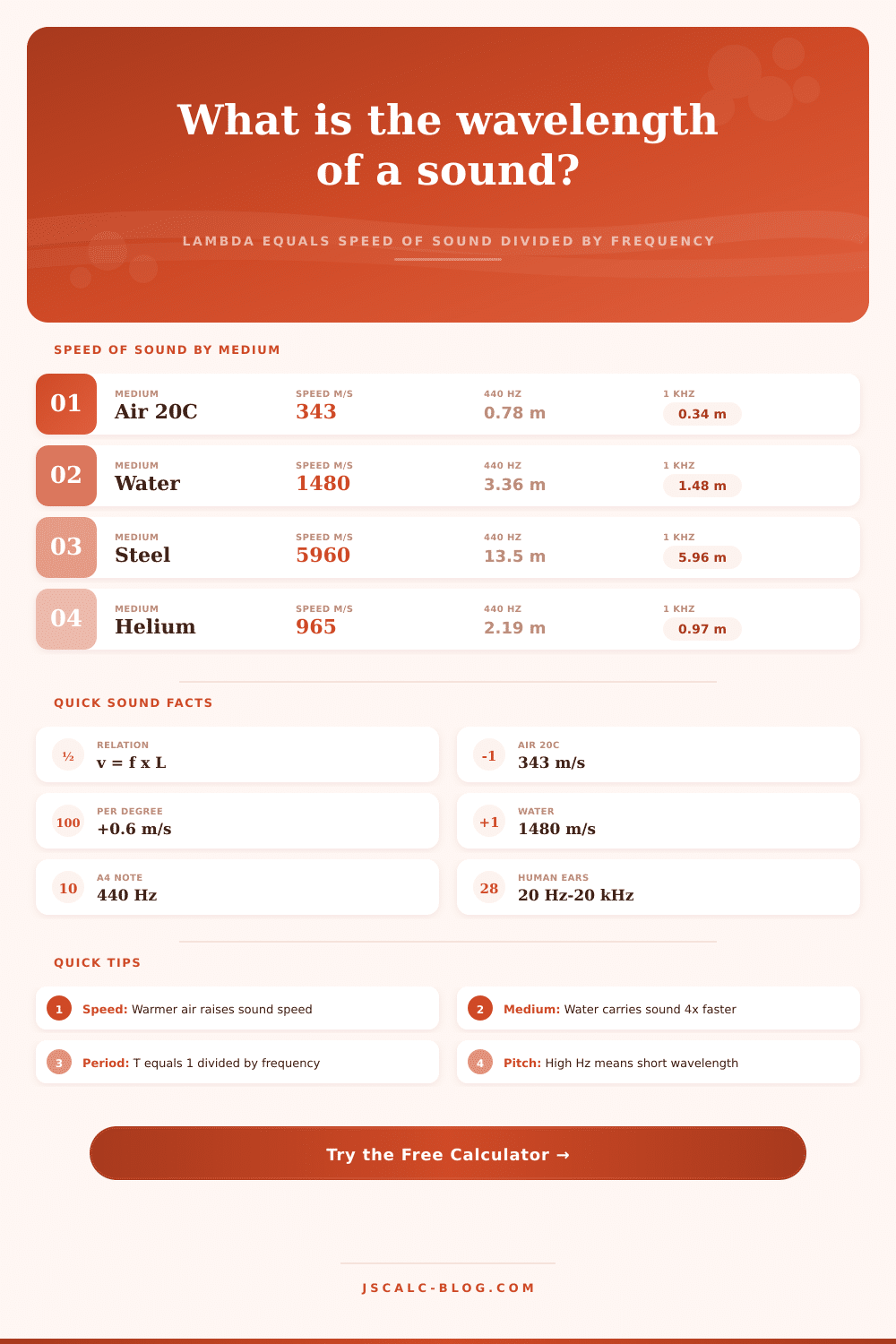
🌍Speed of Sound by Medium
| Medium | Speed (m/s) | λ at 440 Hz | λ at 1 kHz | Notes |
|---|---|---|---|---|
| Air 0°C | 331 | 0.752 m | 0.331 m | Dry cold air |
| Air 20°C | 343 | 0.780 m | 0.343 m | Room reference |
| Helium 20°C | 965 | 2.193 m | 0.965 m | Raises voice pitch |
| Fresh water | 1480 | 3.364 m | 1.480 m | At about 20°C |
| Seawater | 1522 | 3.459 m | 1.522 m | Salt raises speed |
| Wood | 3900 | 8.864 m | 3.900 m | Along the grain |
| Glass | 4540 | 10.32 m | 4.540 m | Typical soda glass |
| Steel | 5960 | 13.55 m | 5.960 m | Longitudinal wave |
| Aluminum | 6420 | 14.59 m | 6.420 m | Very fast metal |
| Rubber | 60 | 0.136 m | 0.060 m | Soft slow medium |
🌡Air Speed vs Temperature
| Temperature | Speed (m/s) | Change vs 20°C | λ at 100 Hz | λ at 1 kHz |
|---|---|---|---|---|
| –20°C | 319.2 | –23.8 m/s | 3.192 m | 0.319 m |
| 0°C | 331.3 | –12.1 m/s | 3.313 m | 0.331 m |
| 10°C | 337.4 | –6.1 m/s | 3.374 m | 0.337 m |
| 20°C | 343.4 | 0 m/s | 3.434 m | 0.343 m |
| 25°C | 346.5 | +3.0 m/s | 3.465 m | 0.346 m |
| 30°C | 349.5 | +6.1 m/s | 3.495 m | 0.349 m |
| 40°C | 355.5 | +12.1 m/s | 3.555 m | 0.356 m |
🎹Musical Note Frequencies (in Air, 343 m/s)
| Note | Frequency | Wavelength | Period | Band |
|---|---|---|---|---|
| E2 (Low E) | 82.41 Hz | 4.162 m | 12.13 ms | Bass |
| A2 | 110.0 Hz | 3.118 m | 9.09 ms | Bass |
| C4 (Middle C) | 261.63 Hz | 1.311 m | 3.82 ms | Midrange |
| A4 (Concert) | 440.0 Hz | 0.780 m | 2.27 ms | Midrange |
| C5 | 523.25 Hz | 0.656 m | 1.91 ms | Midrange |
| A5 | 880.0 Hz | 0.390 m | 1.14 ms | Upper mid |
| C6 | 1046.5 Hz | 0.328 m | 0.96 ms | Treble |
| A6 | 1760.0 Hz | 0.195 m | 0.57 ms | Treble |
📈Frequency vs Wavelength by Medium
| Frequency | Air 343 m/s | Water 1480 m/s | Steel 5960 m/s | Helium 965 m/s | Band |
|---|---|---|---|---|---|
| 20 Hz | 17.15 m | 74.00 m | 298.0 m | 48.25 m | Sub-bass |
| 40 Hz | 8.575 m | 37.00 m | 149.0 m | 24.13 m | Bass |
| 100 Hz | 3.430 m | 14.80 m | 59.60 m | 9.650 m | Low |
| 440 Hz | 0.780 m | 3.364 m | 13.55 m | 2.193 m | Mid |
| 1 kHz | 0.343 m | 1.480 m | 5.960 m | 0.965 m | Mid |
| 4 kHz | 0.0858 m | 0.370 m | 1.490 m | 0.241 m | High |
| 10 kHz | 0.0343 m | 0.148 m | 0.596 m | 0.0965 m | High |
| 20 kHz | 0.0172 m | 0.0740 m | 0.298 m | 0.0483 m | Top edge |
🔊Audible & Sound Range Bands
| Band | Frequency Range | λ in Air | Examples |
|---|---|---|---|
| Infrasound | Below 20 Hz | Over 17 m | Earthquakes, elephants |
| Sub-bass | 20 – 60 Hz | 17 – 5.7 m | Kick drum, organ |
| Bass | 60 – 250 Hz | 5.7 – 1.4 m | Bass guitar, male voice |
| Midrange | 250 – 2 kHz | 1.4 – 0.17 m | Vocals, most melody |
| Presence | 2 – 6 kHz | 17 – 5.7 cm | Speech clarity |
| Brilliance | 6 – 20 kHz | 5.7 – 1.7 cm | Cymbals, air, sparkle |
| Ultrasound | Above 20 kHz | Under 1.7 cm | Sonar, medical imaging |
⚙Full Formula Breakdown
💡Practical Sound Tips
The speed of sound vary with air temperatures; summer sounds are not the same as winter in a concert hall. Why? Sound waves has wavelengths that stretch and shrink according to the medium through which they travels. Use the calculator above and see how long each wavelength is for every note. Knowing this number mean you can guess what you’ll hear when listening.
It’s all very complicated physics hiding some simple math: There are three variables in the core equation: wavelength, frequency, and speed. The first variable, frequency, is dictated by the source: the guitar string that vibrate at 82 hertz. The second variable, speed, depend on the type of medium through which the wave travels. The third variable, wavelength, the distance between peak, balances out the equation. And here’s where it gets important: When the medium becomes slower, the wavelength also decreases.
How Temperature Changes Sound Speed
Know this if you’re designing your speaker setup or tuning your instrument. Air is another variable and temperature play its part here. Warmer air is less dense, meaning it carries sound energy more quickely. The standard reference are taken from the calculator at 20 degrees Celsius with a value of 343 meters per second. As the air temperature lowers to freezing the value reduce to 331 meters per second. Each note played in the cold outdoor venue will have a slight decrease in wavelength different than one played in your warm studio. This is what musicians experience when they find their instrument go out of tune during a performance as the room warms up.
The second point is a matter of medium density. In fresh water, sound travel almost five times as fast as it does in air. Underwater, the same 440-hertz tone produce an audible wavelength exceeding three meters. In air, that same tone yields one just shy of eight decimeters. That’s why sonar operates unlike radar. Even steel conducts sound at an even greater rate where wavelengths reaches into the several-meter range for audible frequencies.
The medium determine the shape of sound. That’s why we can feel vibrations on train tracks and hear them coming long before the train itself come into sight. It is a pattern within the range of human hearing. A low bass note of 40 hertz has a wavelength measured in meters (a few meters). That’s why subwoofers must be big, they require real estate for all those long pressure cycles. At the other end of the spectrum, a high-frequency sound of 20 kilohertz has a wavelength less than a couple of centimeters. Tiny tweeters can easily manages high-frequency sounds.
Use the calculator to get your head around it. As one increase, the other decrease, but the speed stays the same. It can also produce period. This is the length of time taken by a single full cycle of waves passing any given point. In other words, when listening to a tone with a frequency of 440 hertz, it take 2.3 milliseconds for it to repeat itself.
This sense of time is essential when working with digital signal processing or audio engineering. Sampling rates, delay effects, resonance, and much more relies on knowing how long a wave lasts. Fortunately, the tool should of did this for you without having to manually divide anything. There’s no need to memorize how fast all materials carry sound.
Generally speaking, the stiffer and denser a material is, the quicker it will travel. Solids are the fastest, followed by liquids. Gases are the slowest, though rubber is an exception because its elasticity greatly slow transmission. When using the calculator, choose the medium that most closely matches where you work. Otherwise, simply enter known speed. It makes the physics of it more real and brings us back to the relationships, which in turn become intuitive.
Instead of just hearing pitch, you begin to think of sound as a physical space. When you hear something vibrate your floor from far away, like a bass line or thunder rolling in, you can think of those sounds as invisible waves moving through different object. Those same waves morph themselves to fit their surroundings.