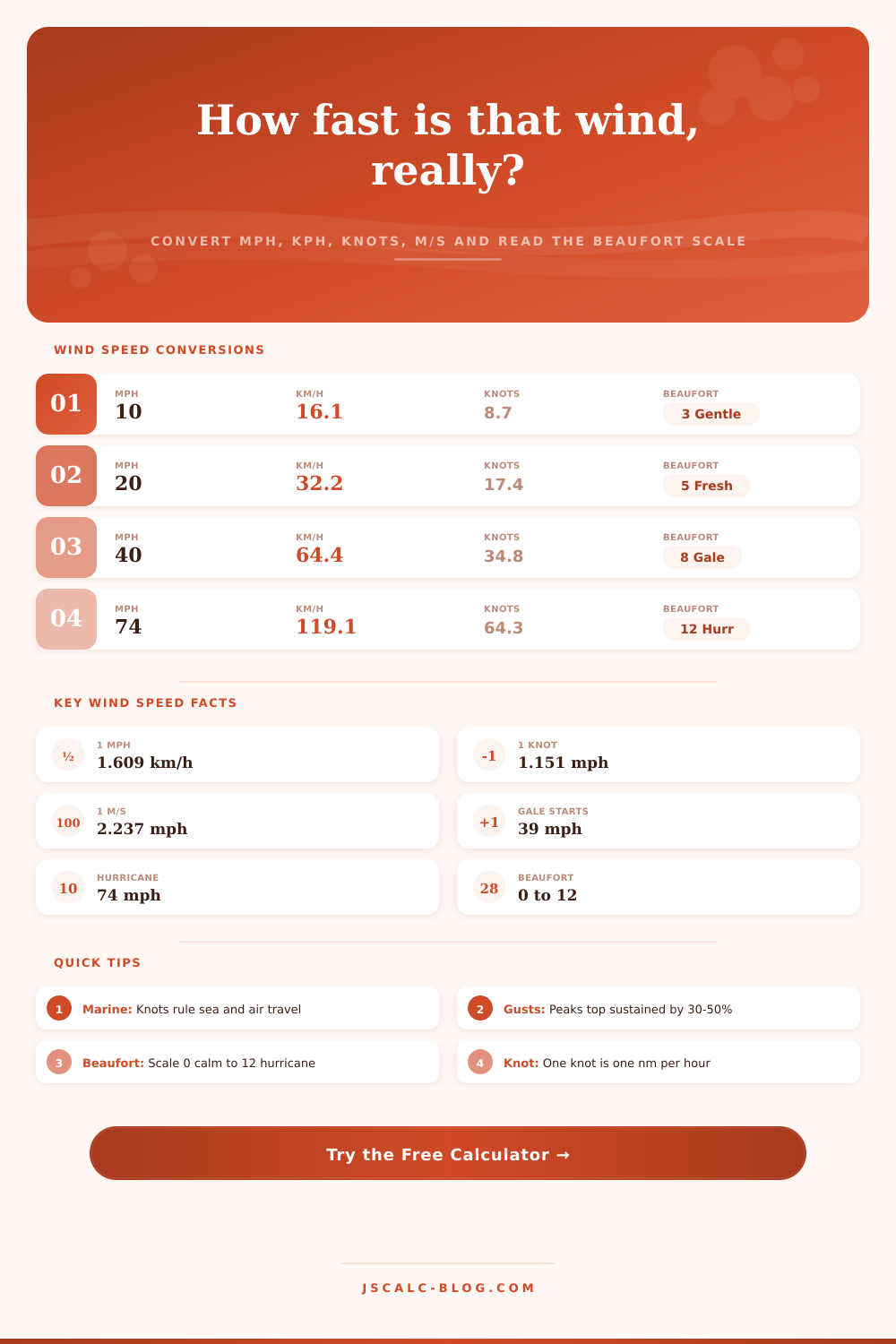
Wind Speed Converter Chart
Convert one wind speed into mph, km/h, knots, m/s, and ft/s, then read the matching Beaufort scale number, its descriptive name, and the land and sea effects that go with it.
🌬Real Wind Scenarios
📝Wind Speed Inputs
Entered in the same unit as the speed above. Leave 0 to skip.
🧭Conversion Factors
🌊Full Beaufort Wind Scale (0 to 12)
| Force | Name | MPH | Knots | KM/H | Land Effect |
|---|---|---|---|---|---|
| 0 | Calm | <1 | <1 | <2 | Smoke rises straight up |
| 1 | Light air | 1–3 | 1–3 | 2–5 | Smoke drifts, vanes still |
| 2 | Light breeze | 4–7 | 4–6 | 6–11 | Leaves rustle, felt on face |
| 3 | Gentle breeze | 8–12 | 7–10 | 12–19 | Leaves and twigs in motion |
| 4 | Moderate breeze | 13–18 | 11–16 | 20–28 | Dust rises, small branches move |
| 5 | Fresh breeze | 19–24 | 17–21 | 29–38 | Small trees sway |
| 6 | Strong breeze | 25–31 | 22–27 | 39–49 | Large branches move, umbrellas hard |
| 7 | Near gale | 32–38 | 28–33 | 50–61 | Whole trees move, walking effort |
| 8 | Gale | 39–46 | 34–40 | 62–74 | Twigs break off, walking impeded |
| 9 | Strong gale | 47–54 | 41–47 | 75–88 | Slight structural damage, shingles |
| 10 | Storm | 55–63 | 48–55 | 89–102 | Trees uprooted, notable damage |
| 11 | Violent storm | 64–72 | 56–63 | 103–117 | Widespread damage, rarely inland |
| 12 | Hurricane | 73+ | 64+ | 118+ | Severe, devastating destruction |
🔄MPH ↔ Knots ↔ KM/H Quick Chart
| MPH | KM/H | Knots | m/s | Beaufort |
|---|---|---|---|---|
| 2 | 3.2 | 1.7 | 0.9 | 1 Light air |
| 5 | 8.0 | 4.3 | 2.2 | 2 Light breeze |
| 10 | 16.1 | 8.7 | 4.5 | 3 Gentle |
| 15 | 24.1 | 13.0 | 6.7 | 4 Moderate |
| 20 | 32.2 | 17.4 | 8.9 | 5 Fresh |
| 30 | 48.3 | 26.1 | 13.4 | 6 Strong |
| 40 | 64.4 | 34.8 | 17.9 | 8 Gale |
| 50 | 80.5 | 43.4 | 22.4 | 9 Strong gale |
| 60 | 96.6 | 52.1 | 26.8 | 10 Storm |
| 74 | 119.1 | 64.3 | 33.1 | 12 Hurricane |
⚓Marine Wind Warnings & Hurricane Categories
| Warning | Sustained MPH | Knots | KM/H | Beaufort |
|---|---|---|---|---|
| Small Craft Advisory | 25–38 | 22–33 | 39–61 | 6–7 |
| Gale Warning | 39–54 | 34–47 | 62–88 | 8–9 |
| Storm Warning | 55–73 | 48–63 | 89–117 | 10–11 |
| Hurricane Cat 1 | 74–95 | 64–82 | 119–153 | 12 |
| Hurricane Cat 2 | 96–110 | 83–95 | 154–177 | 12 |
| Hurricane Cat 3 | 111–129 | 96–112 | 178–208 | 12 |
| Hurricane Cat 4 | 130–156 | 113–136 | 209–251 | 12 |
| Hurricane Cat 5 | 157+ | 137+ | 252+ | 12 |
⚙How The Conversion Works
📋Unit Reference Values
| From 1 unit | MPH | KM/H | Knots | m/s |
|---|---|---|---|---|
| 1 mph | 1.000 | 1.609 | 0.869 | 0.447 |
| 1 km/h | 0.621 | 1.000 | 0.540 | 0.278 |
| 1 knot | 1.151 | 1.852 | 1.000 | 0.514 |
| 1 m/s | 2.237 | 3.600 | 1.944 | 1.000 |
| 1 ft/s | 0.682 | 1.097 | 0.592 | 0.305 |
💡Practical Wind Speed Tips
It’s windy out there. You can feel the air pushing on your face as you step outside; but unless you turn that into some sort of measurement, it remains nothing more than a feeling. On a dry day, it sounds nice, but what about on a day where the wind pick up enough debris to blow across a construction site? Or it sends a sailboat careening around?
Wind is one of those forces we all refer to differently. Some people describe it in knots (pilots). Others describes it in meters per second (meteorologists). Still others describe it in miles per hour (your car dashboard). To go back and forth between these units feels like doing your homework… Except that understanding the difference could mean avoiding poor decision-making in high stakes scenarios.
Understanding Wind Speed Units
You can put in your unit and your speed and let the calculator above do the math for you (no more need to guess at coefficients or flip through tables). It then puts those raw numbers on the Beaufort scale. This scale is older than we might think; it was created in the eighteenth century by Admiral Francis Beaufort, who wanted to standardize how sailors reported sea conditions. But he didn’t have any anemometers. He only had his experience and his eyes.
How were the trees moving? How were the waves forming? And that’s why what comes out isn’t just a number. It’s a description of what is going on. Force zero, smoke rises straight up. Force twelve, roofs lift off and windows shatter. Knowing what force you are in tell you not only how fast the air is moving but also what you should expect to see.
People tend to underestimate units. They anchor you into some sort of context. Nautical miles and knots work well for navigating through the air and on the water. This is because latitude lines provides a natural grid. A knot is 1 nautical mile per hour. It is simple elegance.
Driving around, we’re used to talking about miles per hour, but wind couldn’t care less if you go over your speed limit. The scientific unit is meters per second, based off the International System of Units. And when you look up a weather app that says “m/s,” that’s the language of physics speaking.
The converter connects those worlds without needing you to remember three separate conversion factors at any given time. When it comes to wind, many folks confuse sustained with gusts. That’s expensive. Sustained is the average across a ten-minute period. It’s the steady state. Gusts are short bursts that spike well above that average, sometimes fifty percent or better.
You could of had a gale warning calling for sustained winds of forty miles per hour. But those quick kickers can be way more than that. Most folks don’t realize that. They plan for the average and get blown away by the peak. Always look at the gust potential if you’re heading out on the water or putting something temporary in place. You’ll find that there’s a spot to enter peak and a spot to enter sustained so you can see the whole range of what nature may throw your way.
Even then, there are stronger winds. Winds can exceeds hurricane force. But it reaches twelve on the Beaufort scale and stops. Because once you get to twelve, the destruction is so complete you might as well stop splitting hairs. Whether your house got blown down because it was hit by a hundred-twenty mile an hour wind or one-fifty: it’s still a house that got blown down. Beyond twelve, the Beaufort scale is more about human experience than exact aerodynamics. It’s a scale for how much something gets affected.
At force five, small trees starts to sway. At force eight, twigs start to break. At force ten, entire tree are uprooted. And each level is a leap from the last, not just a leap in mph but in energy. Because while wind speed only goes up by a few mph, wind pressure goes up by the square of the wind. This means a small increase in wind speed equal a huge jump in strength. Wind doesn’t require conversion factors that you have to remember. Just know to respect its effects.
If you like, cross check against the table of reference on the page. But the lesson is in the context. Ten miles an hour as a breeze isn’t anything on dry ground. For a cyclist it’s a headwind, for a drone it’s a tailwind. On open water that produces some good chop. It also makes docking your boat a challenge. The same number has a completely different consequence depending on your location.
But without knowing how to apply those numbers, all of this becomes an abstraction. Do I go outside or not? Is it too windy to launch my drone? Should I tie down the patio furnitures? Now that you can actualy put the wind onto the scale, you begin to see it as a real force that acts in different ways based on who’s taking its measure.
Next time you feel the breeze, put it on the scale yourself before opening the app. Is the smoke standing up straight? Are the trees shaking? Build your intuition by feeling the air and then understanding what the numbers say about it.