Land Area Unit Converter
Convert land and real estate area between acres, hectares, square feet, square meters, square kilometers, square miles, square yards, and regional units. Enter a value or plot dimensions, and every result routes through square meters for accuracy.
📍Common Land Presets
📝Conversion Inputs
Used when method is single area value.
Used only in plot dimensions mode.
🗂Full Conversion Results
| Unit | Symbol | Converted Value | 1 Unit In Sq M |
|---|---|---|---|
| Enter a value above to see every unit converted. | |||
🔢Base Unit In Square Meters
🌐Acre Conversions
| 1 Acre Equals | Value | Unit | Note |
|---|---|---|---|
| Square feet | 43,560 | ft² | Exact by definition |
| Square yards | 4,840 | yd² | 43,560 / 9 |
| Square meters | 4,046.856 | m² | International acre |
| Hectares | 0.404686 | ha | 1 / 2.471054 |
| Square kilometers | 0.004047 | km² | Small fraction |
| Square miles | 0.0015625 | mi² | 1 / 640 |
| Cent | 100 | cent | South India |
| Guntha | 40 | guntha | Maharashtra |
🌾Hectare Conversions
| 1 Hectare Equals | Value | Unit | Note |
|---|---|---|---|
| Square meters | 10,000 | m² | Exact by definition |
| Acres | 2.471054 | ac | 10000 / 4046.856 |
| Square feet | 107,639.1 | ft² | 10000 / 0.092903 |
| Square yards | 11,959.9 | yd² | 10000 / 0.836127 |
| Square kilometers | 0.01 | km² | 100 ha per km² |
| Square miles | 0.003861 | mi² | Roughly 1/259 |
🏡Common Lot Sizes
| Lot / Parcel | Acres | Hectares | Sq Ft | Sq M |
|---|---|---|---|---|
| Suburban home lot | 0.25 | 0.1012 | 10,890 | 1,011.7 |
| Half acre lot | 0.50 | 0.2023 | 21,780 | 2,023.4 |
| Standard acre lot | 1.00 | 0.4047 | 43,560 | 4,046.9 |
| 100 × 150 ft plot | 0.3444 | 0.1394 | 15,000 | 1,393.5 |
| Small farm | 5.00 | 2.0234 | 217,800 | 20,234.3 |
| Large parcel | 10.00 | 4.0469 | 435,600 | 40,468.6 |
| Quarter section | 160 | 64.75 | 6,969,600 | 647,497 |
| One square mile | 640 | 258.999 | 27.88M | 2.59M |
🌏Regional Land Units
| Unit | Region | Sq Meters | Sq Feet | In Acre |
|---|---|---|---|---|
| Cent | South India | 40.4686 | 435.6 | 0.01 |
| Guntha | Maharashtra | 101.171 | 1,089 | 0.025 |
| Ground | Tamil Nadu | 222.967 | 2,400 | 0.0551 |
| Bigha (UP) | Uttar Pradesh | 2,529.29 | 27,225 | 0.625 |
| Katha (Bihar) | Bihar | 126.44 | 1,361 | 0.03125 |
| Are | Metric | 100 | 1,076.4 | 0.0247 |
Regional units like bigha vary widely by state and district (roughly 1,338 to 2,530 m² and beyond). The bigha value here uses the common Uttar Pradesh standard; always confirm the local definition before a transaction.
⚙How The Conversion Works
💡Land Area Tips
What can’t be easily understood by the eye is land area: A fence line might appear normal until you realize it’s on half an acre. This puts your brain into math-anxiety mode, switching off visual estimation and on to something it’s not as good at: measuring land. Instinct isn’t always right when it comes to land measurement.
An acre mean a certain amount of two-dimensional space; what that amount is depends on which system measures it. That’s why measuring systems can throw us for such a loop: There are so many ways to talk about this patch of earth. Americans use square feet and acres. If you visit another country or look at properties outside of the US, you might see square meters and hectares instead.
Why Land Units Are Confusing
A meter here isn’t simply equivalent to a foot there, it’s part of a system of measurement that reflect a different cultural approach to land use. While the acre is an historical relic (what can one ox plough in a day?), the hectare are a tidy metric unit suitable for inclusion in bigger calculations. Land sales often go awry due to confusion about which units is being used.
Plug in your dimensions, and calculator does the math for you. No more tracking down odd conversion factors. You will only find where they came from once you have tracked them down long enough to wonder how anyone would think to come up with such a number. Every result is sent along its way via square meters to ensure accuracy, and also avoids rounding errors at any point during the process that could turn a legal description into a lawsuit.
While there’s no need to remember how many hectares are an acre to get good results out of the tool, being able to understand why that number makes sense goes a long way toward trusting the numbers it spits out. Things get more complicated when dealing with property in South Asia (and other regions) that have a traditional system of regional units. Local listings is filled with terms such as bigha, ground, guntha, and cent…
But each of those has different value from state to state (or even within a single district). In one region, a bigha could be half the size of a bigha in another. That’s why you must standardize what you put into the tool! Before entering any information into the tool, you should know which definition applies to your deed. Otherwise, assuming there’s a universal standard for these older units will result in you buying less land then you paid for.
The other problem with plots is that they have dimensions of length and width, whereas we tend to think about them as areas. Most of us don’t think to multiply our linear measurements to get an area number. We are also not used to thinking about how a change in length scale to a change in area. For instance, if your lot happens to be 100’ by 150’, then we’d expect things to work out easily: it’s just two digits each to add up, right? Except that square footage doesn’t behave like this, it scales different than linear units do.
When we double one dimension, we double the perimeter, but we quadruple the area! That’s why the tool can accepts these dimensions directly, removing that extra step where we would need to multiply things by hand, which inevitably means a higher risk of making an arithmetic error. It is a little thing, but it is significant given how much each square foot contributes to the building envelope.
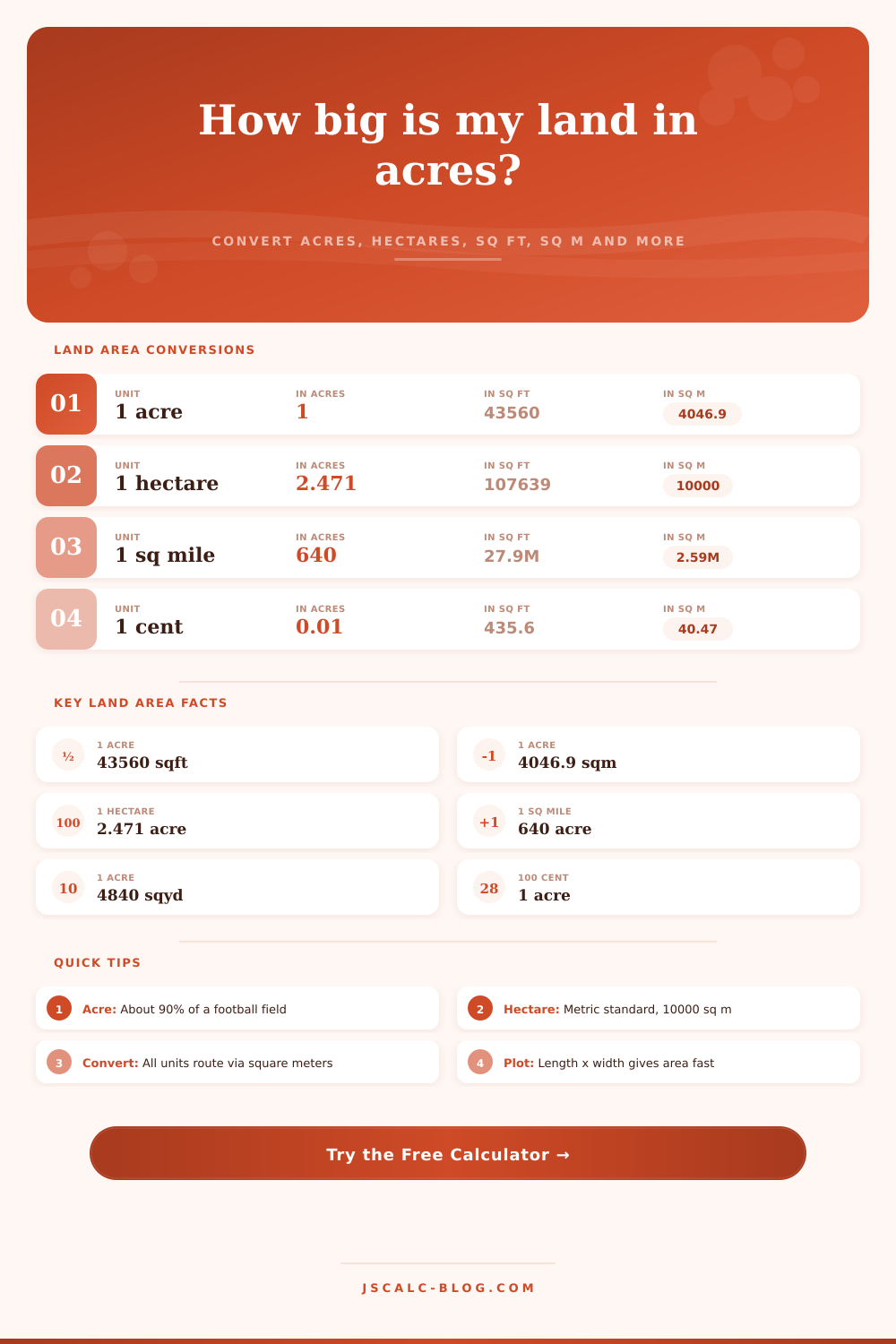
All this can help us visualize these units in two dimensions, and make them more tangible than just numbers in our heads. For example, an acre is equivalent to approximately 90% of an American Football Field (with endzones). That’s a number we can immediately connect with. Hectares are a little bigger at two and a half acres. This should of been easier to wrap your head around if you are viewing land areas like large residential properties or farms. The chart below also shows how fast the numbers gets out of hand once they leave the local-scale (for reference).
Doing unit conversions correctly also saves you money in other ways. How much space can you fit into your back yard before buying that swimming pool? Are there two acre on this farm lot, or four? Converting units correctly makes all the difference between success and disaster.
Do you know why we use the imperial system? Probably not. But do you know why those units can be so confusing? If you don’t, you’ll find out soon enough when the land surveyor shows up and realizes that you’ve built a fence forty feet away from where it should be. The process of converting units matters, but knowing which units you’re working with matters even more.
But stand back one last time in that empty lot. See? You’ve got a sense now of how those units relate to one another, and suddenly the space isn’t a puzzling jigsaw anymore; it’s a clear resource you can really do something with. It’s not about numbers anymore; they fall into place so you’re left to think only about what you’d like to create there.