Absolute Pressure Converter
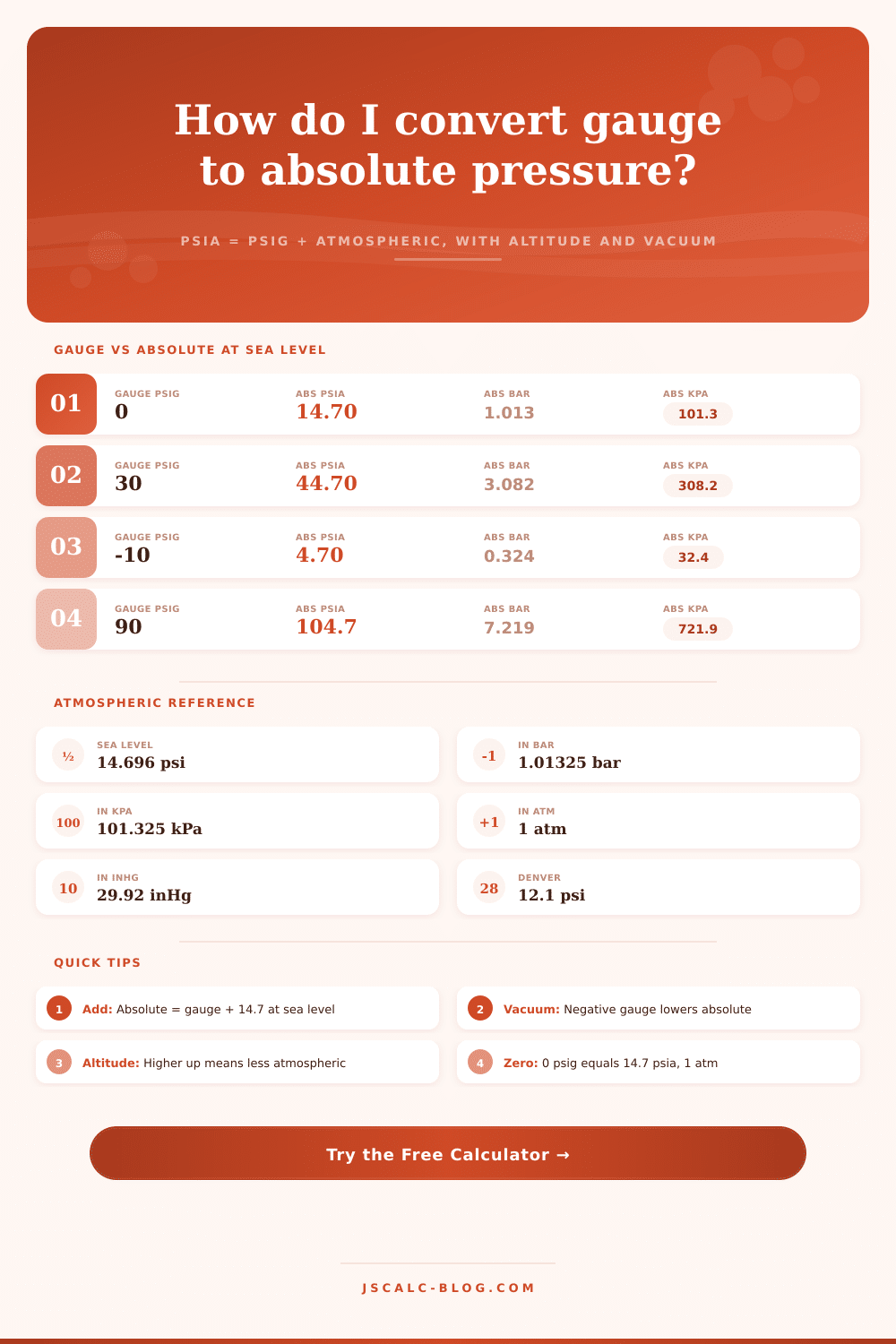
Convert gauge pressure to absolute pressure and back by adding or subtracting the local atmospheric baseline. Handle vacuum readings, altitude, and switch between psi, bar, kPa, atm, and inHg.
🎯Real Pressure Presets
📝Pressure Inputs
Enter a negative value for vacuum when the reference is gauge.
Value uses the atmospheric unit below. Editing switches the preset to custom.
🔢Conversion Snapshot
⚙Full Breakdown
🏔Atmospheric Pressure by Altitude
| Altitude | psi | bar | kPa | inHg |
|---|---|---|---|---|
| Sea level (0 ft) | 14.696 | 1.013 | 101.33 | 29.92 |
| 1,000 ft | 14.174 | 0.977 | 97.72 | 28.86 |
| 2,000 ft | 13.664 | 0.942 | 94.21 | 27.82 |
| 5,000 ft (Denver) | 12.634 | 0.871 | 87.11 | 25.72 |
| 7,500 ft | 11.777 | 0.812 | 81.20 | 23.98 |
| 10,000 ft | 10.911 | 0.752 | 75.24 | 22.22 |
| 14,000 ft | 9.451 | 0.652 | 65.16 | 19.24 |
🔄Unit Conversion Chart (per 1 unit)
| From 1 | psi | bar | kPa | atm | inHg |
|---|---|---|---|---|---|
| 1 psi | 1.0000 | 0.06895 | 6.8948 | 0.06805 | 2.0360 |
| 1 bar | 14.5038 | 1.0000 | 100.00 | 0.98692 | 29.530 |
| 1 kPa | 0.14504 | 0.01000 | 1.0000 | 0.00987 | 0.29530 |
| 1 atm | 14.6959 | 1.01325 | 101.325 | 1.0000 | 29.921 |
| 1 inHg | 0.49115 | 0.03386 | 3.3864 | 0.03342 | 1.0000 |
🗂Gauge vs Absolute Comparison Grid
| Scenario | Gauge psig | Abs psia | Abs bar | Abs kPa | Abs atm |
|---|---|---|---|---|---|
| Full vacuum | −14.70 | 0.00 | 0.000 | 0.00 | 0.00 |
| Strong vacuum | −10.00 | 4.70 | 0.324 | 32.37 | 0.32 |
| Ambient | 0.00 | 14.70 | 1.013 | 101.33 | 1.00 |
| Tire | 32.00 | 46.70 | 3.220 | 321.97 | 3.18 |
| Compressor | 90.00 | 104.70 | 7.219 | 721.87 | 7.12 |
| Boiler | 150.00 | 164.70 | 11.356 | 1135.55 | 11.21 |
| Scuba fill | 3000.0 | 3014.70 | 207.85 | 20785.0 | 205.14 |
💨Vacuum Level Reference
| Vacuum Level | Gauge psig | Abs psia | inHg vac | Notes |
|---|---|---|---|---|
| Ambient | 0.00 | 14.70 | 0.0 | No vacuum applied |
| Light | −2.45 | 12.25 | 5.0 | Gentle suction |
| Moderate | −7.35 | 7.35 | 15.0 | Half atmosphere |
| Deep | −12.28 | 2.42 | 25.0 | HVAC pull-down |
| Near full | −14.21 | 0.49 | 28.9 | 29 inHg gauge |
| Full vacuum | −14.70 | 0.00 | 29.92 | Absolute zero pressure |
💡Practical Pressure Tips
Pressure is what most folks consider to be some sort of number on a dial. They have thirty psi in their tires. Okay, now they got it. But that isn’t actualy the total force on the tire, is it? Nope. All that number say is there are 30 pounds per square inch of whatever is inside the tire. It doesn’t say anything about all the other stuff around it pressing in on it. I am not saying this to pick nits, but it is the difference between measuring something within a system and measuring all the crap that is bearing down on it, even the atmosphere.
Just plug your location into the calculator above and it’s all done for you. This saves you from guessing whether to use fourteen point seven psi or another random number based off what works in your area. You see, atmospheric pressure isn’t always the same. It fluctuate depending on the weather, your location (altitude), and temperature changes. At sea level, standard atmospheric pressure is approximately fourteen point seven psi. Now take it up to somewhere like Denver, which is about five thousand feet above sea level, and that starting point get closer to twelve point six psi. That’s why the tool accounts for that variation so you don’t force sea-level assumptions upon high-altitude reality.
Why Absolute Pressure Matters
This matters because gauge measurements are relative. They compares what’s happening inside a device with the ambient air surrounding it. Zero psig doesn’t indicate no pressure at all. It simply indicates there is no difference between what’s inside and what’s outside the device. By contrast, absolute pressure is measured from a perfect vacuum. This then mean real-world total force is being applied to a surface. So to convert gauge to absolute, you’re really just accounting for that unseen blanket of atmosphere in the equation.
This is why so many folks gets their equipment sizing wrong or try to troubleshoot problems with their system. That logic gets turned upside down with vacuum scenarios. Rather than positive pressure being pushed out, now you have negative (lower) pressure pulling inward different than ambient outdoor air. So maybe your gauge reads negative ten psi, and yes, that’s a lot of suck, but it’s still plenty of pressure within the chamber. Those negative numbers, however, are easily handled by the converter, which simply subtracts them from atmospheric baseline. What you’re left with is a number that tells you how much gas/vapor there actualy is, i.e., not merely how far off from ambient air it is. That can be crucial information for HVAC engineers/technicians who need to know precisely how near they are to true vacuum.
It gets even more complicated with unit confusion. You might be working in inches of mercury, kilopascals, atmospheres, or simply reading in bar. But it’s all just physics. How do we take what we’ve read and translate it from one language to another? If you don’t adjust for the baseline atmospheric level when switching units, you’re gonna get something wrong and that will cascade throughout your whole design project. The other nice thing about the interface is that you can switch from system to system knowing it’ll keep the right offset so converting won’t double count or remove environmental pressure.
Knowing about absolute pressure make it easier to predict how materials act under stress. In practical use, a scuba tank rated for three thousand psi has a hell of a lot more force in absolute terms then just its own gauge reading. It also needs to be strong enough to counteract weight of the water around it. Similarly, accurate absolute calculations is necessary to safely set safety valve openings on an industrial boiler. Otherwise you might have a nasty margin of error if you don’t account for the atmospheric contribution.
It’s a simple idea to wrap your head around, although it does take some practice getting comfortabley with the conversion. The key thing to understand is that internal pressure isn’t only determined by what’s within the container; it’s influenced equally by all the stuff trying to push in from the outside. Once you consider both, you know exactly where you’re at, rather than simply making an educated guess. This additional level of precision turns a vague ballpark figure into a solid engineering fact. You should of known that.