Force to Pressure Converter
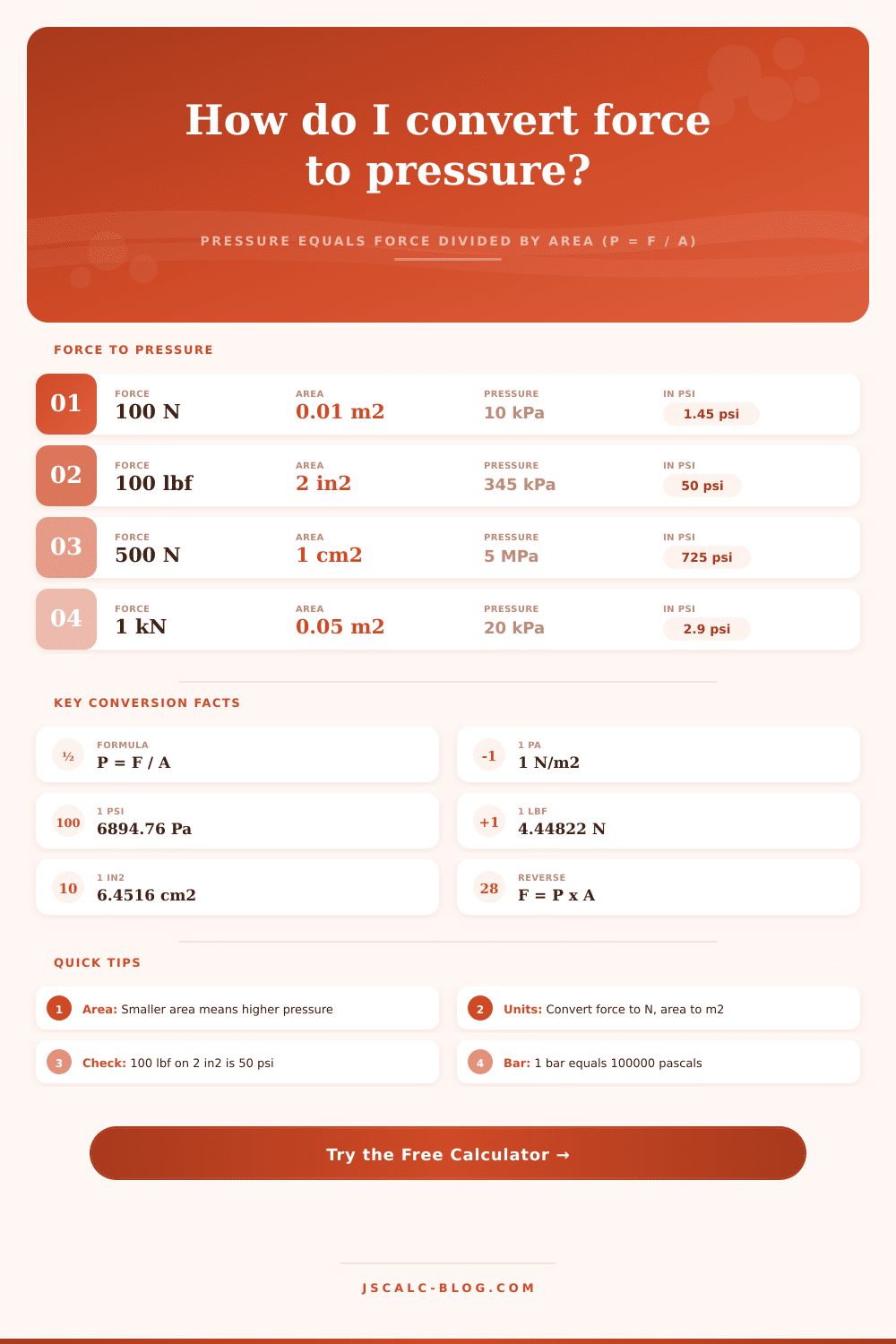
Divide a force by the area it acts on to find pressure using P = F ÷ A. Enter force and area in your chosen units, read the result in pascals, psi, bar, and kilopascals, or reverse it to find force from pressure.
🔩Real Force and Pressure Presets
📝Force, Area, and Mode
Used in forward mode (P = F ÷ A).
Used in reverse mode (F = P × A).
🔢Formula Snapshot
💪Force Unit Conversions
| Force Unit | Symbol | Equals in Newtons | Notes |
|---|---|---|---|
| Newton | N | 1 N | SI base unit of force |
| Kilonewton | kN | 1000 N | Common in structural loads |
| Pound-force | lbf | 4.44822 N | Imperial force unit |
| Kilogram-force | kgf | 9.80665 N | Weight of 1 kg at standard g |
| Gram-force | gf | 0.00980665 N | Small loads and tension |
📐Area Unit Conversions
| Area Unit | Symbol | Equals in m² | Notes |
|---|---|---|---|
| Square meter | m² | 1 m² | SI unit of area |
| Square centimeter | cm² | 0.0001 m² | 1 m² = 10000 cm² |
| Square inch | in² | 0.00064516 m² | 1 in² = 6.4516 cm² |
| Square foot | ft² | 0.092903 m² | 144 in² in one ft² |
| Square millimeter | mm² | 0.000001 m² | Contact and edge areas |
🌡Pressure Unit Conversions
| Pressure Unit | Symbol | Equals in Pascals | Notes |
|---|---|---|---|
| Pascal | Pa | 1 Pa | 1 newton per square meter |
| Kilopascal | kPa | 1000 Pa | Common metric pressure |
| Bar | bar | 100000 Pa | Close to one atmosphere |
| Pound per sq inch | psi | 6894.76 Pa | Imperial pressure unit |
| Atmosphere | atm | 101325 Pa | Standard sea-level pressure |
🗂Force vs Area Comparison Grid
| Scenario | Force | Area | Pressure (Pa) | Pressure (psi) | Pressure (bar) |
|---|---|---|---|---|---|
| 100N on 0.01m² | 100 N | 0.01 m² | 10,000 Pa | 1.45 psi | 0.10 bar |
| 100 lbf on 2 in² | 444.82 N | 0.00129 m² | 344,738 Pa | 50.00 psi | 3.45 bar |
| Foot standing | 700 N | 0.02 m² | 35,000 Pa | 5.08 psi | 0.35 bar |
| Stiletto heel | 500 N | 0.0001 m² | 5,000,000 Pa | 725.19 psi | 50.00 bar |
| Knife edge | 50 N | 0.000002 m² | 25,000,000 Pa | 3625.9 psi | 250.0 bar |
| Car tire contact | 4000 N | 0.016 m² | 250,000 Pa | 36.26 psi | 2.50 bar |
| Shop press ram | 5000 N | 0.005 m² | 1,000,000 Pa | 145.04 psi | 10.00 bar |
| Hydraulic ram | 20 kN | 0.008 m² | 2,500,000 Pa | 362.59 psi | 25.00 bar |
🌍Everyday Pressure Examples
| Example | Approx Pressure | In psi | Why It Matters |
|---|---|---|---|
| Sea-level air | 101,325 Pa | 14.7 psi | Baseline atmosphere |
| Car tire | 220,000 Pa | 32 psi | Typical inflation target |
| Bicycle tire | 620,000 Pa | 90 psi | Road tire pressure |
| Household water | 410,000 Pa | 60 psi | Common supply pressure |
| Adult footstep | 35,000 Pa | 5 psi | Weight over sole area |
| Espresso machine | 900,000 Pa | 131 psi | Standard 9 bar brew |
⚙Full Formula Breakdown
💡Practical Conversion Tips
Consider this: If you press your thumb onto a balloon, you can put your thumb gently on the surface with no problem. Press slightly harder with your thumb and, pop! That same finger now pushes too hard for the latex to handle. Now picture yourself laying down on a bed of balloons. Do they pop? No. You’re putting the exact same amount of force into your body as before, yet something has changed. Instead of having all that force applied to such a small space, it’s spread out across a huge area.
That’s the distinction between pressure and force. Force is simply how much you press. Pressure is what happens when you press that force on a surface. Until we get down to cutting something or holding it together, most consider these terms synonymous. When we need to know if something is going to fail, then the mathematics comes into play. Simply knowing what weight the load might be isn’t enough to determine stress on something. Knowing where the load lands also come into play.
What is Pressure and Force?
With all this math, there’s no need for you to try to match units and wrangle numbers. The calculator up top has the logic built in so it can convert between these types of measurements without causing you any grief. Input your area and force to see all types of stress being applied. These include kilopascals, pascal, bar, and psi.
The basic formula can be written on a napkin: Force/Area = Pressure. But that’s not where the danger lies. The potential for confusion, of mixing up units without knowing it; are the single biggest hazard in DIY and engineering projects alike. For example, you may have measured an area in square centimeters, but your force is known to be in pounds. If you just start plugging numbers into that equation, you’ll get some number that doesn’t mean anything. It looks like math, so it sounds plausible. But its physical meaninglessness gives it away. The trick is to remember that everything you feed into the equation has to speak the same language before they are allowed to chat.
Consider a knife. When it’s dull, it takes a lot of force to cut through a tomato. You must use your entire arm to push downward. With a razor-sharp knife, there’s barely any resistance at all. The blade doesn’t suddenly gain super-strength. Rather, its edge reduces the contact area to something microscopic. Shrinking the denominator in this equation greatly increases the pressure output. With equal force applied, there is great stress on a cellular level. That’s what makes sharp tools effective and blunt tools ineffective.
Think about your feet for a second. In flats, all of your body weight spreads across the full surface area of whatever sole you are wearing. The floor hardly notices it. Strap into a pair of stilettos and suddenly all of that weight pack down onto two very small points. Walking around with heels on feels like walking around on a small truck tire… except its just your heel denting the linoleum floor permanently. The floor doesn’t give a hoot how much weight is pressing down on it. It only knows how hard each point is packing down at any one time.
The reverse is an interesting feature when using the calculator. Sometimes you know your hydraulic system’s max pressure or a seal’s upper limit, but you want to know how strong it is. That comes from reversing the equation, multiplying pressure times the area help define that boundary. That defines where something can be operated safely. The page has a reference table illustrating all of this with everyday examples: A stiletto heel applies thousands of psi; a car tire spreads out the load.
But even just the numbers on the units have a story to say about the places we work and live. A pascal (which is what the scientific world uses) is the measurement of one newton per square meter. It’s abstract until you think: atmospheric pressure is about a hundred thousand pascals. Every second, the air above your head is pressing down on you like this. The force is distributed across all of your skin, which is why our bodies are adapted for it. Apply that exact same amount of force to a tiny square inch and you’re dead in an instant.
So when we talk about the contact patch, understand: This is the shape of the relationship that saves time and materials. The geometry of the contact patch determine the outcome, whether you are tightening a bolt, pumping up a tire, or designing a foundation. Want less force? Lighten the load. It has the same effect but with more area under it. The math doesn’t lie. The math simply asks what you are dividing something by. Be honest about it. Ultimately, it all goes back to the balloon on your thumb. Everything holds together if you spread the load out.