Wholesale Price Calculator
Calculate a wholesale price from unit cost, target wholesale margin, markup, freight, shrink, channel allowances, MOQ, and case-pack rounding. The results show the margin formula, markup formula, actual margin, and order quantity math.
🎯Wholesale Scenario Presets
📝Wholesale Business Inputs
Category presets can update margin, markup, fees, and pack defaults.
Manufacturing, COGS, landed product cost, or buy-in cost.
Use a per-unit freight estimate before setting margin.
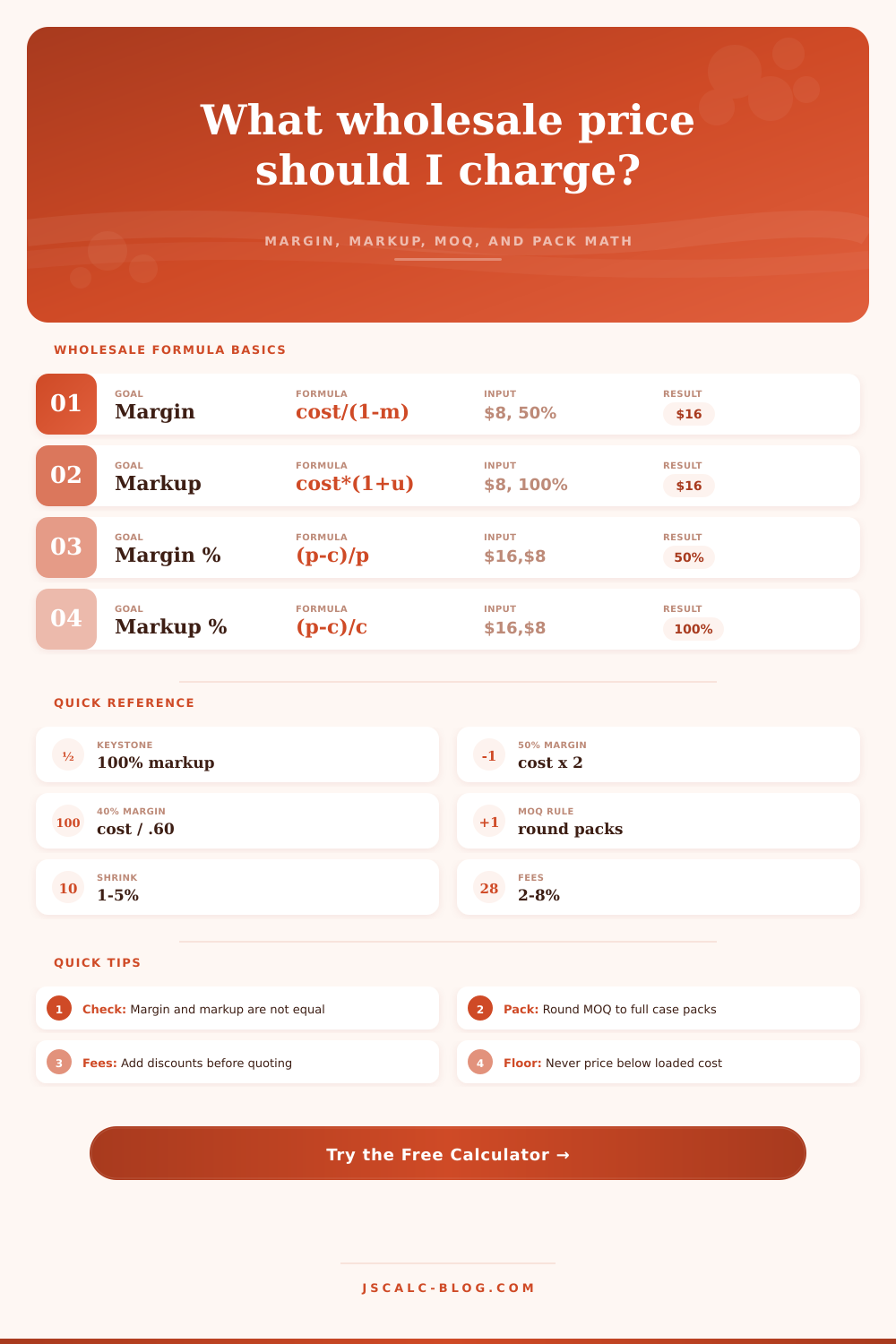
Wholesale price = unit cost / (1 - target margin).
Markup price = unit cost × (1 + markup).
Used when quote basis is manual wholesale price.
Deducted from the invoice price to estimate net realized price.
Card, marketplace, broker, or B2B portal percentage fee.
Adds a per-unit reserve before margin and markup are calculated.
Small sell-in pack, sleeve, bundle, or carton count.
Case pack = units per inner pack × inner packs per case.
The calculator rounds this to a full case pack.
🔢Quote Snapshot
📊Wholesale Category Benchmarks
| Category | Typical Margin | Markup Range | Common Pack | Allowance | Notes |
|---|---|---|---|---|---|
| Beauty / personal care | 45%–55% | 82%–122% | 6×4 case | 3%–8% | Sampling and returns can move the reserve higher. |
| Packaged food | 30%–45% | 43%–82% | 12–24 units | 2%–7% | Shelf life, damage, and slotting allowances matter. |
| Apparel basics | 45%–60% | 82%–150% | Size packs | 3%–10% | Size mix and markdown support often drive the quote. |
| Home goods | 40%–55% | 67%–122% | 2–12 units | 3%–8% | Freight sensitivity is high on bulky products. |
| Gift / stationery | 45%–60% | 82%–150% | 6–24 units | 2%–6% | Display quantities and bundles often set MOQ. |
| Small hardware | 35%–50% | 54%–100% | 50–500 units | 1%–5% | Low unit prices need strict pack rounding. |
| Beverage packs | 25%–40% | 33%–67% | 12–24 cans | 3%–9% | Distributor margin and freight often dominate. |
| Handmade craft | 45%–65% | 82%–186% | 4–12 units | 1%–5% | Labor time should already be in unit cost. |
📐Margin, Markup & Price Comparison Grid
| Loaded Cost | Target Margin | Wholesale Price | Equivalent Markup | Gross Profit | Price Multiple |
|---|---|---|---|---|---|
| $5.00 | 35% | $7.69 | 53.8% | $2.69 | 1.54× |
| $5.00 | 40% | $8.33 | 66.7% | $3.33 | 1.67× |
| $5.00 | 45% | $9.09 | 81.8% | $4.09 | 1.82× |
| $5.00 | 50% | $10.00 | 100.0% | $5.00 | 2.00× |
| $5.00 | 55% | $11.11 | 122.2% | $6.11 | 2.22× |
| $8.00 | 40% | $13.33 | 66.7% | $5.33 | 1.67× |
| $8.00 | 45% | $14.55 | 81.8% | $6.55 | 1.82× |
| $8.00 | 50% | $16.00 | 100.0% | $8.00 | 2.00× |
📦MOQ & Pack Rounding Reference
| Product Type | Inner Pack | Inners / Case | Case Pack | Suggested MOQ | Rounding Rule |
|---|---|---|---|---|---|
| Skincare serum | 6 units | 4 | 24 units | 96 units | Round up to full cases |
| Coffee bags | 12 units | 2 | 24 units | 120 units | Round by roast batch |
| Candles | 4 units | 6 | 24 units | 72 units | Round by fragrance set |
| Apparel tees | 6 units | 5 | 30 units | 120 units | Round by size ratio |
| Snack pouches | 12 units | 4 | 48 units | 192 units | Round by display case |
| Stationery packs | 6 units | 3 | 18 units | 72 units | Round by design set |
| Hardware parts | 100 units | 5 | 500 units | 1000 units | Round by carton |
⚙Wholesale Formula Breakdown
🧾Formula Quick Lookup
| Need To Find | Use This Formula | $8 Cost Example | Watch For |
|---|---|---|---|
| Price from margin | cost / (1 - margin) | $8 / 0.55 = $14.55 | Margin uses price as denominator |
| Price from markup | cost × (1 + markup) | $8 × 1.82 = $14.56 | Markup uses cost as denominator |
| Margin from price | (price - cost) / price | ($16 - $8) / $16 = 50% | Higher price raises margin |
| Markup from price | (price - cost) / cost | ($16 - $8) / $8 = 100% | 100% markup is 50% margin |
| Case pack | inner units × inners per case | 6 × 4 = 24 units | MOQ should fit the pack |
| Rounded MOQ | ceil(request / case) × case | 180 rounds to 192 | Prevents partial cases |
💡Wholesale Pricing Tips
So now you get a call from a retail buyer who wants to know what your price point is for the product, which is made at a cost of eight bucks. Your gut reaction is to double the price and ask $16. That sounds like a nice one-hundred-percent markup. But when you feed that $16 into your margin formula, you realize you’re only earning a margin of fifty percent. And the difference between those two are everything. That is the difference between getting paid and covering overhead.
This is where most first-time wholesaler trip up. They mix up markup with margin, they view them as two words that mean the same thing. In fact, they are two entirely different ways of looking at profit: One is cost-based; the other is sales-based. When you mix up the two, you’ll end up charging a price that appear rock-solid on paper but places you under water.
The Difference Between Markup and Margin
After entering in the data (raw materials + labor), the calculator does all the math for you, it’s the workhorse of the process, saving you from typos that happen when you enter everything by hand into a spreadsheet. Before any thought of profit, it makes you face the full cost of what you are making.
What’s loaded cost? It is not just the fabric or the raw ingredients. It’s the freight that brought those materials to your front door. It’s the shrinkage from damaged units. It’s the reserve needed for samples provided to buyer. If you fail to account for these unseen layers, you’re operating under a fantasy number when it comes to a profit margin. Because this tool embeds them into the beginning, your base price covers the real burden of running a business. That helps avoid the typical error of pricing something based off how it looks without including the four percent distributor allowance or the three percent payment processing fees.
The bottom line: Retail buyers has thin profit margins themselves, so they’re looking at every line item closely. They aren’t out to stomp you. They want to sell product and turn their own inventory as fast as possible. Your number on the quote sheet is your business case. If it’s a bit murky, they’ll believe that your operation is too.
Pricing professionally means knowing more then what a product costs per unit. Case pack rounding and Minimum Order Quantities enter here. Can you really send out 180 units when each of your case packs contains 24? No way. Math gets ugly, and so does your shipping workflow. Here is a table from the page that shows it all. It shows how rounding to the nearest full case simplifies things for everyone involved. It takes an unruly partial order and makes it a clean, predictable shipment.
For example, what’s the difference in selling hardware bolts versus skincare serums? The former might have higher shrink and sampling allowances, while the latter has negligible fees but massive volume requirements. The former may have minimal fees but require large volumes. Using a one-size-fits-all approach to prices is simply a mistake that doesn’t take into account how the category actualy works. To avoid this, understand the markets and physical attributes of each product and adjust your inputs accordingly.
For instance, you may want to set aside more money for shipping a candle because it might break, unlike a stationary box. That adjustment to your percentage changes the loaded cost which then ripples through to your final wholesale price. It’s a minor tweak to the inputs but could of help protect your bottom line big time.
The other aspect of the numbers is psychological as well. Rounding off that last number so that it ends in a zero or a five just sounds more professional than rounding it off to end with a three or a seven. You can use that tool to round off your final unit price, and this is useful in negotiations. It says something about confidence. Quoting some exact jagged number makes it appear you’re nickel-and-diming on the profit. Rounded off cleanly, it shows that you’ve considered the variances and still came away ahead.
At the end of the day, wholesale pricing is built on cost, but it’s also about value. It’s about the quality of your product, the reliability of your service, and the convenience you offer buyers. Price will keep you in business; strategy will take you places. With knowledge of logistics, markup, and margin, you’ll go from guessing to knowing. No longer will you react anxiously to every request from a buyer; instead you can respond with data. Eight dollars won’t be a ceiling, it will be a foundation.
And when we build atop this foundation, we do so precisely, which is what transforms a hobby into a viable wholesale brand. Recall that first price, sixteen bucks? That wasn’t incorrect. But it was incomplete. Now you know how to complete the equation.