Target Profit Price Calculator
Calculate the selling price needed to cover variable costs, fixed costs, and a target profit, then audit margin, markup, break-even units, and fee-adjusted list price.
📌Profit Pricing Presets
🧮Target Profit Inputs
The category sets the interpretation label; the math uses the same target-profit formulas.
Every focus still calculates price, revenue, margin, markup, and break-even outputs.
Use units, seats, servings, tickets, hours, or project deliverables for the same period.
Direct materials, labor, fulfillment, royalties, or payment costs that scale per sale.
Include rent, salaries, setup, software, equipment allocation, or campaign overhead.
Enter the desired operating profit before tax, owner draw, or reinvestment allocation.
Used to audit actual profit, margin, markup, and required units at a known price.
Marketplace fees, card fees, platform fees, commissions, or royalties charged on sales.
Use expected discounting, shrink allowance, rebates, or wholesale deductions from list price.
Rounded values are shown separately so the exact formula remains visible.
Formula breakdown
📊Pricing Snapshot Grid
📋Scenario Comparison Table
| Scenario | Units | Variable/unit | Fixed costs | Target profit | Required revenue | Target price |
|---|---|---|---|---|---|---|
| Results load after calculation. | ||||||
📈Margin And Markup Table
| Measure | Formula | Numerator | Denominator | Current result |
|---|---|---|---|---|
| Results load after calculation. | ||||
🔍Price Sensitivity Table
| Price point | Net price | Revenue | Contribution/unit | Profit | Margin |
|---|---|---|---|---|---|
| Results load after calculation. | |||||
📘Formula And Method Breakdown
💡Target Profit Pricing Tips
The fact is most small business owners don’t begin from a formula; they begin from a feeling. They think about something they’d like to produce. They think about how much they might charge for it. And they think about how much they need to earn at the end of the day (or month).
Margin is what gets lost between these three dots. This happens silently, often because people see fixed costs as just another bill to pay instead of something they actualy need to understand and manage.
How to Set the Right Price
While the calculator above helps with the math (after you estimate your own volumes), it spares you having to guess at conversions and coefficients. But knowing what those numbers represent is where the sweat come in.
What people fail to grasp is that this isn’t about revenue minus materials = profit. Nope. That’s only a fraction of it. When they see the price of the raw materials in a widget, then tack on an extra 20%, they feel like they’ve got a nice markup. What they ignore is that their own salary doesn’t scale based off how many widgets you produce. Neither does insurance, nor software subscriptions, nor rent.
Those are fixed costs, a lump sum that has to be paid back before you have earned a single dollar of profit. You either underprice to overcome this hurdle (working for free) or overprice to clear the hurdle (nobody buys). This balance between these two outcomes is the heart of your pricing strategy.
Variable costs follow each sale; therefore, they are simpler to monitor: Shipping, packaging, direct materials, payment processing fees; those scale in lockstep. Yet those same variable costs has traps within them. For example, while a marketplace commission may appear small expressed as a percent, it’s a bite out of the net price you pocket.
This tool will help show you the fee-adjusted list price (the base price minus any deducts). That difference is important if you’re doing business on marketplaces where someone takes a cut of each transaction. Don’t subtract that cost from what you aim for as profit. Instead, price the fee into the sticker.
All other things being equal, it’s all about volume. You can think about this as: How many units do you expect to sell? In doing so, you’re implicitly determining how much of the fixed costs to put onto each individual item.
If you have high volume, your overhead gets spread thin and you can lower the price per unit. If you have low volume, then each unit has to bear more of the overhead cost. That’s why discounted prices are commonly given if you buy items in bulk. You aren’t losing money by selling at a lower price, you’re lowering the amount of marketing/handling/effort spent on each unit.
The calculator will allow you to plug in different assumptions around the number of units to be sold, which allows you to quickly test how sensitive your price requirement is.
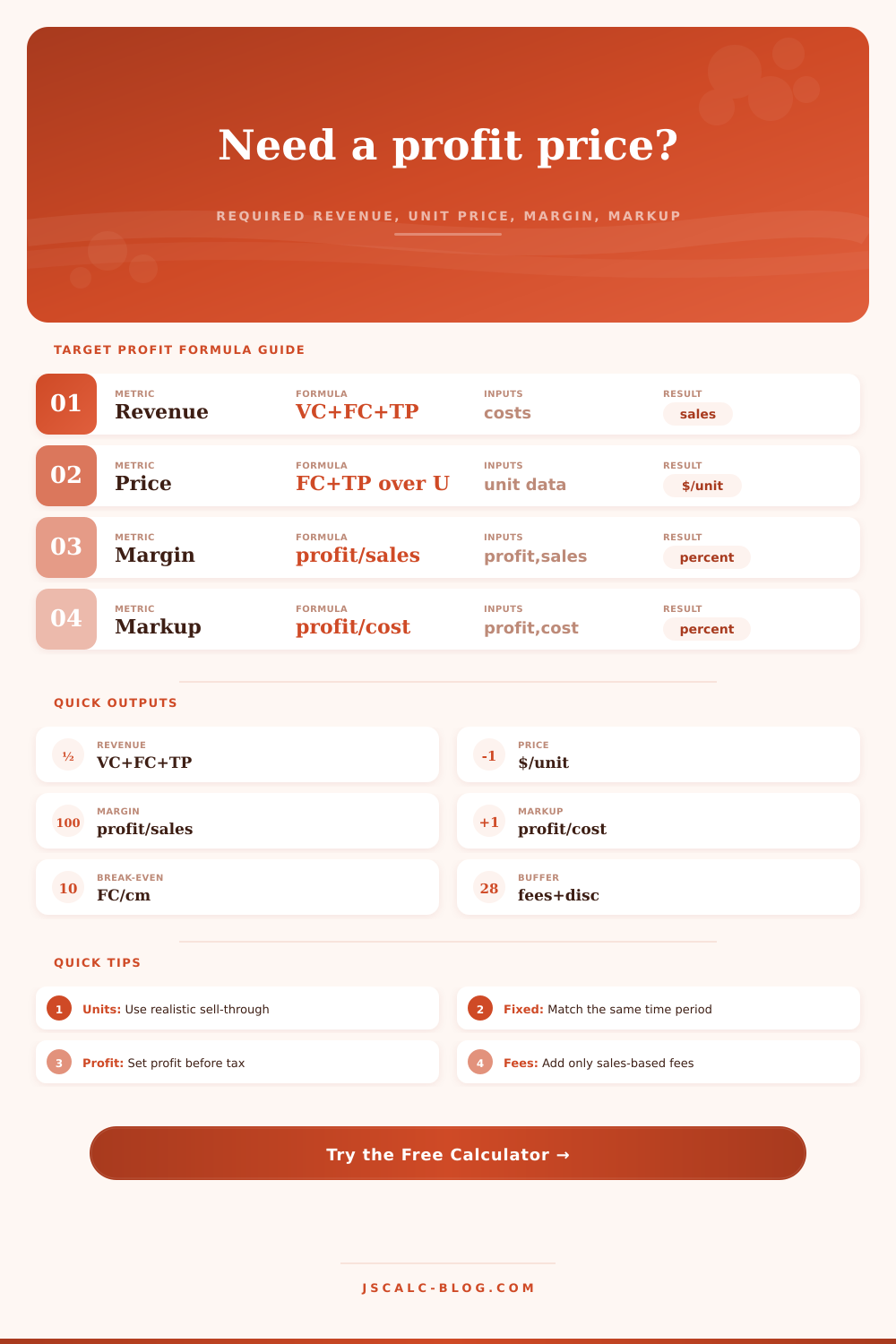
Or, margin vs. Markup. These are both important numbers, but they measure different items. Margin is expressed as a percentage of your total sales price. Markup is expressed as a percentage of your cost. A 50% markup is not the same as a 50% margin. Mixing up these terms will lead to pricing mistakes.
What you’re interested in knowing is what portion of every dollar coming into your bank account remains profit. It is not about what portion I’m adding to the cost of producing it. This is made clear by the breakdown table in the tool, which shows you the numerator and denominator for each number so you can double check the math.
Your estimates then become safe by way of break-even analysis. This shows how many units you must sell in order to pay for everything with no profit whatsoever. Then you know exactly what it would take to make this work.
If it breaks even at five-hundred units, but you believe you will be able to sell eight-hundred, then there’s your price. If it breaks even at nine-hundred, then you’ve got some issues. Either increase the price, reduce the cost, or re-think the product. It takes the emotional decision out of it.
A price isn’t just a number. It’s a formula that changes with platform fees, supplier quotes, and. If you’re lucky, rising consumer demand. Your first pass can be conservative (to capture market share) before tightening the screws when you’ve won over repeat buyers. But always maintain input parity.
If you estimate monthly sales, make sure to match them with your monthly fixed expenses. Balance annual costs against annual projections. Muddle timeframes, and you muck up the math.
Ultimately, price is a promise. It is a promise to support your past investments, current responsibilities and future dreams. The trick isn’t intuitive, it’s understanding the entire cost structure and how much volume there realistically can be together. Those two come together and all of sudden you’re not guessing… You’re creating.