Timesheet Hours Calculator
Enter clock-in, clock-out, unpaid break minutes, rounding method, and overtime threshold to total daily hours, weekly hours, regular hours, overtime hours, and decimal payroll hours.
⚡Timesheet presets
📋Timesheet settings
Optional label used in the breakdown.
This is a planning split, not legal advice.
Adds paid break time back after unpaid breaks are subtracted.
Use for approved edits such as missed punches or corrections.
🕑Daily clock entries
| Day | Worked? | Clock in | Clock out | Unpaid break | Paid credit | Net hours |
|---|---|---|---|---|---|---|
| Mon | 8.00 | |||||
| Tue | 8.00 | |||||
| Wed | 8.00 | |||||
| Thu | 8.00 | |||||
| Fri | 8.00 | |||||
| Sat | 0.00 | |||||
| Sun | 0.00 |
📊Current timesheet comparison grid
📘Rounding method table
| Rounding option | Minute increment | Applied to | Calculator effect |
|---|---|---|---|
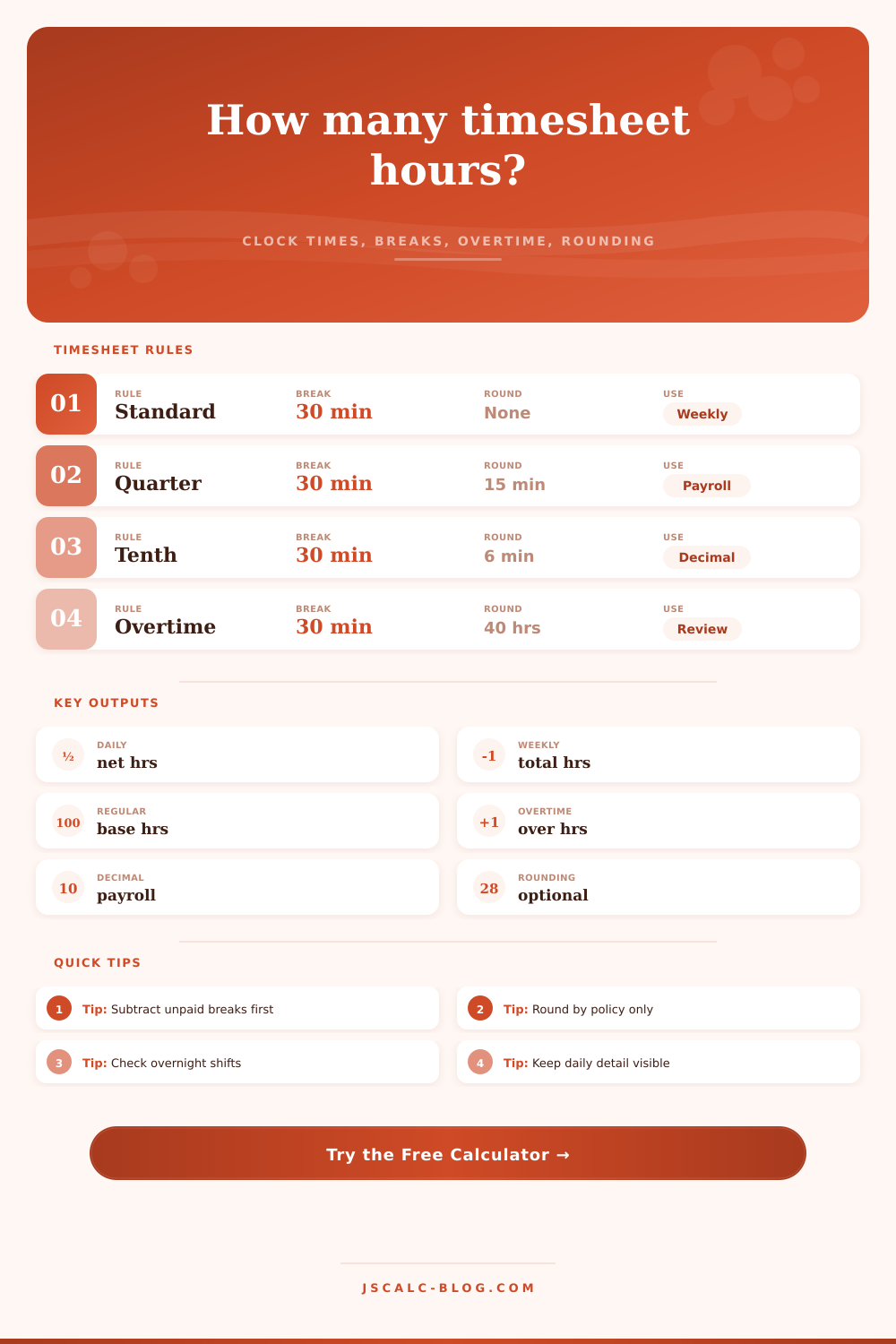
| No rounding | Exact minute | Each workday | Uses raw clock-out minus clock-in minus unpaid breaks. |
| Nearest 6 minutes | 0.10 hour | Each workday | Reports decimal payroll hours in tenths. |
| Nearest 15 minutes | 0.25 hour | Each workday | Rounds each daily net to the closest quarter hour. |
| Round up 15 | 0.25 hour | Each workday | Moves any daily remainder up to the next quarter hour. |
| Round down 15 | 0.25 hour | Each workday | Drops each daily remainder to the lower quarter hour. |
| Nearest 30 minutes | 0.50 hour | Each workday | Compresses small punch differences into half-hour blocks. |
📝Decimal payroll conversion table
| Minutes | Decimal hours | Quarter-hour display | Common timesheet note |
|---|---|---|---|
| 6 minutes | 0.10 | 0.00 or 0.25 by rounding | Useful for tenth-hour payroll systems. |
| 12 minutes | 0.20 | 0.25 if nearest quarter | Small late or early punches become visible. |
| 15 minutes | 0.25 | 0.25 | Classic quarter-hour timesheet block. |
| 30 minutes | 0.50 | 0.50 | Typical unpaid meal break entry. |
| 45 minutes | 0.75 | 0.75 | Long meal break or training split. |
| 60 minutes | 1.00 | 1.00 | One full payroll hour. |
⚙Schedule profile comparison
🧮Formula and audit table
| Step | Formula | Where used | Check before payroll |
|---|---|---|---|
| Daily span | Clock-out minus clock-in | Each worked day | Confirm AM/PM and overnight punches. |
| Daily hours | Span minus unpaid breaks | Daily net hours | Break minutes should not exceed the span. |
| Weekly total | Sum of daily hours | Main weekly card | Include approved manual adjustments only. |
| Regular hours | Total capped at threshold | Regular card | Use the threshold that matches your policy. |
| Overtime | Total over threshold | Overtime card | Review daily overtime rules separately if needed. |
✅Timesheet tips
JSCalc-Blog.com: This timesheet hours calculator totals clock-in and clock-out entries, unpaid breaks, rounding options, weekly overtime splits, and decimal payroll hours for timesheet review.
On a Friday afternoon, perhaps, after realizing you were late for clocking in or took too long for lunch, you become nervous about having messed up and getting less money. Let the timesheet hours calculator do the math for you. Simply input your raw clock times. It converts the minutes into decimals for you, saving you the trouble of doing it yourself when you’re fatigued from work.
Do you want to track payroll time? Or do you want to track actualy time? Payroll time is the time that your boss says she will pay you for. Actual time is the time you arrived at work and the time you departed work. There’s a difference. Depending on how your company chooses to round time up or down, this could matter a lot. Some companies round time down, so if it took you six minutes longer than you were supposed to be working, you get no credit for that time. Some companies round to the nearest quarter hour, so if you are only a few minutes late, that delay becomes nothing. The calculator has an option to toggle from one type of rounding to another. Watch as the dollars is impacted by the difference between actual time worked versus billed time.
Why You Should Use a Timesheet Calculator
The math gets tricky when breaks are involved. Perhaps you work an eight hour shift, but have a thirty minute unpaid lunch, so that only counts as seven and a half hours of billable time. Or maybe your schedule vary or is split up. For example, you go on a twenty minute break in the morning, and again in the afternoon. Before you can do any math about whether you’ve hit the overtime mark, you need to remove those minutes from your overall time. It’s easy to fail to remove the break time, and thereby convince yourself that you hit overtime too soon. That happens all the time.
Many assume they should of count every single hour they work towards regular pay. Then when payday comes around, the payroll system will deduct it from their pay. There’s a lot more to this than just overtime rules. Did you know that many folks think that the magic number is forty hours/week? It turns out that some contracts and some states has overtime rules based off daily numbers. Even though you worked 20 hours all week, if you put in an extra ten on Monday then you’ll be owed overtime for those final two hours. Using the tool, you can set daily and/or weekly overtime rules. That way you know whether you’re getting screwed when you put in long days. This is not a substitute for legal advice. But it will help you see what you should get paid prior to payday.)
Most payroll systems process in decimal hours rather than minutes. That means that 15 minutes is.25 hours; 30 minutes is.50 hours. A six minute late punch? It is about.1 hours. Small numbers, but over a year’s time, it adds up. The calculator will convert your weekly number of hours to decimals for you. If your payroll system demands some precision, you can change the number of decimal places.
It is helpful because it is transparent. Because people don’t want to run the calculations themselves, they tend to trust it (most employees anyway). So when you check what was inputted, you see exactly how much your paycheck gets deducted for breaks and rounding. That helps you better understand your true hourly wage. It converts ambiguous time into concrete money.
You no longer have to guess at the split between regular and overtime hour. Knowing the breakdown protects your sense of wellness. It helps you see if you’re being shortchanged.