Time Rounding to Nearest Increment Calculator
Round a punch time to 5, 6, 10, or 15 minute increments using round, floor, or ceil logic, then test grace periods and payroll impact per punch, pay period, and year.
Grace period compares the actual punch with this anchor.
The core formula rounds this total minute value from midnight.
Used only when custom increment is selected.
If actual time is within grace, the rounded time becomes the anchor.
Used to estimate exact versus rounded shift length.
Rounded time results
Current method and grace period.
Same method without grace override.
Always moves to the prior mark.
Always moves to the next mark.
| Method | Formula step | Behavior | Best audit use |
|---|---|---|---|
| Round | round(total minutes / increment) x increment | Moves to the nearest mark, with half increments rounding up. | Neutral payroll rounding checks. |
| Floor | floor(total minutes / increment) x increment | Always moves backward to the prior increment boundary. | Elapsed-time caps and conservative starts. |
| Ceil | ceil(total minutes / increment) x increment | Always moves forward to the next increment boundary. | Minimum billable block or job ticket rules. |
| Grace | if abs(actual - anchor) is within grace, use anchor | Overrides the rounded mark when the punch is close enough to schedule. | Early or late arrivals near a scheduled start. |
| Actual punch | Raw delta from anchor | Rounded punch | Timestamp change | Payroll minutes |
|---|
| Policy | Increment | Rounded time | Time change | Payroll impact |
|---|
| Volume scenario | Punches per period | Minutes per period | Value per period | Annual value |
|---|
| Increment | Marks in one hour | Common decimal equivalent | Example rounded marks |
|---|---|---|---|
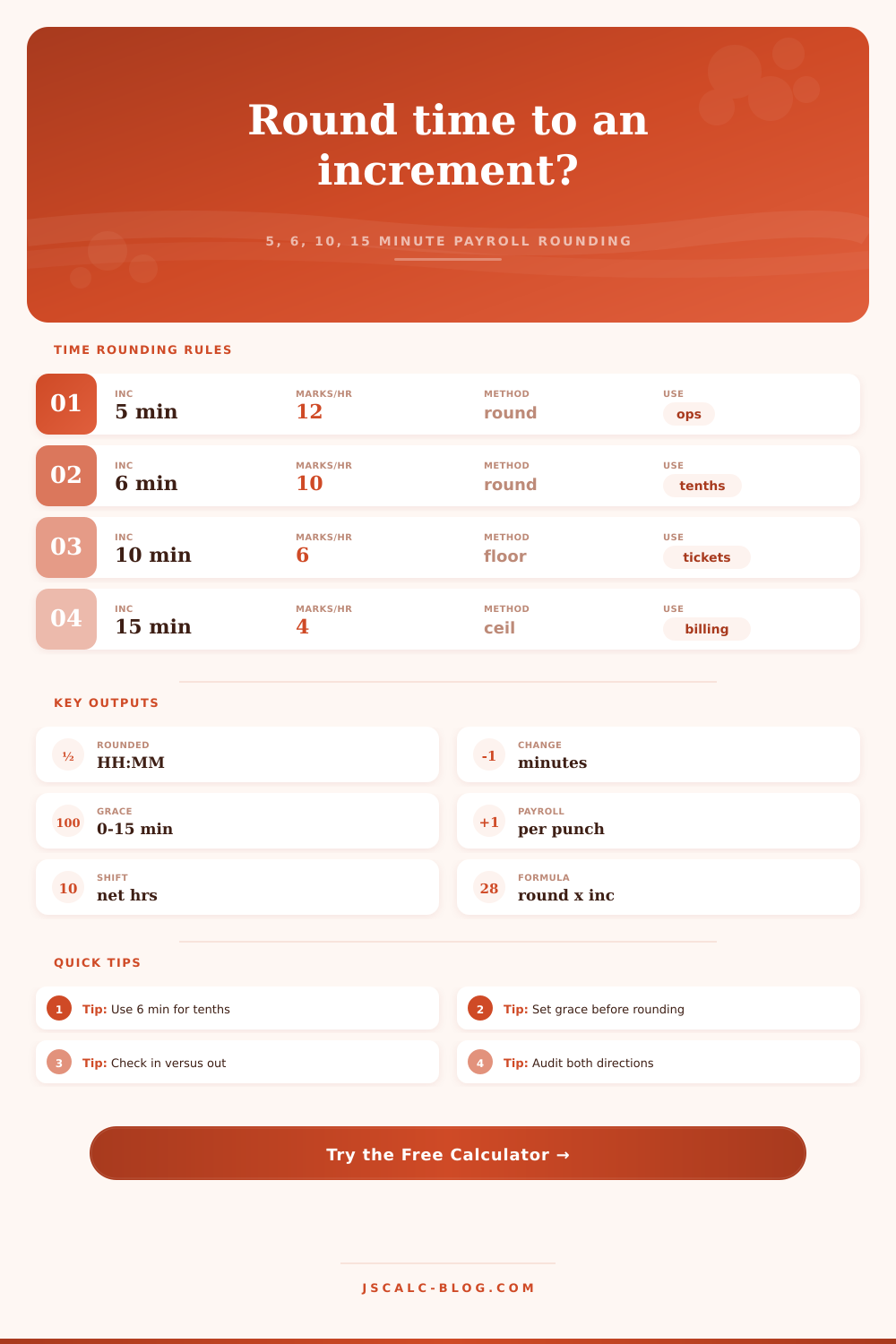
| 5 minutes | 12 | 0.0833 hour | :00, :05, :10, :15 |
| 6 minutes | 10 | 0.10 hour | :00, :06, :12, :18 |
| 10 minutes | 6 | 0.1667 hour | :00, :10, :20, :30 |
| 15 minutes | 4 | 0.25 hour | :00, :15, :30, :45 |
It’s usually over minutes: your company believe they’re within a hair of the quarter hour when you punched in, while you believe they should of rounded down because of something. The margin between a generous payroll practice and an impossibly leaky one can be measured in seconds. This is where time rounding comes in, although in practice it is never quite as straightforward as people imagine.
Time rounding isn’t merely a numbers game; its a math contract between the wallet and the clock. By plugging your increments into this calculator (along with your punch times), it do the math for you. No need to convert or even think of coefficients, which saves you the guessing game.
How Time Rounding Works
But rounding isn’t all about making things look clean; it’s inherently about assigning risk. With an increment of five minutes, you’re slicing up the hour into 12 pieces. With one of 15 minutes, you cut it into four larger chunk. Those larger chunks absorb more variance, which means more money move with each keystroke.
The inputs matter; they set the floor on the argument. Specifically, there is the grace period setting. There is a bit of leeway on when a punch happen so it snaps back to the right time. If it’s within some reasonable range, it effectively ignores the variation. Every second don’t count. That’s what a grace period does; it smooths the noise from human error.
You can dial in the size of that grace period and see how much you’re saving or giving up in terms of money. Does it make your policy more protective? Or do you just have a bunch of extra padding on it?
It’s all about where you put that punch. Clocking in vs. Clocking out is a mirror image of clocking in, but with opposite financial consequence. When you round your clock-in time up to the next increment, you delay when you begin being paid. That’s good for the company, saving them money. When you round your clock-out time up to the next increment, you extend how long until you stop getting paid. That’s bad for the company, costing it more. You could easily forget whose side of the door you’re standing on. With the calculator, you split those tasks into separate roles so you can clearly see the dollar effect of every decision.
The increment selection is what most people screw up on. They choose 15-minutes. It’s familiar from the old-timey time card! But they fail to account for the hidden financial price of familiarity. Six minutes cleanly matches tenth-of-an-hour decimal notation. That matches the digital machinery of moddern payroll systems. That gets you ten ticks per hour (rather than four) and therefore more fine-grained numbers. More precise numbers means smaller rounding errors. So you’re giving up a little admin hassle in exchange for much higher accuracy.
On the page, it explains and shows in the reference table how each one work under pressure. The floor logic is conservative on the start time and aggressive on the end time (it always move backwards to the previous mark). The ceil logic does the opposite; it’s pushing forward to the next mark. Those are not neutral calculations. Those biases is built into the algorithm. And you should know which bias aids your audit trail.
All this gets concrete when I open the tool’s annual sensitivity table. On any given Tuesday morning, one extra minute for a punch doesn’t feel like much. But you can multiply that one minute by ten punches a day, five days a week, and 26 pay periods over a year. Suddenly, that minute shows up as an important line-item entry. It is time’s compounding interest. The tool estimates that annual impact to help you compare the policy with its true cost.
Tradition is not policy. You could have a 15 minute grace period where it doesn’t cost you a dime because, in practice, everyone’s coming in 3 minutes early. It swallows up that habit. A five minute policy might not. It creates extra work and creates tension while yielding no financial benefit.
There’s no need to capture each second of time. We want to create a system that’s fair, defensible, and financially tight. No spreadsheet can replace judgment. It gives you the math; you supply the meaning. Is the potential for higher accuracy within six minutes worth an extra effort to report? Would people find it so unfair that their morale would suffer? How is your culture’s willingness to accept rounding? The digits don’t change, but they do need to be interpreted differently by your culture.
Time rounding is really just accounting in disguise. You’re making a choice about when to draw the line between paid vs. These are unpaid moments. That’s something you need to decide. The calculator will show you where that line is drawn. Mostly, the trick is knowing what you’re measuring.