Cap Table Ownership Calculator
Estimate fully diluted ownership before and after a financing round, including common shares, preferred shares, issued options, option pool, warrants, convertibles, pro-rata participation, and pool expansion.
📌Cap Table Presets
🧮Ownership Inputs
Used only for valuation and investment displays.
Adds a stage label and benchmark context to the output.
Issued common stock, usually founders and early common holders.
Advisor shares, exercised options, or employee common stock.
Existing preferred stock before the new financing round.
Granted equity awards counted in fully diluted ownership.
Available equity plan shares before any pool refresh.
Use as-converted shares for notes, SAFEs, and warrants.
Enter the founder, employee, investor, or grant share count.
Used with fully diluted shares to compute round price per share.
New investor shares = investment divided by price per share.
Enter 0 if no option pool expansion is planned.
Pre-money pool increases dilute existing holders before investor pricing.
Optional new-money participation by the stakeholder being analyzed.
Ownership calculations use the displayed rounding choice.
🔍Comparison Grid
📋Current Cap Table Breakdown
| Security Group | Shares | Pre FD Ownership | Post FD Ownership | Use In Fully Diluted Shares |
|---|
💸Financing Round Table
| Round Item | Formula | Shares or Value | Ownership Impact | Notes |
|---|
📊Scenario Comparison Table
| Scenario | Investment | Pre-Money | Pool Target | Post FD Shares | Stakeholder Post % | Dilution |
|---|
📐Formula Reference Table
📚Cap Table Reference Table
| Item | Usually Included | Pre-Money Effect | Post-Money Effect | Check Before Signing |
|---|---|---|---|---|
| Founder common | Yes | Sets current ownership base | Diluted by pool and new investors | Confirm vesting and repurchase rights |
| Preferred stock | Yes | Counts as converted common | Diluted alongside common | Check conversion ratio and anti-dilution |
| Issued options or RSUs | Yes | Usually counted fully diluted | Remain in post-round denominator | Separate granted from unissued pool |
| Unissued option pool | Yes | May be expanded pre-money | Target post-round recruiting reserve | Negotiate whether expansion is pre-money |
| Warrants and convertibles | Often yes | As-converted shares add to FD base | Can change price and ownership | Model caps, discounts, and warrant coverage |
| New round shares | No before round | Used to price round after PPS | Added to post-money capitalization | Check investment amount and share price |
💡Cap Table Tips
Prior to seeing a term sheet, you usualy think you know exactly what percentage of the company you own. “I’m going to be the 40% owner of the company.” Right before you sign the term sheet, lawyer brings up the concept of fully diluted ownership. That figure slide down a few percentage points. It’s magical! Actualy, it’s an accounting trick.
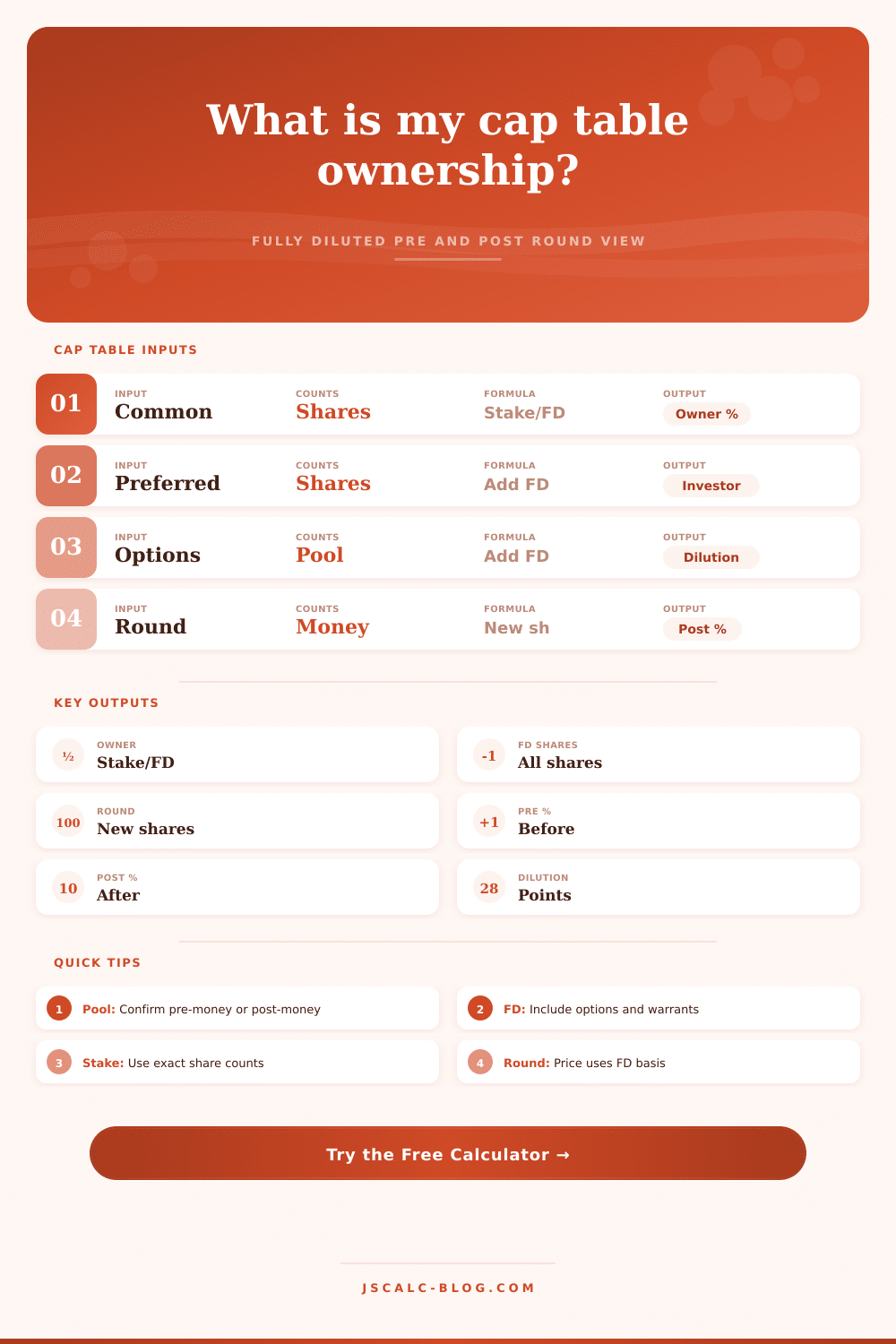
The difference lie in what you count as a share. What does it mean to “own” a share? In general, most early stage founders assumes they “own” whatever common stock has been issued to them and their fellow co founders. They don’t, those are just the shares they already own. Investors, however, price the business according to entire set of potential equity. This includes preferred stock that will convert into common upon exit, convertible notes, options granted to employee, and the reserved option pool for future hires. Those is all shares that might exist one day, so that’s the fully diluted share count.
What Is Fully Diluted Ownership
All that math gets crunched by calculator above, which asks you to plug in your specific share counts for things like common and preferred stock, options, the unissued pool, and warrants to calculate the rest. No need to guess at how many shares will be issued with the next round and then add them all together. It makes you tell the difference between issued and unissued options. That’s an important difference, because the issued options is actually granted to someone. Those options contributes to your dilution as of today. Unissued options are just a waiting pool of awards reserved for yet-to-be-hired employee. Those dilute other holder only when board expands the pool.
Enter in amount raised plus your valuation before investment, and it tell you price per share. That sets number of new shares each investor receives. The greater the number of shares, the higher your dilution rate different than others. The option pool refresh is something investors will commonly ask for prior to writing check. They want the option pool to be increased. If it currently sits at ten percent and expands to fifteen percent. Those new shares is deducted from the pre money capitalization. So the existing shareholders are diluted prior to arrival of investor. This is a subtle but important cost.
You can model whether this pool expansion is pre money or post money in calculator. If it’s pre money, the founders (and any early angels) takes the hit. If it’s post money, then new investor helps share some of the dilution. Your final ownership percentage change as a result of this by a significant amount.
Then there’s pro rata participation. Existing investors may choose to invest more money in order to keep their percentage stake. Their slice stays constant and everyone else’s gets reduced proportionally. No one thinks it’s personal, that’s simply the nature of capital. With the tool, you can include proportional investments and get a true view of post round picture. Otherwise your model depicts a theoretical world which doesn’t correspond based off reality.
Growth lead to dilution. Dilution is the price of growth. You exchange a percentage of your company for market access, talent, and time (speed). The hope is that pie will grow large enough that your smaller piece becomes worth more than larger piece you used to have.
The trick is the number at the bottom (the denominator). Not accounting for convertible notes or warrants mean you’ve overestimated your ownership stake. Forgetting about the option pool means you’ve underestimated the dilution. These numbers represent negotiating power; accuracy count.
Step 1 is to enter existing common, total preferred, and then add in outstanding options and the unissued option pool. Add in any fully diluted shares (i.e., warrants, convertibles). Enter your pre money valuation and enter the new investment amount. You get a result showing what you own before money and after money. Dilution equal the difference.
Play with it. What happens if the valuation comes down? How large does the pool need to be? See the tradeoff instantly. You should of seen that coming.
A cap table is a living document. Each round, each grant, each hire update it. Maintaining accuracy and clarity is not just a box-checking exercise, it’s running the business. What gets measured get managed.
Learning about full dilution is translating abstract legal ideas into concrete numbers you can actualy influence. That is the value of clarity. The map (the numbers on the paper) is not as important than the destination: a funded, viable, founder-aligned company. Don’t forget that moment when your percentage get cut. It’s only the beginning of learning to read the room.