Retail Price Calculator
Set a retail price from landed unit cost, target gross margin, markup, shrink, channel fees, and planned discounts. Compare margin price, markup price, gross margin, and contribution after fees in one pass.
🎯Retail Pricing Presets
📝Retail Price Inputs
Channel presets apply selling fee percentage and fixed per-unit fee.
The invoice or production cost for one sellable unit before freight.
Inbound freight, packaging, prep, labels, and unit handling.
Applied to supplier unit cost before shrink allowance.
Allocates unsellable units across the units that remain sellable.
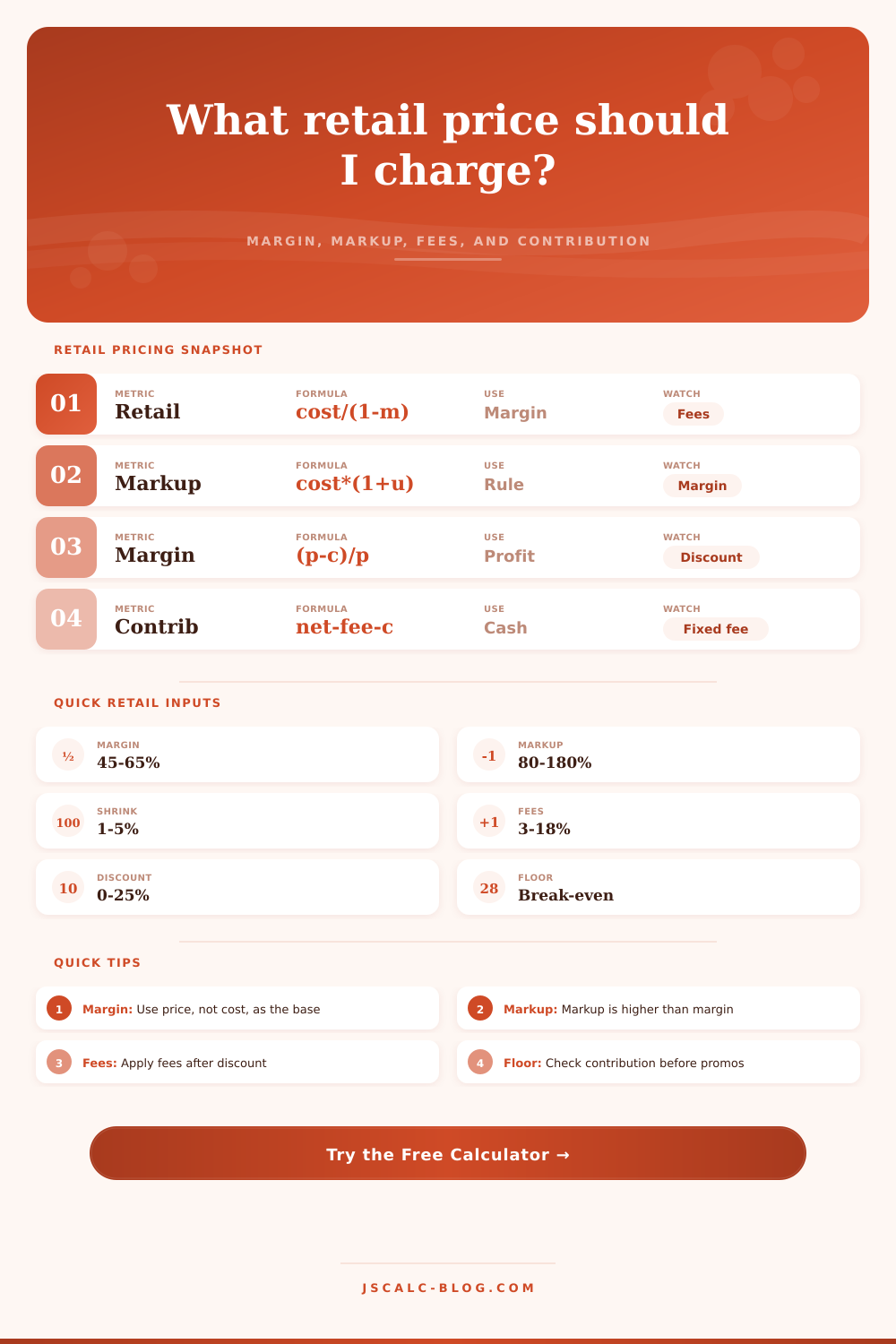
Retail price = landed unit cost / (1 - gross margin).
Markup price = cost × (1 + markup).
Used to test contribution after markdowns and channel fees.
🔢Current SKU Snapshot
📐Margin and Markup Conversion Table
| Target Margin | Equivalent Markup | Cost $10 Retail | Cost $25 Retail | Cost $50 Retail | Common Use |
|---|---|---|---|---|---|
| 30% | 42.9% | $14.29 | $35.71 | $71.43 | Competitive staples |
| 40% | 66.7% | $16.67 | $41.67 | $83.33 | General merchandise |
| 50% | 100.0% | $20.00 | $50.00 | $100.00 | Keystone retail |
| 55% | 122.2% | $22.22 | $55.56 | $111.11 | Premium DTC |
| 60% | 150.0% | $25.00 | $62.50 | $125.00 | Apparel and beauty |
| 65% | 185.7% | $28.57 | $71.43 | $142.86 | High-touch retail |
| 70% | 233.3% | $33.33 | $83.33 | $166.67 | Small batch goods |
🛒Channel Fee Comparison Grid
| Channel | Variable Fee | Fixed Fee | Best Fit | Pricing Pressure | Contribution Check |
|---|---|---|---|---|---|
| Own retail store / POS | 3.0% | $0.10 | In-store basket | Lower online fees | Watch rent outside SKU math |
| DTC website checkout | 3.2% | $0.30 | Owned customer data | Ads and returns | Discounts hit after price |
| Online marketplace | 12.0% | $0.40 | Discovery traffic | Referral fee drag | Set promo floors first |
| Amazon-style marketplace | 15.0% | $3.50 | Fulfilled units | Percent plus fixed fee | Low ASP can compress fast |
| Wholesale-to-retail planning | 0.0% | $0.00 | Retailer MSRP checks | Retailer takes margin | Use landed cost cleanly |
| Specialty grocery shelf | 8.0% | $0.05 | Small consumables | Thin unit pennies | Shrink matters by case |
| Pop-up market / event booth | 4.0% | $0.25 | Bundles and craft goods | Event fees outside unit | Round for cash handling |
| Subscription replenishment | 5.0% | $0.35 | Repeat refills | Retention discounts | Track net price by cycle |
📊Retail Scenario Comparison Table
| Scenario | Cost Pattern | Typical Margin | Markup Range | Discount Guard | Fee Sensitivity |
|---|---|---|---|---|---|
| DTC skincare launch | Medium COGS, high pack | 60%–70% | 150%–233% | 15% max launch promo | Payment fee plus ads |
| Amazon gadget with FBA | Low COGS, fixed fulfillment | 45%–60% | 82%–150% | Coupon floor needed | Fixed fee is material |
| Boutique apparel rack | Seasonal buy risk | 55%–65% | 122%–186% | Markdown ladder | Returns and shrink |
| Specialty grocery jar | Low ticket, case shrink | 35%–50% | 54%–100% | Short promo windows | Pennies matter |
| Handmade Etsy ceramic | Labor-heavy unit | 50%–65% | 100%–186% | Bundle instead | Marketplace fees |
| Imported home decor | Duty and freight heavy | 55%–70% | 122%–233% | Plan freight buffer | Tariffs shift floor |
| Subscription refill SKU | Stable replenishment | 40%–55% | 67%–122% | Retention discount cap | Payment fee repeats |
📈Price Floor Sensitivity
| Shelf Price | After 10% Discount | 12% Fee | $0.40 Fixed Fee | $15 Sellable Cost | Contribution |
|---|---|---|---|---|---|
| $24.99 | $22.49 | $2.70 | $0.40 | $15.00 | $4.39 |
| $29.99 | $26.99 | $3.24 | $0.40 | $15.00 | $8.35 |
| $34.99 | $31.49 | $3.78 | $0.40 | $15.00 | $12.31 |
| $39.99 | $35.99 | $4.32 | $0.40 | $15.00 | $16.27 |
| $44.99 | $40.49 | $4.86 | $0.40 | $15.00 | $20.23 |
| $49.99 | $44.99 | $5.40 | $0.40 | $15.00 | $24.19 |
⚙Retail Price Formula Breakdown
💡Retail Pricing Tips
From the invoice down to the price tag on a shelf is the span of your business. How wide that spread is will be what makes the difference between making money as a retailer, or losing money slowy.
New sellers guesstimate that spread, look at supplier cost on the invoice, then make a best guess about how much they’ll sell it for in store. That’s why most people start with round number (something easy to remember), and cross their fingers.
Why Retail Pricing Is Hard
That doesn’t work out so well, because there are hidden costs. Import duty, marketplace fees, freight charges, and shrinkage all eat away at your gross margin. They all eats into your gross margin before you ever see a dime of profit.
Next it use your raw supplier cost and turns it into the true cost per unit sellable. It factors in the duty rate and the cost of shipping. Then it take into account how much you think you’ll lose on the way to shelf. What if half of your inventory get stolen or damaged during shipment? You can’t ignore that reality if you want your end margin to match what you planned.
Once you understand your true landed cost, its time to figure out what you’ll sell it for, in other words, what will you charge? This is where it matters to understand the difference between margin and markup.
Margin is based off the selling price; markup is based on the cost. And though they sound alike, they’re not the same thing. If you add a 50% markup to $20 product, it becomes priced at $30. Its margin is just 33%. That may be death of any business with thin margins.
A 70% margin calls for a 233% markup. Seems steep, doesn’t it? But if you want to maintain seven-tenths of a dollar for every dollar, then that’s what the math forces you to do. Do NOT confuse markup and margin. Decide which way you plan to work and stick to it.
Contribution margin = Cash Remaining After Variable Costs. Each time you sell a product, somebody cuts you a check for less than your asking price. Platform operators and payment processors all cut in on your action. Even worse, some has a fixed handling cost per unit, whether it sells for $10 or $100.
With this tool, you can play with promotions and see how they impact the price. Looks like nothing, right? 10% off sounds nice! But when you subtract fixed handling costs and variable fees at the new lower price point, the contribution could go away. Or worse, you might sell enough units to cover your variable cost but lose out on your fixed overhead. Ouch. That’s the trap. Move volume, but lose cash.
The math is very different depending on the distribution channel. DTC means lower variable fees (but higher customer acquisition). Wholesale = no selling fee, but must sell for less then retail. Amazon-like channel = huge reach (but super-high fees that squashes your margin if you’re just charging $10 for something).
This is where the comparison grid helps highlight those trade-offs. If a given item will make it through fixed fees, then it’s likely because it’s a high-ticket item. But if you’ve got low-cost accessory, good luck.
You need to see net price, after fees and discounts. Then the truth come out. But pricing isn’t just math; it’s a statement of value.
Underpriced? You’re telling people they shouldn’t spend as much, which means you’re not worth it, and you’ll get in a price war. Overpriced without explanation? People won’t buy, and you leave money on the table or fail to enter the moddern marketplace at all.
Your floor is the lowest price you can charge to cover your costs. Don’t sell below this number. Then you add up from there: How much will customers be willing to pay? How strong is your brand?
The tool structures this for you, making sure the math works out. It eliminates guessing so you can think strategically. Yes, that requires you to determine how much value you can capture. But now you know exactly what it costs to stay lit.
Price so that you cover all of your hidden costs and have wiggle room to grow. You should of seen that a line item becomes a business.