Weighted GPA Calculator
Calculate weighted GPA from grade points, course credits, AP, IB, honors, dual enrollment, custom boosts, cap options, current transcript GPA, and target planning.
Use A-, 91, 3.7, P, or mixed entries by course.
Base grade points are converted before honors or AP boosts.
Most 5.0 systems cap each AP or IB course at 5.0.
Use 5.0 for common weighted GPA scales.
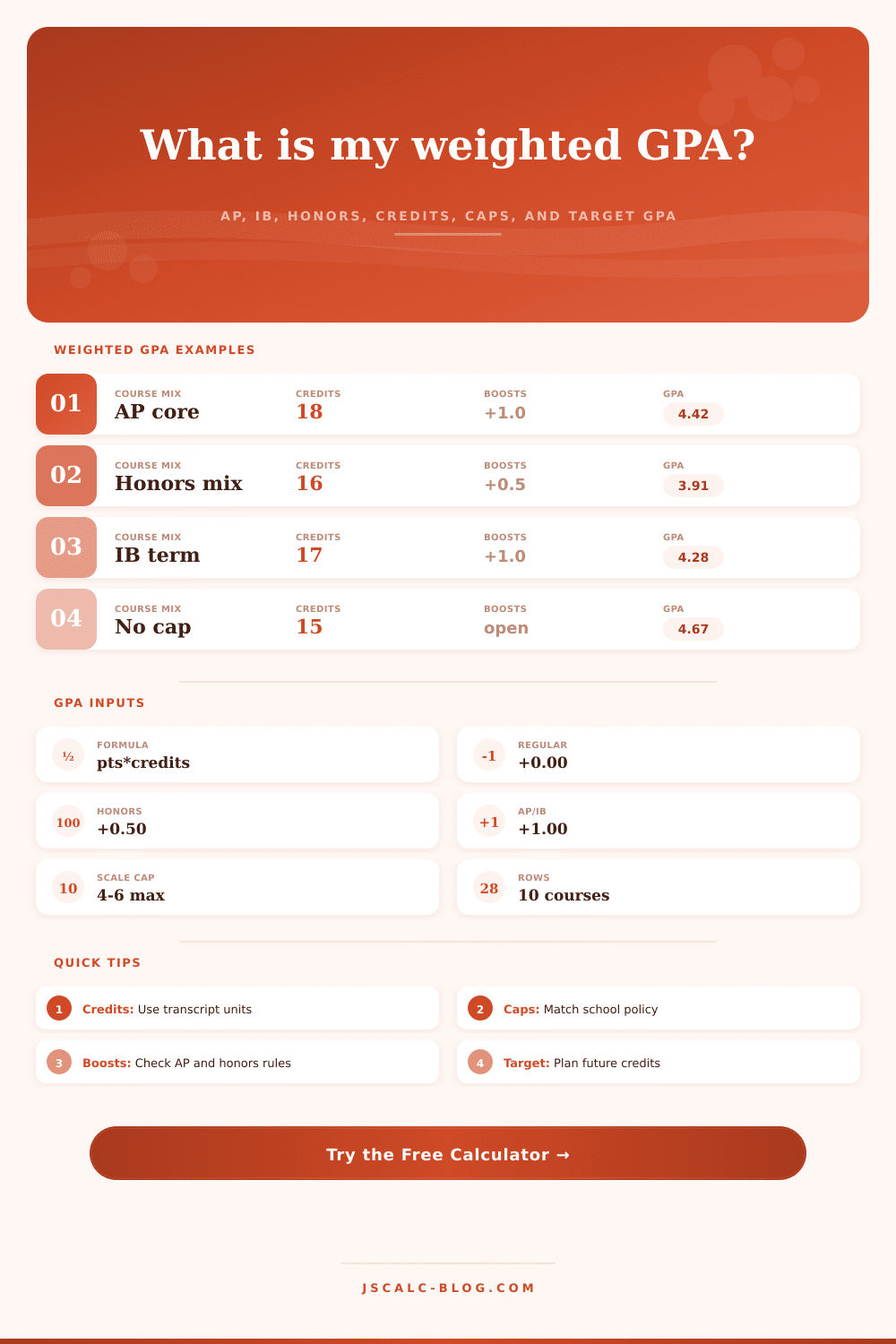
Common value is +0.50 above base grade points.
Common value is +1.00 for AP and IB courses.
Set to 0 if your school leaves college courses unweighted.
Use the decimal precision shown on your transcript.
Use 0 with 0 current credits for a term-only result.
Use credits already included in current weighted GPA.
The target card estimates the future average needed.
Credits planned after the courses entered below.
| # | Course label | Grade | Credits | Level | Custom boost | Base pts | Weighted pts | Quality pts |
|---|---|---|---|---|---|---|---|---|
| 1 | ||||||||
| 2 | ||||||||
| 3 | ||||||||
| 4 | ||||||||
| 5 | ||||||||
| 6 | ||||||||
| 7 | ||||||||
| 8 | ||||||||
| 9 | ||||||||
| 10 |
| Course | Grade | Credits | Level | Base pts | Boost | Weighted pts | Quality pts |
|---|---|---|---|---|---|---|---|
| Enter courses and calculate to see the weighted GPA breakdown. | |||||||
| Course level | Typical boost | A result | B result | Common cap | Use when |
|---|---|---|---|---|---|
| Regular | +0.00 | 4.00 | 3.00 | 4.00 or 5.00 | Standard grade-level courses. |
| Honors | +0.50 | 4.50 | 3.50 | 5.00 | District honors or pre-AP classes. |
| AP | +1.00 | 5.00 | 4.00 | 5.00 | Advanced Placement courses. |
| IB | +1.00 | 5.00 | 4.00 | 5.00 | IB HL or weighted IB courses. |
| Dual enrollment | +0.50 to +1.00 | 4.50 to 5.00 | 3.50 to 4.00 | 5.00 | College courses on high school transcript. |
| Custom | Entered row value | By row | By row | Selected cap | Published school-specific policies. |
| Percent range | Letter | Standard pts | No plus/minus pts | A+ scale pts | AP weighted example |
|---|---|---|---|---|---|
| 97-100 | A+ | 4.00 | 4.00 | 4.30 | 5.00 with cap |
| 93-96.99 | A | 4.00 | 4.00 | 4.00 | 5.00 |
| 90-92.99 | A- | 3.70 | 4.00 | 3.70 | 4.70 |
| 87-89.99 | B+ | 3.30 | 3.00 | 3.30 | 4.30 |
| 83-86.99 | B | 3.00 | 3.00 | 3.00 | 4.00 |
| 80-82.99 | B- | 2.70 | 3.00 | 2.70 | 3.70 |
| 77-79.99 | C+ | 2.30 | 2.00 | 2.30 | 3.30 |
| 73-76.99 | C | 2.00 | 2.00 | 2.00 | 3.00 |
| 70-72.99 | C- | 1.70 | 2.00 | 1.70 | 2.70 |
| 60-69.99 | D range | 0.70-1.30 | 1.00 | 0.70-1.30 | 1.70-2.30 |
| 0-59.99 | F | 0.00 | 0.00 | 0.00 | 1.00 before caps if boosted |
| Method | Where cap applies | Formula detail | Best match | Watch for |
|---|---|---|---|---|
| Per course | Each course | min(base + boost, cap) x credits | Most 5.0 high school GPAs | A+ plus AP may still stop at 5.0. |
| Final GPA | Term average | min(sum weighted quality / credits, cap) | Policies that cap transcript term only | Course rows can exceed the cap. |
| Both | Course and term | Course cap first, final cap second | Very strict published policies | Usually same as per-course at 5.0. |
| No cap | None | (base + boost) x credits | Scenario testing and custom scales | May exceed official transcript limits. |
| Target average | Future credits | needed quality / planned credits | Planning next terms | Impossible if needed GPA is above cap. |
The typical high schooler views his or her GPA as a mindless average. An “A” in advanced calculus equals an “A” in biology, end of story. That’s almost always the wrong approach to building a college application plan.
Admissions officers consider context, and weighted GPA is intended to reflect it: Harder courses is valued over easier ones. The GPA calculator do all this math for you. No need to waste time figuring out complicated credit + boost/cap interactions (just worry about your strategy).
Why Weighted GPA Matters for College
But that’s the trick: the system is simple, yet its simplicity can be deceptive. You start with a base grade point, usually on 4.0 scale. Add bonus points for advanced classes, such as Advanced Placement or Honors courses. An A in a regular class stays a 4.0, while an A in an AP class might jump to a 5.0. The plus-one is your compensation for taking the risk.
Over time, that little one-point margin accumulates across four years of high-school life. When push comes to shove, and you have to choose between taking an easy course where you’re certain to earn an A, or taking a challenging one where you’ll probably end up with a B, the weighted system tends to encourage people to take hard road. After all, even a B in an AP class typically beats out an A from a regular course. Taking the plunge pays off; in numbers.
First things first: Know what your school’s policies are. Not all districts follows a 5.0 scale. Some limit weighted grades up to 4.5, others have wild multipliers on dual enrollment or IB courses. You can set these multipliers/limits within the tool based off the actual policy of your transcript. Using an incorrect multiplier will result in a fictional (not factual) projection of your GPA.
For instance, dual enrollment class weights varies widely by district. Ask your counselor or check your student handbook exactly how they’re weighted. Some do not weight them at all. Others view them as Honors, while others view them as AP.
And then there’s the issue of credits. Seniors takes this four-credit monster called “senior thesis” that impacts their GPA twice as much than their other one-credit electives do. Every class is weighted by its number of credits, as colleges do when calculating your term average. So your goal should of be to guard against low grades in high-credit classes in the major, rather than fretting too much about getting a B in a low-credit elective course. Let’s get a B in art and an A in math if the math class has more credits.
Math doesn’t give a hoot whether or not you like it; it cares only what numbers you shovel into it. Most students gets hung up on planning for the future. How do I raise my GPA? Can I get into X college with my current standing?
The app has a projection feature which shows you what cumulative GPA you’ll need over the next few semesters to meet a desired number. It is useful for setting realistic goals. If it says you’d need a higher grade than you’re capable of getting (given your school’s caps), then you know your goal isn’t attainable. You save yourself time chasing after an unattainable number. Rather, you shoot for the best that you can.
Finally, remember that your GPA is only one piece of the puzzle. Admissions officers look at your transcript as a whole. They’re aware of how hard you work, the pattern of your grades, and your level of commitment outside of school. An unchallenged, perfect weighted GPA isn’t as compelling than a slightly lesser GPA with a full plate of AP classes.
Think of it as a road map, use it to plan your academic path, but don’t let it become a measure of who you are or how you feel about yourself. Strive to improve, enroll in classes that intrigue you, and know that getting a good GPA is a way to reach a goal, not the destination itself.
It is simple math. Strategy take some consideration.