Simple Interest Loan Calculator
Calculate simple interest with I = P x r x t, maturity value, daily and monthly accrual, day-count basis, APR notes, and optional payment credits on JSCalc-Blog.com.
📌Choose a loan preset
Each preset fills a real-world simple-interest note. You can edit every field before calculating.
📝Loan inputs
The face amount of the note before any upfront principal credit.
Use for down payment, rebate, or immediate principal reduction.
Does not change I = P x r x t unless you choose to finance it in principal.
Day-count basis changes t when a note defines a year differently.
Many notes apply payments to accrued interest before principal. Confirm your note.
Simple interest estimate
The base result uses I = P x r x t. Payment credits are modeled separately on a simple daily accrual timeline.
📊Live loan metrics
Original principal after upfront credit.
Year fraction used inside I = P x r x t.
Principal times annual rate divided by 12.
Approximate annualized cost after entered fees.
Total scheduled credits during the modeled term.
📅Payment-credit timeline
This table applies simple interest between payment dates, then applies each credit using the selected payment rule. It is a planning model, not an amortized compound-interest schedule.
| Event | Day | Start principal | Interest accrued | Credit applied | Principal paid | Ending principal | Accrued interest left |
|---|---|---|---|---|---|---|---|
| Calculate to see payment credits against simple-interest accrual. | |||||||
🧾Formula and day-count breakdown
| Method | Time factor | Daily interest | Total interest | Maturity value | Best used when |
|---|---|---|---|---|---|
| Run the calculator to compare day-count methods. | |||||
📐Simple-interest reference tables
| Day-count option | Formula for t | Example: 180 days | Interest effect | Typical note wording |
|---|---|---|---|---|
| Actual/365 | Actual days / 365 | 0.4932 years | Standard calendar-year estimate | 365-day year or actual/365 |
| Actual/360 | Actual days / 360 | 0.5000 years | Slightly higher daily charge | Bank basis or commercial note |
| Actual/366 | Actual days / 366 | 0.4918 years | Leap-year daily adjustment | Leap year or actual/actual proxy |
| 30/360 | 30-day months / 360 | 0.5000 years | Standardized month count | Each month treated as 30 days |
| Months/12 | Entered months / 12 | 6 months = 0.5000 | Good for whole-month terms | Monthly simple-interest note |
| Rate | $5,000 for 90 days | $10,000 for 180 days | $25,000 for 1 year | $50,000 for 2 years | Daily on $10,000 |
|---|---|---|---|---|---|
| 5% | $61.64 | $246.58 | $1,250 | $5,000 | $1.37 |
| 8% | $98.63 | $394.52 | $2,000 | $8,000 | $2.19 |
| 10% | $123.29 | $493.15 | $2,500 | $10,000 | $2.74 |
| 12% | $147.95 | $591.78 | $3,000 | $12,000 | $3.29 |
| 18% | $221.92 | $887.67 | $4,500 | $18,000 | $4.93 |
💡Simple interest tips
This JSCalc-Blog.com calculator is for planning simple-interest loans. It is not a lender disclosure, legal advice, tax advice, or a substitute for your signed note.
The loan agreement is simple: you borrow money; the lender gets their cut. Remove the fine print, which typically clouds this fact, and that’s all there is to understand.
When the interest rate is “simple,” it appears easy, you have the rate, the principal amount, and the time span. Just multiply. It looks like third-grade arithmetic! But there’s always a catch.
How to Understand Simple Interest Loans
And almost never does the catch involve math. The catch involves your definition of time. A year, a year: everybody thinks it’s a year. But it’s not. At least, not in the world of loan notes. Some lenders has a 365-day year; some, a 360-day year. And then there are those who adjust for leap years.
It all sounds like an obscure accounting detail, but it makes a difference in the price per day of your debt. On a 365-day year, your daily rate of interest is lower than on a Actual/360 basis. To see what happens when you change day-count conventions, choose one in the calculator above and let it do the math. Because that variable is taken into account rather than ignored, it will save you money over the term of your loan.
The formula for interest is principal times rate times time. That’s the simple equation (I = P x r x t). It is simple and elegant. The tool use that equation for whatever inputs you provide; whether they’re a short term bridge loan or a two year personal note.
It figures out your total interest payments. It then adds up the interest and shows you the maturity value, which is the total amount owed on the day it comes due. You know that dollar figure from day one and there’s no sticker shock because you’ve seen the total amount you owe on the due date.
Another twist on simple interest catches borrowers off guard: payments don’t immediately lower their principal. Instead, they often apply first to the interest accumulated from previous month’s payment. Then it chips away at the remaining balance using the remainder of your check. This impacts cash flow planning, as sending an insufficient payment will simply delay the day when you’ll start shrinking the principal. You’re no longer reducing the debt at all.
Our tool accounts for this… Allowing you to select whether you want payments to be applied to interest or principal. That way you can track precisely how much of every payment is going toward interest, and how much goes toward reducing the debt.
This is where APR comes in: The APR tries to represent the whole story, not just the cost of the money (which is what the simple interest rate is), but also all the fees associated with the loan. For example, suppose a lender has a low stated interest rate but also charges you an origination fee. That fee raises your effective borrowing cost; so how does it affect you?
There’s a place on the calculator for those fees. And it lets you see how the real annualized cost compares to the headline rate. When you’re shopping around for loans, that allows you to shop apples-to-apples. Maybe you’re okay with a slightly higher stated rate as long as the fees are lower and this tool can help make that trade-off clear.
Because the interest is calculated based off the outstanding balance each and every day, this is a strong idea for getting out early, you can see how much interest you avoid by paying off the loan sooner. Paying down your loan early also means saving money. Each additional dollar you pay toward the principal means less interest building up over time. This tool allows you to input an early payoff date (or add some extra payments) and it will show you the actual amount of interest saved. It makes the abstract savings concrete.
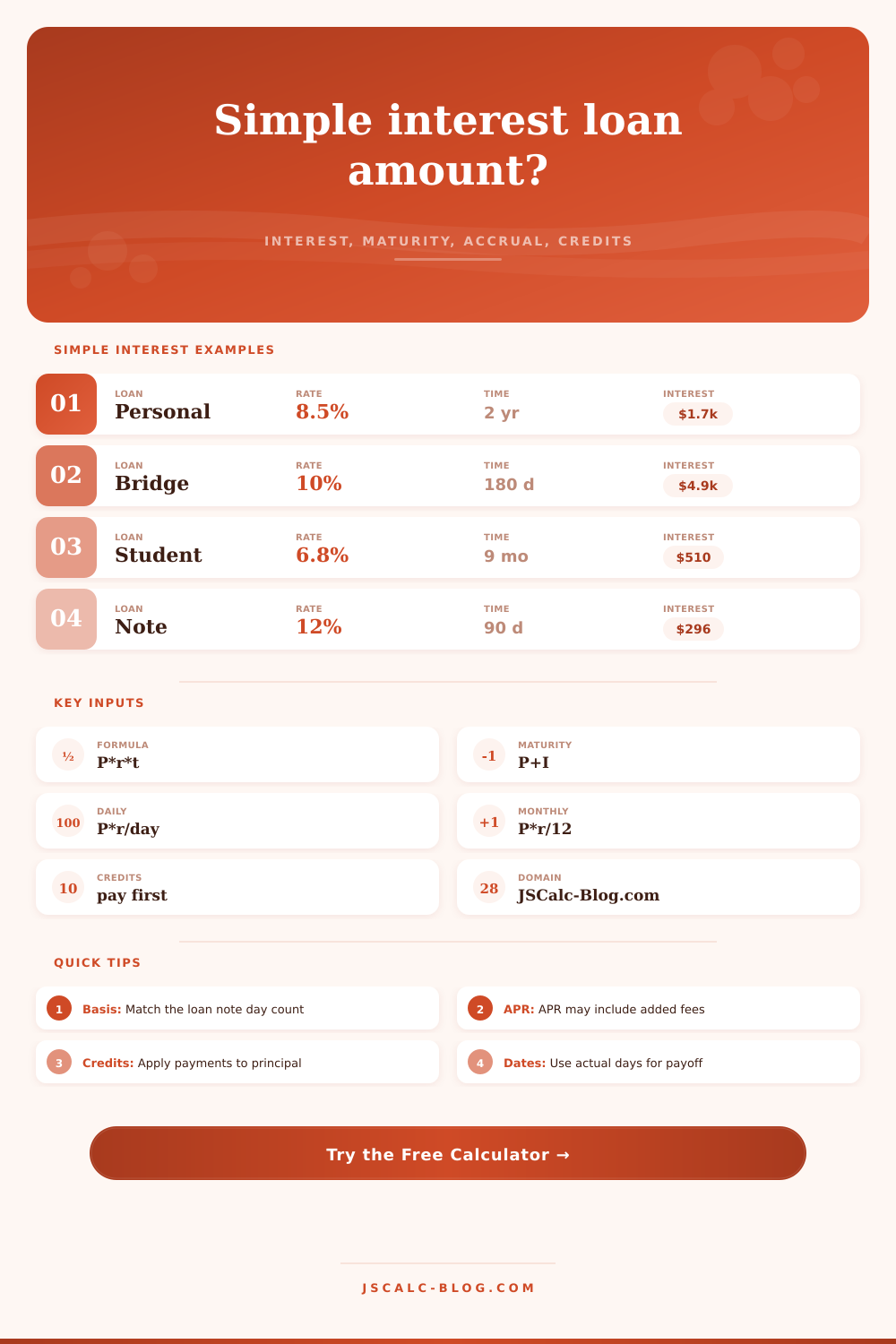
For instance, there are some quick benchmarking reference tables in the interface. It will tell you instantly what it means to take out a loan of $5k for 90 days at an interest rate of 5 percent. This is nothing like taking out a $50k loan for two years at 18 percent per year. Those figures anchor the math in reality.
Before even entering your own data points, you can get a rough idea of what something might cost. And that gives you a little sense of scale. What’s the total cost sensitive to? How much does the interest fluctuate when time increase/decreases?
For short-term finance, a loan based on simple interest is often common. It’s seen with small business inventory advances. It’s found on loans with student grace periods. And it’s used for bridge loans too. Private lending from family member to family member use simple interest as well. Simple interest is easy to understand, so it allows both parties to come to terms easily without arguing over complicated amortization schedules.
But since it is so simple, one must pay attention to the details. How will the fee structure work? In what order are payments applied? How does the day-count basis work? If you get this right, then you’ll know where you’re going. Get these wrong and you could end up paying more than you bargained for.
That’s where the tool comes in. It does all the math for you while you make the calls. You choose whether or not to borrow money, you choose the length of time to carry it, and you choose how hard (or soft) to pay it off. The calculator simply shows you the price tag associated with each decision. It’s a reflection of your financial plan.
Pay attention to the results it spits out. Those numbers reflect reality behind your loan. The point here is: you want to pay less than you owe. And how do you do that? You must first know exactly what you owe.
With simple interest, you get that transparency, because it shows how lending works. If you know the cost of carrying debt day-to-day, you can make smarter decisions. You can pay it off early if necessary. You can alter your budget accordingly. You can refinance if necessary.
Knowledge is an advantage. Use it. It’s as simple as the math and you control the strategy.