Loan Comparison Calculator
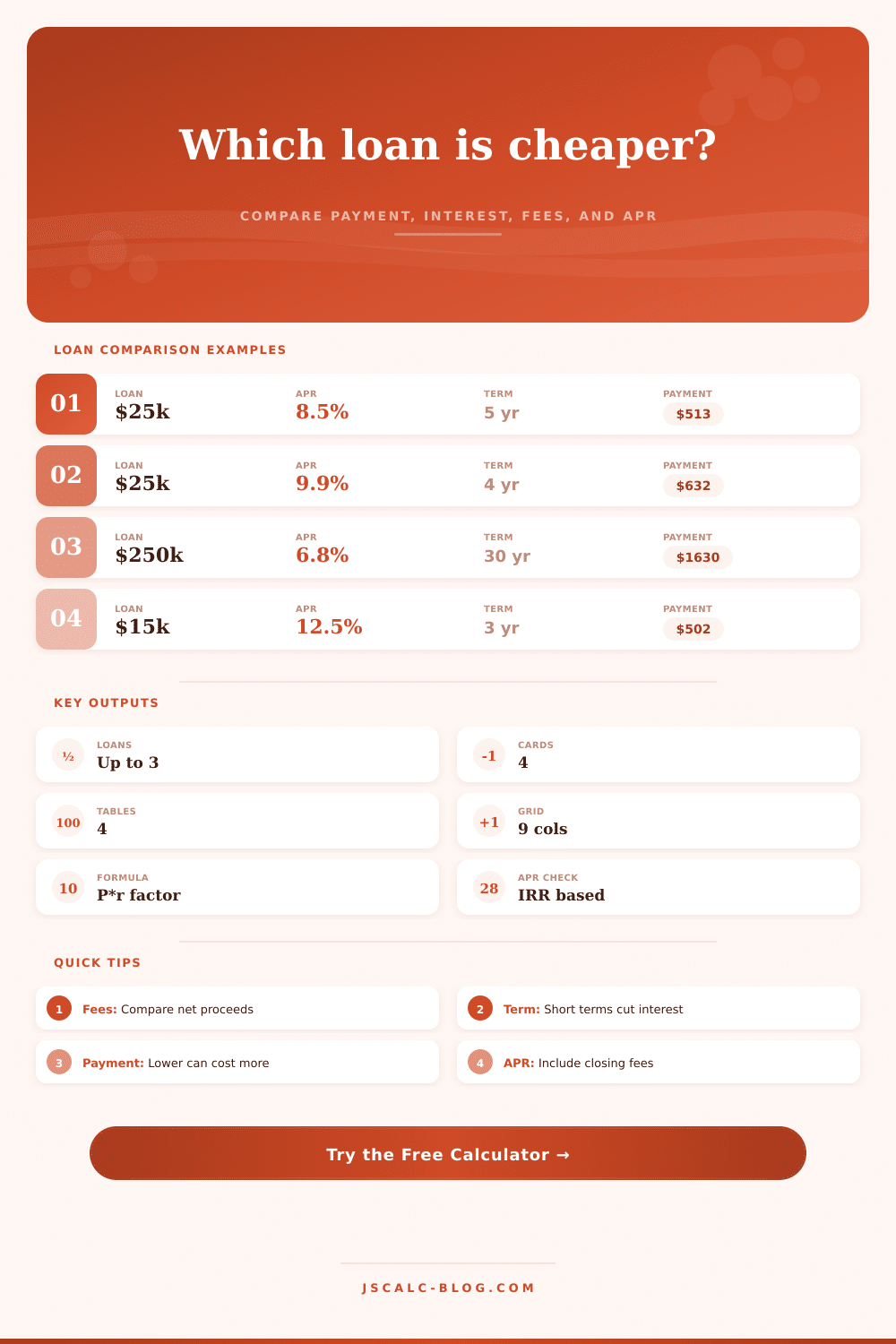
Compare up to three amortized loans side by side with monthly payment, total interest, fees, effective APR, and the term-versus-cost tradeoff.
Load a real-world scenario, then adjust the loan amounts, quoted APRs, terms, closing fees, and monthly add-on fees.
| Loan | Principal | Quoted APR | Term | Payment | Total interest | Total fees | Total cost | Effective APR |
|---|---|---|---|---|---|---|---|---|
| Calculate to fill the side-by-side comparison grid. | ||||||||
| Month | Payment | Principal paid | Interest paid | Fees paid | Remaining balance |
|---|---|---|---|---|---|
| The winning loan schedule appears after calculation. | |||||
| Comparison point | Winner | Monthly payment | Payoff months | Total cost | Difference from cheapest |
|---|---|---|---|---|---|
| Calculate to compare payment relief against lifetime cost. | |||||
| Metric | Formula | What it includes | Why it matters |
|---|---|---|---|
| Monthly payment | P x r / (1 - (1 + r)^-n) | Principal and interest | Shows required cash flow before monthly fees. |
| Total interest | Sum of interest portions | Interest from amortization | Separates financing charge from fee cost. |
| Total cost | Payments + monthly fees + upfront fees | All borrower outflow | Ranks the actual lifetime cost. |
| Effective APR | Monthly IRR x 12 | Rate plus upfront and monthly fees | Standardizes unlike fee structures. |
| Payment tradeoff | Cheapest cost vs lowest payment | Cost gap and payment relief | Shows the price of stretching the term. |
| Scenario | Common term | Fee pattern | Comparison watchout | Best ranking lens |
|---|---|---|---|---|
| Auto loan | 36 to 84 months | Small title or lender fees | Dealer incentives can hide term cost. | Total cost and payment |
| Personal loan | 24 to 84 months | 0% to 10% origination | Low rates may have deducted proceeds. | Effective APR |
| Mortgage | 180 to 360 months | Points plus closing costs | Small rate gaps compound over decades. | Total interest |
| Student refinance | 60 to 240 months | Often no origination fee | Long terms lower payment but raise interest. | Term tradeoff |
| Business equipment | 24 to 72 months | Documentation and monthly fees | Monthly admin fees can change APR. | All-in cost |
| Home improvement | 36 to 180 months | APR, points, or contractor fees | Compare identical draw amounts. | Lowest total cost |
Here are three loan offers on your desk. One is from a local bank, another is from a credit union and a third is from an online lender. The local bank has a long-term loan, so the payment is low; the online lender charges no fees but its rate is higher; and the credit union offer a lower rate but a high origination fee. Which one’s cheapest? That depends.
The one with lowest payment, that’s rarely the case. Nor is it necessarily the one with the lowest APR (that’s advertised). That’s where people go wrong.
How to Choose the Cheapest Loan
These are full-fledged financial products, and this tool computes the math for you. It goes past sticker prices (the quoted annual percentage rate). You plug in the loan amount. You also enter interest rate, the length of the term in months, and all associated fees.
It strips away marketing speak. It subtracts out any upfront costs, which might be tacked onto your closing table, or deducted from your proceeds. That’s what effective APR measures, and that’s why it makes a difference.
Because if one lender charges 3 percent for origination and another doesn’t charge anything at all, the nominal rates appear comparable. Yet true cost of borrowed money is quite different.
Think of the term like a lever. With a shorter loan term, you’ll pay off more principal sooner… Which saves you money on total interest paid over long run. With a long-term, you stretch those payments out. That reduces how much cash you need each month while increasing the total cost of the loan over its entire life.
You can adjust what you rank most important in the calculator. Do you want shortest payoff period? Or do you want lowest payment (which is best for your cashflow)? Or do you want the lowest total cost (which will save you the most money overall)?
Most folks pick “lowest payment”. Since that’s what they can afford right now. But this tend to mean paying several thousand dollars more in interest over the life of the loan. The comparison grid show how much more you’re paying for that quick monthly savings.
Fees are the wildcard when comparing loans. Sometimes, an origination fee is taken from the loan proceeds. For example, if you borrow twenty-five grand but get just twenty-four grand in your pocket, that’s twenty-five grand you still have to repay with interest. The net proceeds on the loan change the math; they make the effective APR higher than the advertised interest rate (see how the calculator accounts for those?).
There are also monthly service fees. Some credit card balance transfers has these, and so do some types of equipment financing. A few bucks per month adds up over three or five years. The calculator will take these into account when calculating the effective APR. Which means you can compare a monthly-fee loan side-by-side with a fee-free loan.
There’s another nice feature: The ability to make additional principal payments each month. If your income is stable, you might like to knock out debt more quickly. You can enter in how much extra you’d like to throw at debt repayment which applies to all your loans. That’s handy for testing how changes affect the outcome.
For example, you can determine whether high-fee/low-rate loan becomes less expensive than the no-fee option when you throw an extra hundred bucks a month at it. Usually yes. Lowering your outstanding principal means less interest will accumulate. That offsets the effect of higher rate. It also decreases the size of the fees-to-principal ratio.
Below, I break out the winning loan into a month-by-month amortization milestones table. You can see how each payment is divided between principal vs. Interest. In the beginning, interest comprises most of each payment. Banks seeks to be repaid their risk premium upfront. As time passes and your principal balance decreases, the interest charge declines. Then more of your payment will go towards paying off the debt itself.
Knowing that pattern gives you an idea whether it makes sense to speed up your payments based off your own cash flow.
The page even includes a reference table that outlines typical scenarios, from mortgages to student refinancing to auto loans. Term structure is diverse. Each have different fee patterns. Closing costs and points occur frequently with mortgages (small fraction percent-wise, but huge dollar-wise). Dealer markup on interest rate can be found with an auto loan, obscuring real cost. Long-term swap for reduced rate is frequent with student refinancing. Total interest paid must be looked at carefully.
The trick to choosing the correct loan for you is to know your priorities. Are you looking for cash flow now? Or are you seeking to build wealth down the road? The calculator provides you with the facts to back whichever decision you prefer.
It eliminates the confusion around interest rates and fees. Simply plug in terms that were stated in the offer documents, enter them exactly as written. Don’t estimate costs. Don’t round off the numbers. Enter the actual rate and the true fee. Then let the effective APR show you the truth.
Compare the cheapest and most-expensive offers and the answer typically shows itself. The objective: Reduce the cost of money. And make sure you can afford the monthly payment. Smart borrowing happens at this sweet spot.