Personal Loan Payment Calculator
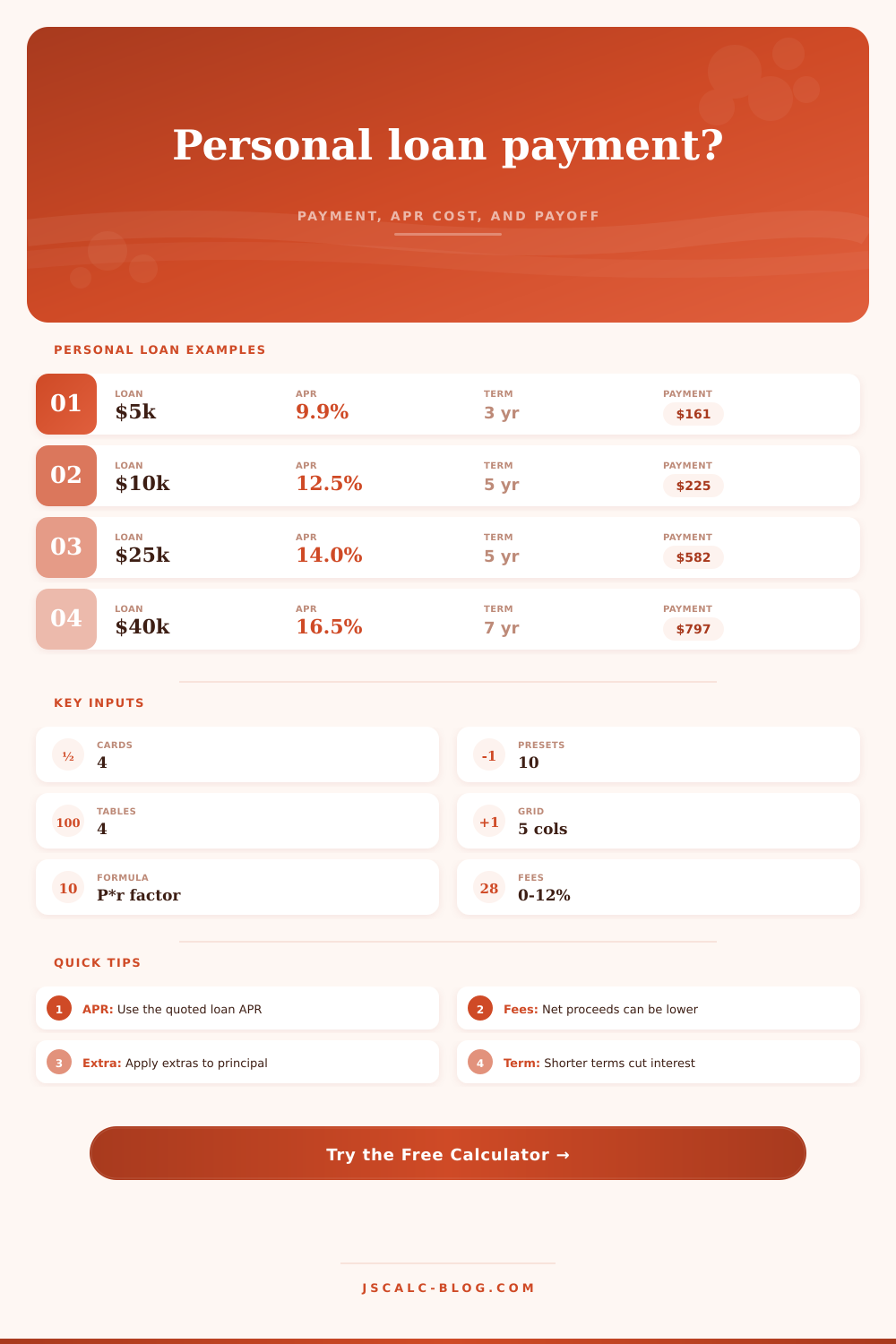
Estimate a fixed personal loan payment with amortization math, origination fee net proceeds, total interest, APR cost signals, and the payoff impact of extra principal.
Load a common personal loan scenario, then adjust the amount, APR, fee, term, and extra-payment strategy.
Payment and payoff result
Amortized personal loan estimate from JSCalc-Blog.com.
The first table uses your live inputs. It shows selected months plus the final payoff month from the extra-payment simulation.
| Month | Payment | Interest | Principal | Extra | Ending balance |
|---|
| Extra monthly | Payoff time | Total interest | Interest saved | Months saved |
|---|
| Fee treatment | Payment balance | Net proceeds | Best use | Watch point |
|---|---|---|---|---|
| Deducted | Approved loan | Loan minus fee | Most personal loan disclosures | Cash received is lower than requested |
| Financed | Loan plus fee | Requested cash | When fee is rolled into principal | Payment and interest both increase |
| Cash | Approved loan | Full approved loan | When borrower pays fee separately | Total cash outlay includes upfront fee |
| Term | Payment pattern | Interest pattern | Common fit | Planning note |
|---|---|---|---|---|
| 12 to 24 months | Highest payment | Lowest interest | Small balances, fast payoff | Check monthly cash flow first |
| 36 months | Moderate-high | Lean total cost | Debt cleanup, medical bills | Often a strong payoff pace |
| 48 to 60 months | Middle range | Noticeable interest | Home projects, consolidation | Compare against current payments |
| 72 to 84 months | Lowest payment | Highest interest | Large personal loans | Extras can offset long-term cost |
| Step | Formula | Uses | Calculator output | Why it matters |
|---|---|---|---|---|
| Monthly rate | r = APR / 12 | APR percent | Rate per month | Converts annual APR to payment periods |
| Payment | M = P*r*(1+r)^n / ((1+r)^n - 1) | Principal, rate, term | Scheduled monthly payment | Fully amortizes a fixed-rate loan |
| Net proceeds | Cash = loan - deducted fee | Fee mode and fee rate | Cash received | Shows whether the loan funds the needed amount |
| Extra payoff | Balance rolls monthly | Payment plus extras | Payoff month and interest | Captures savings from principal prepayment |
You take out a personal loan, and the lender gives you an annual percentage rate. Your brain quickly multiplies it out to get an idea of the price tag.
It never ends up being that simple. The true cost of taking on a personal loan is hidden by how long it takes to pay back. It is also hidden by how the fee is applied and, most importantly, how closely you follow the due date (as if it’s a firm deadline versus a moving target).
The Real Cost of Personal Loans
This is where most people fall off the tracks: understanding the gap between what they borrow and what money ends up in their hands.
You input the details and the calculator does the amortization math for you. No guesswork about the difference between compounding over 36 months vs. The term is 60 months. It breaks out the principal from the origination fee when you input a loan amount, which is important, as many lenders subtracts the origination fee from the disbursement.
If you borrow $10k but the lender deducts a three percent origination fee from the disbursement, you don’t recieve $10k in your pocket. You receive $9,700 instead. Now you’re obligated to pay interest on $10k. That difference represent the silent tax on seemingly cheap debt.
The tool displays the net amount you receive. Can you see whether the loan will meet your expense needs? Or must you borrow more money to reach the amount of cash you need?
Interest is a percentage, but it’s also a charge for time. If you stretch out the payoff, you’ll end up paying more total interest. It doesn’t matter how comfy your monthly payment might be; it still mean you’re stretching out the payoff period.
On one hand, a higher monthly bill isn’t so bad when it’s spread out over seven years. That sounds doable. “Low” payments can mean “longer” term. You’re paying for the right to keep the money in your pocket longer. The bank gets paid each month for this benefit.
Reduce the term, and you spike the monthly cost. You also slash total amount of interest. It’s a trade-off: short term vs. Instant cash flow relief, and long term vs. You are preserving your wealth.
Most people pick the former. Why? Because the pain of the higher monthly bill is visible now, whereas the reward of the lower term come later and is abstract.
Model extra payments using the calculator. This is the single most powerful tool you have. You can add even a small fixed amount to each monthly payment and shave years from the life of the loan. You’ll cut thousands off the interest. And it’s not hard to understand when you see the amortization schedule.
At the beginning, nearly all of your payment gets sent to interest. Why? Because that’s the part with the biggest balance. The more you chip away at the principal, the smaller the interest piece becomes. More of your payment reaches the balance.
Extra payments speed up this transition. By forcing the bank to recalculate interest based on a lower balance earlier than planned, they cause the interest to shrink faster.
That’s where folks mess up. They assume an extra payment simply pays down their loan faster. An extra payment changes the structure of every future payment. Each payment starts working harder for your equity.
Another variable is origination fees. Here’s how some lenders do it: They roll the fee into the loan, so you’re paying interest on the fee amount too. Other lenders take the fee out of your cash amount, meaning you get less money but a lower monthly payment. The table on the page makes that clear enough. You’ll see exactly how each method compares side by side.
With a financed fee, your monthly payment goes up. But you do get the exact amount of money you requested. With an origination fee deduction, your payment drops a little bit. You begin with a smaller amount of cash. Which is better? That’s up to you. Pick one metric; either the size of the monthly bill or the amount of cash in hand.
The rate you get is determined by your credit score. But your true cost is determined by your behavior. A good borrower could get a great rate because they have good credit. But if they extend the loan for seven years so their payments are lower, over the long haul they could pay more in total interest than someone with a fair credit rating who takes out a three year loan. In other words, term selection can be more important then getting the best rate.
You could have the best rate in the entire world and still screw it up if you allow the loan to drag on and on. Time will eat away at the savings.
The loan term is like a dial. Moving to the right means lower payments. The total cost is higher. To the left, there are higher payments. You pay it off quicker. Generally, somewhere in between is the sweet spot: the payment’s still a bit painful, but it’s doable. That pain is your reminder that you’re not buying too much time.
Use this tool to get there. Pull up your existing payment. Run it through. Now pull up one with a small additional contribution. See how the payoff changes? That change represents money you’ve saved. It’s not just some abstract number on a screen. It’s cold hard cash sitting in your bank account. You can let that money compound. It is free money.
The goal is not just to get the loan. You’re trying to manage it. After you learn about the fee deduction, you’re no longer a passive payer: You’ve become an active debt manager. Your money is going somewhere very specific. Every single dollar. You know where that is. You know if a fee is chewing up some of your proceeds. You know whether you should take out a longer-term loan with additional interest. You know whether you might be able to tighten your belt and pay it off sooner.
The math doesn’t lie. It’s waiting for you to look at it.
Personal loans are simple. Payments are fixed; terms are fixed; rates are fixed. Things get complicated with all the hidden variables, such as how often interest is compounded. What’s the fee structure like? How does early repayment affect me?
You don’t need to be a mathematician for any of this stuff. All you have to do is pay attention to the right numbers. What did I actually get? These are the net proceeds. What did it actualy cost me? This is the total interest. When will it end? Payoff date Those are the three numbers to keep in front of you.
Tinker with the inputs until the story told by these numbers matches your financial reality. And then sign on the dotted line with your eyes wide open.
The rest is arithmetic.