Unweighted GPA Calculator
Calculate GPA from letter grades, percentages, or grade points using credits only. AP, honors, IB, and dual-enrollment labels are shown for context but never add rigor boosts.
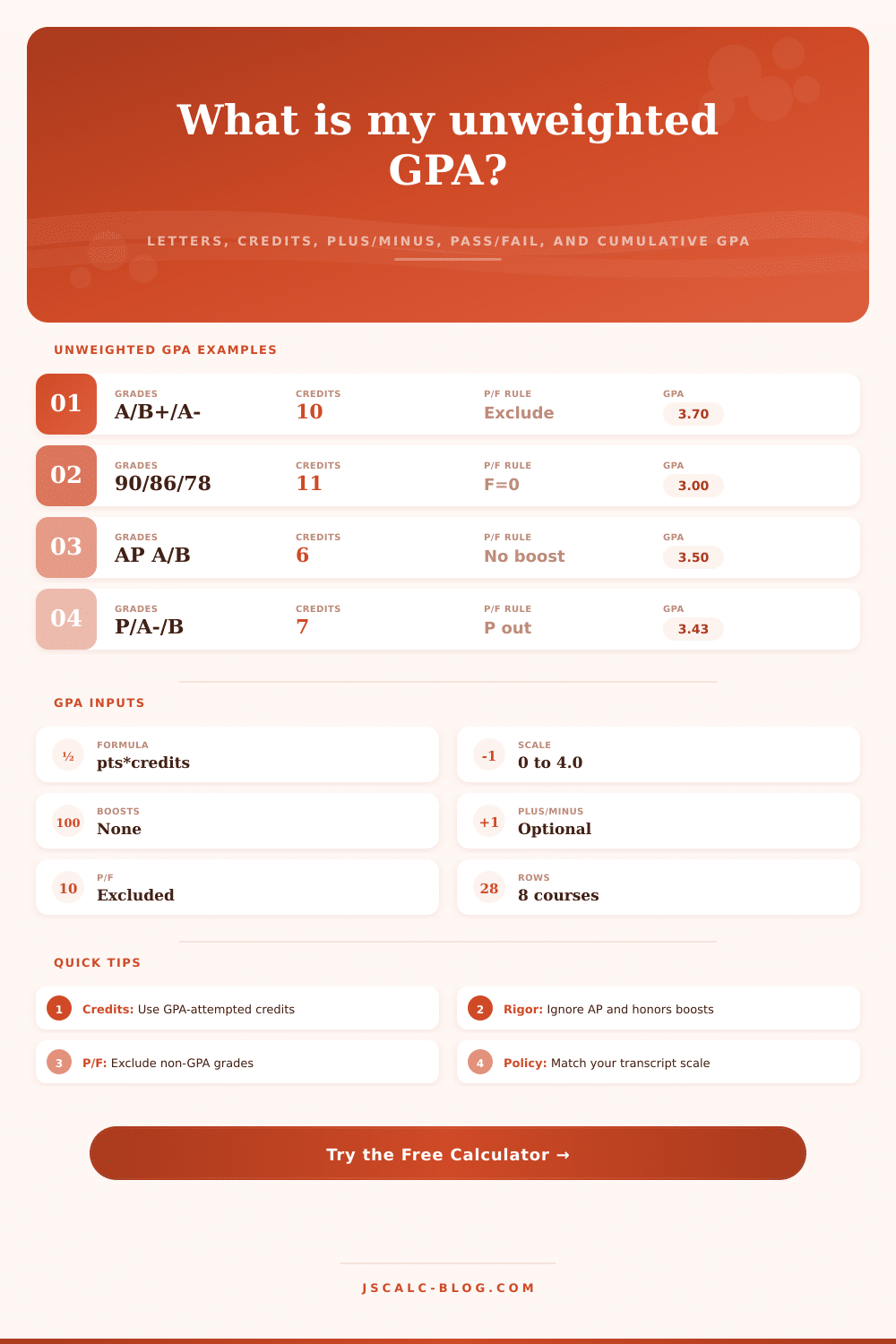
Unweighted GPA uses grade points and credits only.
Mixed mode accepts A-, 92, 3.67, P, W, CR, NC, and similar transcript marks.
All policies remain unweighted: honors and AP do not add points.
Most unweighted GPA policies remove passing P/F credits from the numerator and denominator.
Internal math keeps full precision before display rounding.
Use 0 if you only want the new course GPA.
Enter credits that already count toward your cumulative GPA.
Used for the target gap line in the breakdown.
The formula is the same; this label helps the breakdown read like your transcript.
| # | Course | Grade | Credits | Course Type | Grade Points | Quality Points |
|---|---|---|---|---|---|---|
| 1 | ||||||
| 2 | ||||||
| 3 | ||||||
| 4 | ||||||
| 5 | ||||||
| 6 | ||||||
| 7 | ||||||
| 8 |
Use these tables to match your school policy before relying on a GPA estimate.
| Letter | Standard Points | No Plus/Minus | Typical Percent Band | Counts In GPA? |
|---|---|---|---|---|
| A+, A | 4.00 | 4.00 | 93-100 | Yes |
| A- | 3.67 | 4.00 | 90-92 | Yes |
| B+ | 3.33 | 3.00 | 87-89 | Yes |
| B | 3.00 | 3.00 | 83-86 | Yes |
| B- | 2.67 | 3.00 | 80-82 | Yes |
| C+, C, C- | 2.33 / 2.00 / 1.67 | 2.00 | 70-79 | Yes |
| D+, D, D- | 1.33 / 1.00 / 0.67 | 1.00 | 60-69 | Yes |
| F | 0.00 | 0.00 | 0-59 | Yes |
| Transcript Mark | Meaning | Default Treatment | Credits In Denominator? | Quality Points |
|---|---|---|---|---|
| P, S, CR | Pass or credit | Excluded | No | 0, not counted |
| NC | No credit | Excluded | No | 0, not counted |
| NP | No pass | Depends on setting | Optional | 0 if counted |
| W | Withdrawn | Excluded | No | 0, not counted |
| I | Incomplete | Excluded | No | 0, not counted |
| F | Failing grade | Counted as letter | Yes | 0.00 x credits |
| Course Type | Weighted GPA | Unweighted GPA | Example A Grade | Why It Matters |
|---|---|---|---|---|
| Regular | No boost | 4.00 | 4.00 | Same on both scales |
| Honors | May add 0.5 | 4.00 | 4.00 | Rigor label ignored |
| AP | May add 1.0 | 4.00 | 4.00 | No AP bonus here |
| IB | May add 1.0 | 4.00 | 4.00 | No IB bonus here |
| Dual enrollment | School-specific | 4.00 | 4.00 | Use letter only |
| Lab or seminar | Credit-weighted | Credit-weighted | 4.00 | Credits still matter |
This JSCalc-Blog.com calculator is an educational planning tool. Always follow the grade scale and repeat-course policy printed by your school or college registrar.
Your transcript contains a list of courses, credit hours, and (hopefully) good grades. But to you, the information appear as data, and sometimes as noise. You seek clarity about your standing, but the math varies based off policy or teacher. To simplify it, the unweighted GPA reveals raw average of how well you performed academically.
Before looking for weighted boosts or harder classes, scholarship committees and admissions officers looks at this bare-bones measure. This is first thing they review. It’s basic math, but it matters how you count.
What Is Your Unweighted GPA?
Your grade point average are calculated using a zero-to-four scale. In this calculation, an A equals 4.0 points; an F equals 0.0, etc. Other classes will fall somewhere inbetween according to your school’s scale. An unweighted GPA operates on a strict zero-to-four scale, where an A equals 4.0 points; an F equals 0.0, etc. Other classes will fall somewhere inbetween according to your school’s scale. The calculator will convert your letter grades into points, then divide them by total credits earned.
Why? Because most students mistake is simply averaging their letters without considering credit hours. Calculus is worth four credits, while a one-credit art seminar carries less weight.
Some student find pass/fail courses difficult to manage. They assume that passing a class doesn’t matter, but the policy determine whether or not it’s included in your overall grade. Usually, only passing grades are excluded from an average (unweighted). For example, taking more difficult classes won’t actualy boost your unweighted GPA with this system. However, it also prevents you from boosting your average with these types of class. In most cases, failing a pass/fail class result in an F. That decreased score can greatly impact your standing. Know this rule and make sure you don’t mess up, because one error could throw off your whole semester.
Another area of confusion is course rigor. Sometimes students believe they will increase their unweighted GPA by taking honors or AP classes. They won’t. Unweighted doesn’t account for difficulty level of the course. If a student earns an A in AP biology, it’s equivalent to a student earning an A in regular biology. That seems like an injustice to students who push themselves to take more challenging classes, I know. But there’s a reason. Because different schools have different curriculums, weighted GPAs don’t make grades directly comparable across schools. What you see when you list your courses is the type (for context), but no bonus points given. So the number stays accurate AND comparable.
Similarly, make sure to look at the impact of plus/minus grading on your GPA. For example, some school weight their scale so that an A- equals 3.67. Other schools round it down and consider it equivalent to a B (or 3.00 points). Depending on which school you attend, this policy can swing your GPA up or down by a tenth of a point during any given semester… Enough to push you over the line for a scholarship or miss it by a hair. Use the calculator’s option to select the policy that applies to your transcript. That way, what you get out will be a reflection of your reality and not just a rough guess.
To project your future GPA, it use the classes you’re taking now and where you are today. Enter how many credits you’ve taken so far and what your current cumulative GPA is, along with what grade you expect to recieve in each of your next few classes. It will mix that information together and give you an idea of what your final projected score might be. Use this tool to plan (i.e., figure out what classes you should of focus on most if you want to maintain a particular GPA). If you know what you want your final GPA to be, reverse-engineer it to find out how you’d need to do in your remaining classes.
In conclusion, there is nothing complicated about your unweighted GPA. Your unweighted GPA represents your performance in every subject at its basic value. There is no indication of the difficulty of your class load, but this will be a steady base from which to measure your academic habits. Once you know how everything fits into your transcript: credits, grades, and policies, then you’ll have a handle on how to control the narrative of your transcript. The formula doesn’t change, only the stakes seems heightened. You are the variable; the formula indicates what happens next.