GPA From Letter Grades Calculator
Convert letter grades into credit-weighted GPA with plus/minus scales, pass/fail exclusions, repeat policies, and cumulative planning from JSCalc-Blog.com.
Enter at least one graded course with credits to calculate GPA.
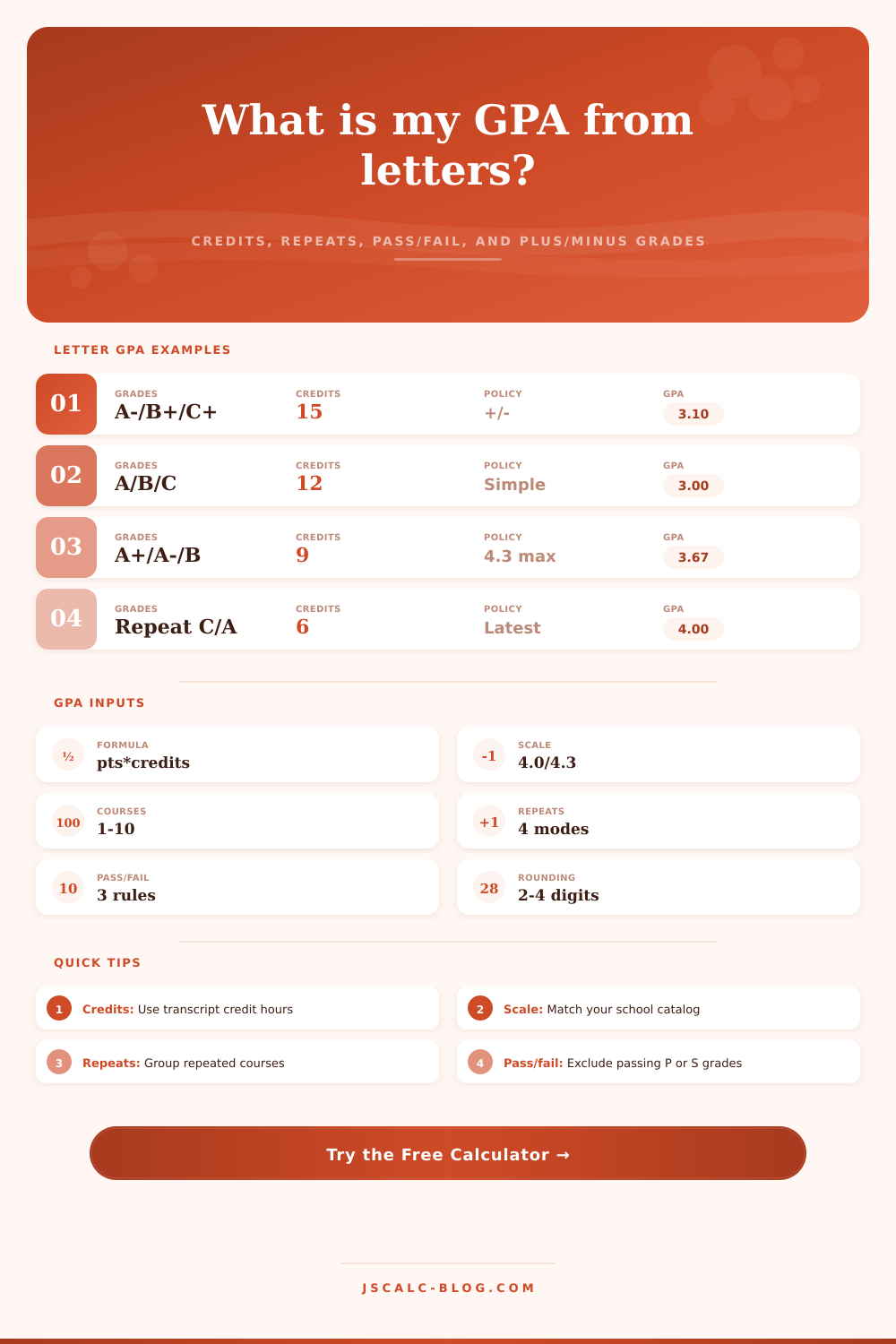
The standard 4.0 mapping uses A- = 3.7, B+ = 3.3, B = 3.0, down to F = 0.
Assign the same repeat group to courses that repeat the same requirement.
Most GPA policies exclude P or S credits while counting failed pass/fail attempts as zero points.
Transcripts commonly report two or three decimals; internal calculations keep full precision.
| # | Course | Letter grade | Credits | GPA status | Repeat group | Attempt | Category |
|---|---|---|---|---|---|---|---|
| 1 | |||||||
| 2 | |||||||
| 3 | |||||||
| 4 | |||||||
| 5 | |||||||
| 6 | |||||||
| 7 | |||||||
| 8 | |||||||
| 9 | |||||||
| 10 |
| Course | Grade | Credits | Grade points | Quality points | Counted? | Reason |
|---|
| Letter | Standard 4.0 | 4.3 scale | Simple scale | Common meaning | Typical cutoff |
|---|
| Policy | Passing P/S | NP/U | Credits in GPA | Best use |
|---|---|---|---|---|
| Count fail | Excluded | 0.0 if credits entered | Failed only | Common transcript rule |
| Exclude all | Excluded | Excluded | None | Planning pass/fail only |
| Count all fail | Excluded | 0.0 if credits entered | Failed only | Strict eligibility review |
| Repeat option | Included attempt | Excluded attempt | Credit effect | When to choose |
|---|---|---|---|---|
| Count all attempts | Every graded row | None | All credits count | Graduate-style averaging |
| Latest attempt | Highest attempt number | Earlier rows | Latest credits count | Replacement by chronology |
| Highest grade | Best grade points | Lower rows | Best credits count | Forgiveness policies |
| Grade replacement | Latest attempt only | Earlier rows | Prior credits excluded | Retake repair plans |
| Scenario | Scale | Credits | Repeat mode | Pass/fail | Planning note |
|---|---|---|---|---|---|
| Freshman core | 4.0 +/- | 15 | All | P excluded | Term baseline |
| STEM heavy | 4.0 +/- | 17 | All | None | Lab credits weighted |
| Repeat recovery | 4.0 +/- | 16 | Latest | P excluded | Retake lifts GPA |
| Honors load | 4.3 | 15 | All | None | A+ can exceed 4.0 |
| Eligibility | Simple | 12 | All | NP as F | Conservative review |
| Target repair | 4.0 +/- | 14 | Best | P excluded | Future GPA shown |
| Bucket | Counted credits | Credit share | Quality points | GPA contribution |
|---|
This calculator is for planning and checking arithmetic on JSCalc-Blog.com; official transcript rules can vary by institution.
Maybe you think of it as a sort of scoreboard.
In truth, though, your GPA is mechanical: your grade point average are a weighted average, with credit hours serving as leverage. An A in a one-credit seminar won’t impact you as much as B in a four-credit lab course. That’s why it’s important to know how you’ll apply your effort. Does this mean you need to improve your grades? Where will you focus your attention?
How to Use a GPA Calculator
The calculator does all this math for you. Simply input your course load, and the calculator produces your GPA. You don’t have to calculate grade points times credit hours for each class and total them up anymore. The calculator turns a heap of letters into one number. This provides an easy-to-read score for employers and admission office.
You should know that it’s important to set the grade scale of the school you attended so your results is accurate. Most people assume every college operate on a 4.0 scale (though most don’t). Many schools operate on a 4.3 scale. Some use only letters (no pluses and no minuses). Unless you use correct conversion, your calculations won’t line up with what’s on your actual transcripts.
To that end, the settings panel provides options for different grade scales. Match them to how your registrar does things. It sounds like a trivial matter, but it’s the foundation upon which an accurate projection rests. Otherwise, you’re shooting in the dark.
Different colleges has different rules around retaking classes. At some, they’ll overwrite your old grade and remove it from your GPA calculation, though it stays on file in case you want to check it. At others, they’ll tally up each attempt. Even if you receive an A when you retake the course, that previous F still drags down your average.
You can flip between those two settings with this calculator so you’re able to simulate the effect of a retake and see what your final number would be. This is helpful for planning. If there is a replacement policy, maybe you focus on retaking any low-grade core course? With a “counts all attempts” policy, maybe you aim to maximize credits earned through newer classes? The math will tell you which lever to pull.
And then there are the pass/fail classes. Typically pass-fails don’t factor into your GPA. But they also don’t just vanish from existence. Pass fails typically applies toward your degree but don’t provide any quality points. You can flag those in the tool as being counted/considered (or not) depending on the policy at your school. So if you’re enrolled in some non-letter graded courses and want it to not break down the sheet with a credit hour entered where there’s no actual grade, you’ve got that covered. Handy for people who audit vs. This is handy for people who audit versus those who get graded for certain classes. Until you put one of those in and your spreadsheet goes kaput, most people forget about it.
But that’s the big picture: GPA represents consistency across semesters. If you’ve had a long string of good grades, it’s hard for one weak semester to do any serious damage.
That said, we also built in a tool that lets you enter both your existing GPA and total credit hours so you can project what happens when you add some additional course. That makes it more like a roadmap than just a static number. You can actualy visualize how many A’s you must earn in higher credit courses to offset that low grade from last semester. It’s not about getting As; it’s about balance.
As I said, this page includes the reference tables of policy definitions and grade mappings. These help explain what those grades mean and how they map to one another, in case you want a side-by-side comparison of what grades should look like across schools. If you have a footnote from your registrar that you can’t interpret, or an old transcript that’s got some cryptic codes, these will help you get there (the raw numbers don’t really). Half the battle is understanding the policy. The other half is doing the work.
In the end, your GPA is simply a narrative about your approach to learning. It is about which classes you chose to prioritize, how you balanced your schedule, and whether you asked for assistance. You control where it goes… The calculator provides the information.
Treat it as a tool for testing out scenarios, never as a measure of who you are. A number from one semester, or even one year, cannot fully describe you. Your grit, your growth, and your developed skills wouldn’t of be there. But a number does tell you something: it tells you what you need to aim for. And once you have that aim in mind, you can develop a game plan for getting there.
That’s the beauty of learning the formula. It transforms anxiety into action.