GPA From Percentages Calculator
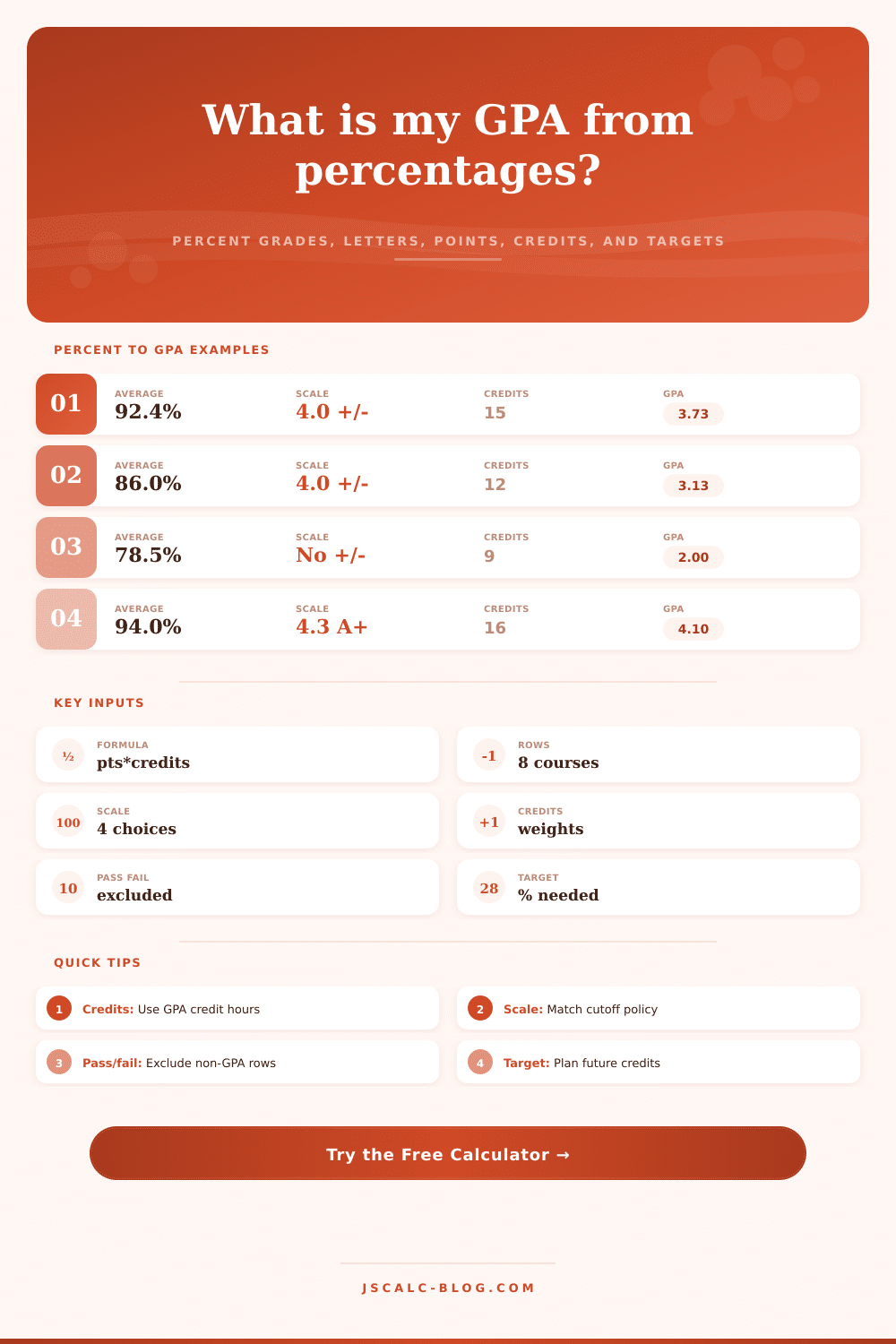
Convert percentage grades into letter grades, grade points, credit-weighted GPA, cumulative GPA, and the future percentage average needed for a target.
Choose the cutoff table that matches the transcript policy.
Use Count F if your school includes failed pass/fail courses in GPA.
Scores below this threshold are assigned F when counted.
Used to estimate the average percentage needed after this term.
| # | Course | Percent | Credits | Status | Letter | Points | Quality Points |
|---|---|---|---|---|---|---|---|
| 1 | |||||||
| 2 | |||||||
| 3 | |||||||
| 4 | |||||||
| 5 | |||||||
| 6 | |||||||
| 7 | |||||||
| 8 |
| Percent Band | Letter | Standard Points | A+ 4.3 Points | No +/- Points |
|---|---|---|---|---|
| 97 to 100 | A+ | 4.00 | 4.30 | 4.00 |
| 93 to 96.99 | A | 4.00 | 4.00 | 4.00 |
| 90 to 92.99 | A- | 3.70 | 3.70 | 4.00 |
| 87 to 89.99 | B+ | 3.30 | 3.30 | 3.00 |
| 83 to 86.99 | B | 3.00 | 3.00 | 3.00 |
| 80 to 82.99 | B- | 2.70 | 2.70 | 3.00 |
| 77 to 79.99 | C+ | 2.30 | 2.30 | 2.00 |
| 73 to 76.99 | C | 2.00 | 2.00 | 2.00 |
| 70 to 72.99 | C- | 1.70 | 1.70 | 2.00 |
| 60 to 69.99 | D | 1.00 | 1.00 | 1.00 |
| Below 60 | F | 0.00 | 0.00 | 0.00 |
| Scale | Best Use | A+ Treatment | Plus/Minus | Passing Floor |
|---|---|---|---|---|
| Standard 4.0 plus/minus | Common US college scale | 4.00 cap | Yes | User setting |
| No plus/minus | Schools using whole letters | 4.00 | No | User setting |
| A+ as 4.3 | Transcripts awarding A+ bonus | 4.30 | Yes | User setting |
| Strict college cutoffs | Higher cutoffs for each band | 4.00 cap | Yes | User setting |
| Target needed percent | Planning future terms | Scale based | Scale based | Computed from GPA target |
| Row Status | Credit Counted? | Points Used | When To Use | Result Impact |
|---|---|---|---|---|
| Graded | Yes | Percent table | Normal letter-bearing course | Affects GPA and credits |
| Pass | No | None | P, S, CR, satisfactory | Excluded from GPA math |
| Fail | Depends on setting | 0.00 if counted | F or NC under GPA policy | Can lower GPA sharply |
| Exclude | No | None | Audit, withdrawal, incomplete | Ignored in totals |
| Blank row | No | None | Unused course line | Ignored in totals |
A single number on your report card seems like a final thing, but then it’s time for jobs, for scholarships. So you got an eighty-eight in biology and a ninety-two in calculus? Those aren’t equal grade in the world of school. Maybe they’re a comfortable B-plus and a hard A-minus; maybe one is curved up, another down; maybe one is easy, another hard. And it’s all about what happens when you try to take that raw percentage and turn it into a grade point average.
The math isn’t hard. But the rules gets applied different than place to place. That’s where confusion enters. When you plug in your classes, the calculator do the math for you, and spares you from guessing what to convert to what.
How to Understand Your GPA
For instance, imagine you had a one-credit seminar and a four-credit lab. The calculator account for the fact that the lab have a greater impact on your GPA, even if its grade was a slightly lower percentage. This is something many student do incorrectly: They simply take the percent per class and average them out together. However, this method assume that all classes are equally weighted, which isn’t true.
If you have a really heavy class load, but low grades, then it will bring your GPA wayyyy down. On the other hand, if you have a lighter class load, but high grade, then it could blow up your GPA! Your class load make a huge difference. The calculator illustrates exactly how much impact each class have on your overall score.
Another area of contention is grades themselves. At some colleges, the highest grade is A-plus but capped at four-point-zero, eliminating any separation between the best of the best from an A. Under other grading systems, top student may earn a four-point-three, breaking through the old ceiling. Depending off this policy, you could be a few hundredths of a point better or worse in terms of your cumulative GPA (enough to affect merit-based aid). Before you read into where you stand, find out what system your school employs. It’s clearly spelled out in reference table, and you’ll see just how one college’s system lines up with another’s.
The calculation also takes into account pass/fail courses. For most students, this means that if they take a course on a pass/fail basis in order to protect their GPA, it get completely removed from their GPA. While that’s certainly correct for a passed class, unfortunatly many schools will still include a failing class as part of the GPA (typically with a zero). So students believe they’ve protected themselves from a bad grade, only to find it still brings down there average because of a failing mark. You can turn on/off which non-graded rows is included in the calculation, so it reflects your school’s policy instead of making some broad assumption about what happens with pass/fail.
The beauty of this tool, though, come when you start using it to plan ahead. Want to achieve Dean’s List? Need to meet a pre-med requirement? The calculator will tell you what average percentage you must earn in your remaining classes to reach that goal. That switches the mindset from reactionary worry to proactive planning. You’ll know exactly how far behind you are (or aren’t) and whether it’s realistically possible based off your current trajectory.
Most people don’t realize how psychologically important grades is. One bad grade seems like a disaster. In the end, though, that one lousy mark won’t matter much (especially since your overall credit load is so high). Alternatively, a couple great marks in hard class will really help cushion the blow. You should of known this sooner. Knowing this will relieve some stress and direct your attention to what matters most. Study hard for those big-credit classes and don’t sweat a half-percentage point on an easy elective.
In conclusion, GPA is a snapshot of academic performance. And it’s filtered by particular institutional rules. It is not a measure of potential or intelligence. But institutions uses it as a way to select and sort. And knowing how that metric is built allows you to control what it means. You can stop wondering what a ninety-four means and begin managing how you take your courses to match. Without the right context, those numbers are just data points. And when you do, the path ahead becomes clearer.