4.0 Scale GPA Calculator
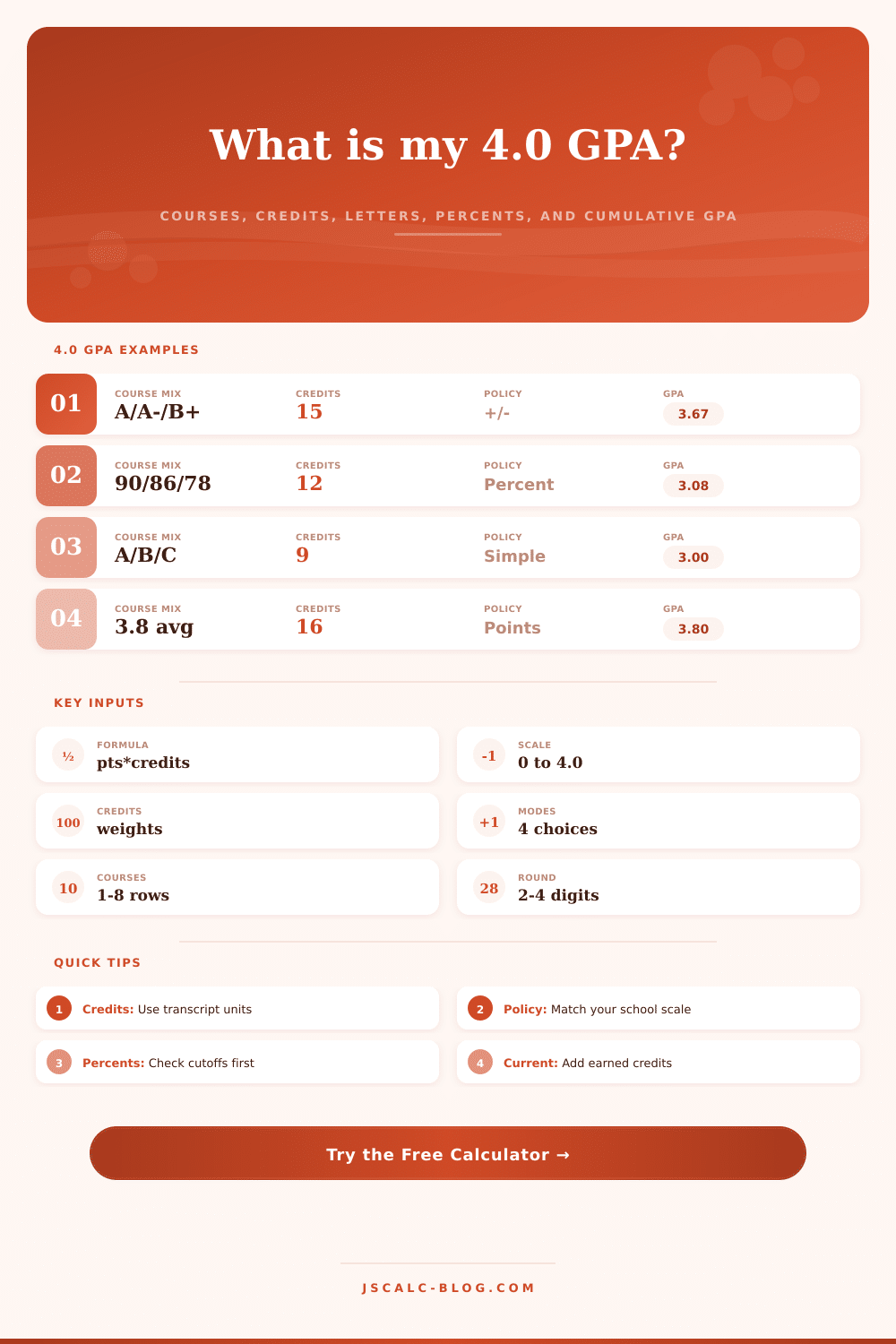
Convert letter grades, percentages, or direct grade points into a credit-weighted 4.0 GPA with cumulative projection.
Use letters like A-, percents like 91, or points like 3.7.
The calculator stays on a 4.0 maximum per course.
Use the decimal count your school reports.
Most transcripts exclude passing P/S/CR grades from GPA.
Leave at 0 with current credits at 0 for term-only GPA.
Use only credits that already count toward GPA.
| # | Course label | Grade entry | Credits | 4.0 points | Quality points |
|---|---|---|---|---|---|
| 1 | |||||
| 2 | |||||
| 3 | |||||
| 4 | |||||
| 5 | |||||
| 6 | |||||
| 7 | |||||
| 8 |
| Letter | Standard points | No plus/minus | Typical percent range | Notes |
|---|---|---|---|---|
| A+ | 4.0 | 4.0 | 97-100 | Some schools list 4.3, then cap GPA at 4.0. |
| A | 4.0 | 4.0 | 93-96.99 | Top standard 4.0 grade. |
| A- | 3.7 | 4.0 | 90-92.99 | Plus-minus policy changes this row most often. |
| B+ | 3.3 | 3.0 | 87-89.99 | Converted before multiplying by credits. |
| B | 3.0 | 3.0 | 83-86.99 | Three quality points per credit. |
| B- | 2.7 | 3.0 | 80-82.99 | Counts below a B in strict plus-minus systems. |
| C+ | 2.3 | 2.0 | 77-79.99 | Often acceptable for general credit. |
| C | 2.0 | 2.0 | 73-76.99 | Common minimum for many prerequisites. |
| C- | 1.7 | 2.0 | 70-72.99 | May not satisfy some program requirements. |
| D+ | 1.3 | 1.0 | 67-69.99 | Counts in GPA if your school awards credit. |
| D | 1.0 | 1.0 | 63-66.99 | Low passing grade in many systems. |
| D- | 0.7 | 1.0 | 60-62.99 | Policy varies by school. |
| F | 0.0 | 0.0 | 0-59.99 | No quality points. |
| Percent score | Letter used | 4.0 points | Credit example | Quality points |
|---|---|---|---|---|
| 97-100 | A+ | 4.0 | 4 credits | 16.0 |
| 93-96.99 | A | 4.0 | 3 credits | 12.0 |
| 90-92.99 | A- | 3.7 | 3 credits | 11.1 |
| 87-89.99 | B+ | 3.3 | 4 credits | 13.2 |
| 83-86.99 | B | 3.0 | 3 credits | 9.0 |
| 80-82.99 | B- | 2.7 | 3 credits | 8.1 |
| 77-79.99 | C+ | 2.3 | 3 credits | 6.9 |
| 73-76.99 | C | 2.0 | 3 credits | 6.0 |
| 70-72.99 | C- | 1.7 | 3 credits | 5.1 |
| 60-69.99 | D range | 0.7-1.3 | 3 credits | 2.1-3.9 |
The number doesn’t add up, so you look at your transcript and shake your head. Why isn’t it working out? It’s simple, one of those classes was a heavy major class while the other was a light elective. You got a B in one and an A in the other, yet your GPA didn’t budge much. That’s what makes GPA confusing. Usually, it’s not your doing; it’s the weighting.
What good is a grade if it doesn’t come with any credits? When you input your courses into the calculator (above), it does the work for you in terms of converting and coefficients. But when you know how weights matter, then you can use the number.
How to Calculate Your GPA
The typical student regard all classes as being created equal. To them, an A and a B are both equivalent: they raise (or lower) the GPA equally. This isn’t true if credits aren’t. The grading system multiplies credits by grade points to generate quality points, which are the actual basis of your academic standing.
Because of this, a four-credit calculus class will impact your GPA four times more heavily than a one-credit lab section. Your term GPA results is simply the total number of quality points divided by the number of total credits attempted. In other words, it’s not a simple mean, it’s a weighted average. And that’s why a low mark on a huge class feels like Armageddon, whereas the identical grade on a small seminar feel like a minor hiccup.
Every institution has different grade conversion rules. Some schools use a strict four-point scale where an A plus, an A, and an A minus are all worth the same. Other schools will split up those points by increments of one-third of a tenth. This calculator gives you the option to pick which policy works for your registrar. Selecting the incorrect policy can mean the difference between getting a 3.7 instead of a 4.0. That’s a small detail, but it can shift the story of your semester. Before relying on a generic online answer, you should confirm how your school assigns grades.
The plus minus policy is typicaly the hidden factor in GPA anxiety. The real benefit of this tool is seeing your total predicted results. That means inputting how many credits you’ve already taken and your existing GPA, followed by entering what new classes you’re taking. When you do, it displays how much weight each class carry and where that puts you at the end of the semester.
This allows you to think strategicaly. Want to get into an honors program? Do you need a certain GPA to declare your major? You need a certain GPA to keep getting scholarships. See which grades will push you into these goals. Concrete goals replace vague ambition.
Now you know: maybe it would of been better to save your energy on those massive classes rather than stress about that easy elective. They confuse things further with percentage scores. At one school, a ninety two percent could be an A, while at another it’s an A minus. Know your schools’ cutoffs, and the calculator will translate percentages for you. Otherwise, use straight letter grades (or direct grade points) in the calculator, don’t mix them when you’re not certain of the conversion table. Look at the reference table on the page, which explains how system works for standard systems.
For example, an A minus actualy costs you three tenths of a point, bringing you down to three point seven instead of an A. Those lost tenths begin to accumulate over many credits making a large difference.
People don’t understand what pass fail grades mean. At most schools, they aren’t factored into your GPA (you get a CR), P, or S and those are ignored for the GPA. You only receive credit hours but no quality points. In other words, having a bunch of pass fail course won’t water down your GPA by bringing it to an even average. It will only increase the number of credits in the denominator without changing anything else. The tool can automatically ignore these rows so that you don’t have to.
And if you’re failing a course, why not take it pass fail? That way you get it out of the way and prevent it from killing your GPA. That’s a strategic play, not something you do because it’s convenient.
This applies to rounding as well: yes, rounding can make a difference to appearance, but what matters more is that it’s accurate. Most reports round to 2 decimal places. Some, like some competitive graduate applications, may require 3 or even 4. You can choose this on the tool. This will alter the presentation of your number; it doesn’t alter the reality of what you achieved. Rounding seems precise and so makes us feel we have control. In most cases, a three point eight two isn’t any ‘better’ than a three point eight four. Employers want trends… Not decimals.
Calculating your GPA is more than just getting a number. It’s about tracking your progress as an academic. You want to know if you’re trending upward or downward. You want to be able to determine if a current slump can be recovered from. And how? With a calculator, you get the snapshot. What you do with it creates the future. Don’t panic; use it to strategize.
Value = grade. Weight = credit. Both are managed by you. The average is the result. Enter in where you currently stand. End with knowing where you stand. Simple math. Your strategy.