5.0 Scale GPA Calculator
Calculate weighted GPA on a 5.0 scale with credits, AP and honors bumps, course caps, current GPA projection, and 4.0 equivalent conversion.
Use A-, 91, 3.7, or mixed entries by course.
Course points are capped by the maximum scale below.
Set 5.0 for the common weighted high school scale.
Choose the transcript precision your school reports.
Use 0 with 0 current credits for term-only GPA.
Enter GPA credits already earned on this scale.
| # | Course label | Grade | Credits | Level | Custom bump | Weighted pts | Quality pts |
|---|---|---|---|---|---|---|---|
| 1 | |||||||
| 2 | |||||||
| 3 | |||||||
| 4 | |||||||
| 5 | |||||||
| 6 | |||||||
| 7 | |||||||
| 8 |
| Course | Grade | Credits | Level | Base 4.0 pts | Bump | Weighted pts | Quality pts |
|---|---|---|---|---|---|---|---|
| Enter courses and calculate to see the row-by-row weighted GPA breakdown. | |||||||
| 5.0 weighted GPA | Simple 4.0 equivalent | Typical interpretation | Conversion math |
|---|---|---|---|
| 5.00 | 4.00 | Maximum on a 5.0 scale | 5.00 / 5 x 4 |
| 4.75 | 3.80 | Very strong weighted term | 4.75 / 5 x 4 |
| 4.50 | 3.60 | A-level weighted average | 4.50 / 5 x 4 |
| 4.25 | 3.40 | Advanced mix with A/B grades | 4.25 / 5 x 4 |
| 4.00 | 3.20 | Strong weighted or all-A regular | 4.00 / 5 x 4 |
| 3.50 | 2.80 | B/B+ weighted average | 3.50 / 5 x 4 |
| Course level | Typical bump | A grade result | B grade result | Notes |
|---|---|---|---|---|
| Regular | +0.00 | 4.00 | 3.00 | Uses base 4.0 grade points. |
| Honors | +0.50 | 4.50 | 3.50 | Common half-point weighting. |
| AP | +1.00 | 5.00 | 4.00 | Usually capped at 5.0 per course. |
| IB | +1.00 | 5.00 | 4.00 | Often treated like AP weighting. |
| Dual credit | +1.00 | 5.00 | 4.00 | Policy varies by district. |
| Custom | Entered | By cap | By cap | Use when your school publishes its own bump. |
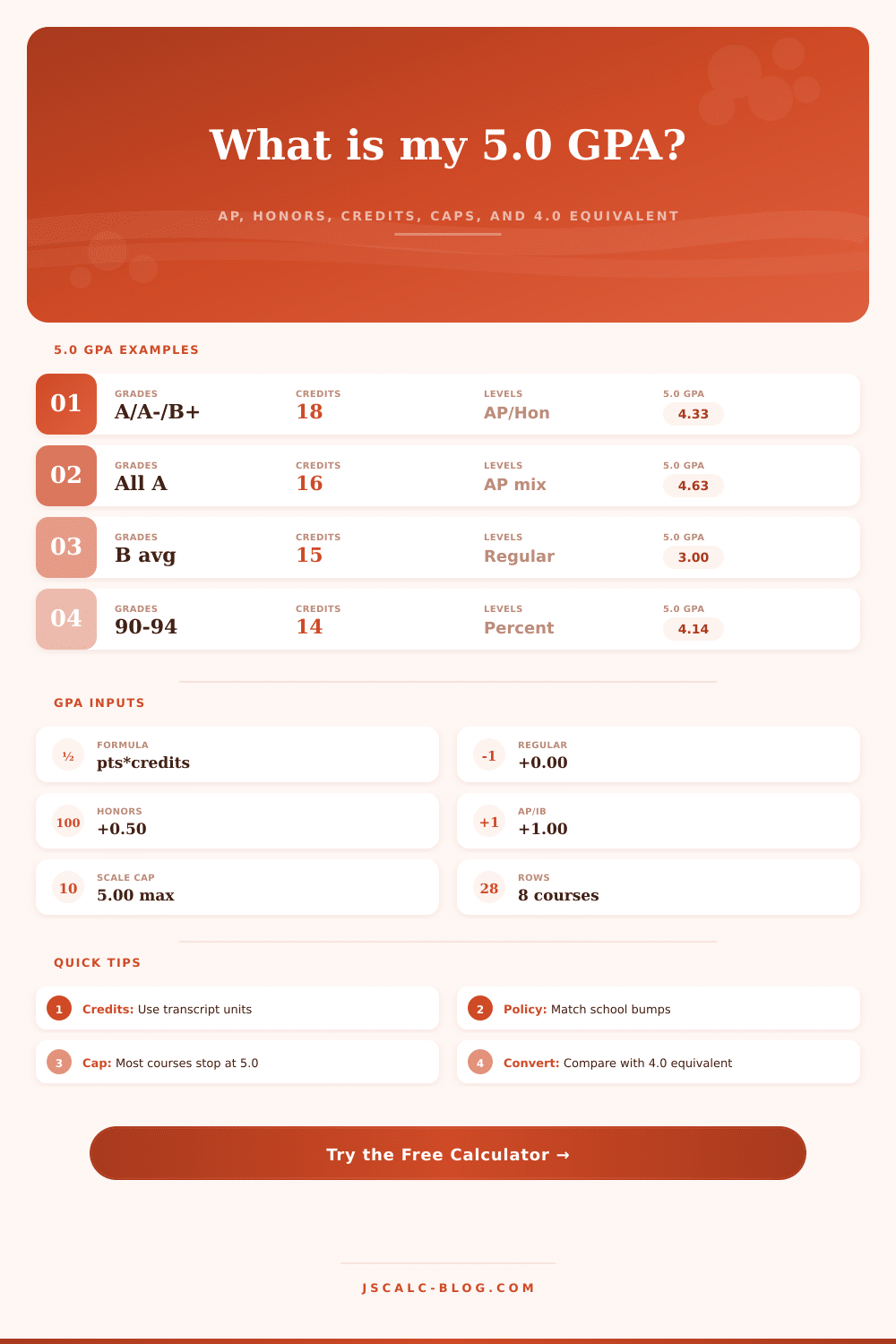
A college transcript is not simply a bunch of letter grades. College admissions is very concerned about course difficulty. That’s why there is 5.0 scale. Students is rewarded for taking hard classes. An A in a standard high school English course earn 4.0 grade points. An A in AP English equals 5.0 points. For college admissions officers, this distinction matter as it reflects the level of academic difficulty.
That’s where the math comes in. And it’s why I built the calculator here. The biggest variable go into the first box: the level of your course. Usually, schools will increase each grade by 0.5 if the class is honors-level, and increase it by 1.0 if it’s an AP or IB course. These increases occurs before the cap. If you score an A in an AP class, then that gets capped at 5.0. You don’t get a 6.0 or even a 5.1 for any one course on most standard scales. That cap ensures nobody can take all advanced courses and inflate their GPA. The cap requires some balance between performance and difficulty.
How to Calculate Your GPA
Grades aren’t everything, though; credits count, too. When calculating a weighted GPA, total isn’t an average. It’s a weighted average, meaning each class have an effect on the whole equal to its credit value. For example, an A in a 4-credit senior seminar will have double impact of an A in a 1-credit elective. Lots of kids forget this credit multiplier and only pay attention to their letter grade. Quality points is calculated by multiplying your weighted points by number of credits. Your final number is driven by these quality points.
Know your school’s policy Every district is different. Some have a hard limit on each class: no matter what the grade, each class has a max of 5.0. Other schools will let students goes above 5.0 if they recieve an A plus in an AP class (though this is unusual). Use the scale cap option to set how high your GPA can reach. Make sure it matches your transcript perfectly. Is your school on a 5.0 scale? Set it to 5.0. Are you on a 6.0 scale? Adjust. This is a mistake that results in an overly-optimistic, or overly-harsh, projected GPA. Be accurate and don’t be surprised by actual transcript.
The other nifty addition is that it calculates your 4.0 scale equivalent. Many colleges prefer to see your unweighted GPA, so they can compare across schools. To do this, the calculator takes your weighted score and divides it by the cap then multiplies it times 4.0. You’ll have a place to start. It removes the AP bonuses and lets you see how your grades appear using a normal ruler. It’s a nice sanity check (are you really excellent), or did you get a big weighted score because of heavy weighting?
But don’t discount the running total. What you have right now was in the past. What you have from here on out is up to you. Plug in what you’ve got so far (credits earned, weighted GPA) and observe how much work would of been needed for this term to change the outcome. It requires many A+s to move from a weighted 4.1 to a 4.5 if you’re already at 72 credits. The numbers won’t lie. Once the anchor is down, the boat has nowhere to go. History anchors the ship. Future grades must pulls in the opposite direction.
That’s how it breaks down on the table; you can see the source of every point in clear detail: base grade, bump, weighted value. That helps you catch mistakes. Why aren’t my AP courses getting the full bump? Did I check that under policy settings? Why don’t the quality points look so good? Check those out (there is credits involved). It is a diagnostic tool and a calculator.
Weighted GPA: This is more like a game of leverage. Take as many hard classes as possible to add heft to your weight, but don’t take so many that they brings down your grades. Aim for a big weighted average, not necessarily a big number of AP class. Try experimenting. What would happen if you dropped that harder AP class in favor of an honors one? How does the number change? How about the opposite? The right mix tends to be one that signals to admission officers that you’ve taken rigorous courses, yet also one that maintains your own confidence. Do the math and see if you’re on track.