Weight Converter
Convert between kilograms, grams, milligrams, pounds, ounces, stone, metric tonnes, and US tons. Enter any weight to see every unit at once with the exact conversion factors used.
🎯Real Conversion Presets
📝Convert A Weight
Type the amount you want to convert.
👶Body Weight Helper (lb + oz)
Handy for newborn weights, deli portions, and boxing/wrestling class limits. This loads the total into the converter above as ounces.
🔢All Units At Once
| Unit | Symbol | Value | Grams Per Unit |
|---|---|---|---|
| Enter a value above to see it in every unit. | |||
📏Conversion Factor Reference
📊Full Conversion-Factor Table
| Unit | Symbol | Grams Per Unit | System |
|---|---|---|---|
| Milligram | mg | 0.001 | Metric |
| Gram | g | 1 | Metric |
| Ounce | oz | 28.349523125 | Avoirdupois |
| Pound | lb | 453.59237 | Avoirdupois |
| Kilogram | kg | 1000 | Metric |
| Stone | st | 6350.29318 | Imperial |
| US ton (short) | tn | 907184.74 | US customary |
| Metric tonne | t | 1000000 | Metric |
🍴Common Weights Reference
| Everyday Item | Metric | Imperial | Category |
|---|---|---|---|
| Bag of sugar | 1 kg | 2.205 lb | Kitchen |
| Stick of butter | 113 g | 4 oz | Kitchen |
| Newborn baby | 3.4 kg | 7 lb 8 oz | Body |
| Adult (average) | 70 kg | 11 st 0 lb | Body |
| Cup of flour | 125 g | 4.4 oz | Kitchen |
| Gold bar (1 oz) | 31.1 g | 1 troy oz | Precious |
| Bag of cement | 25 kg | 55.1 lb | Building |
| Small car | 1.2 t | 1.32 US ton | Vehicle |
⚖Metric vs Imperial Quick Grid
| Amount | Grams | Kilograms | Pounds | Ounces | Stone |
|---|---|---|---|---|---|
| 1 oz | 28.35 | 0.028 | 0.063 | 1.000 | 0.004 |
| 1 lb | 453.59 | 0.454 | 1.000 | 16.00 | 0.071 |
| 500 g | 500.00 | 0.500 | 1.102 | 17.64 | 0.079 |
| 1 kg | 1000.0 | 1.000 | 2.205 | 35.27 | 0.157 |
| 1 stone | 6350.3 | 6.350 | 14.00 | 224.0 | 1.000 |
| 10 kg | 10000 | 10.00 | 22.05 | 352.7 | 1.575 |
| 50 lb | 22680 | 22.68 | 50.00 | 800.0 | 3.571 |
| 100 kg | 100000 | 100.0 | 220.5 | 3527 | 15.75 |
📐Pounds + Ounces to Kilograms
| Body Weight | Total Ounces | Kilograms | Grams |
|---|---|---|---|
| 5 lb 0 oz | 80 oz | 2.268 kg | 2268 g |
| 6 lb 8 oz | 104 oz | 2.948 kg | 2948 g |
| 7 lb 8 oz | 120 oz | 3.402 kg | 3402 g |
| 8 lb 6 oz | 134 oz | 3.799 kg | 3799 g |
| 9 lb 4 oz | 148 oz | 4.196 kg | 4196 g |
| 10 lb 0 oz | 160 oz | 4.536 kg | 4536 g |
⚙Full Formula Breakdown
💡Practical Conversion Tips
For most folks, it’s obvious: Pounds aren’t the same thing as kilograms. But getting back and forth between those units can be confusing. Maybe you’re standing in the grocery store in another country, staring down a bag of rice marked with metric measurements. Or maybe you’re checking the shipping price. You might see the cargo weight listed in US tons on one part of the screen and stones on your scale.
Why? It is rarely because we don’t know any better. Rather, it’s because of the random way that humanity determined how it should weighs things. Various areas had their own system for various needs; now, it’s up to you to do all the translating.
Why Weight Units Are Different
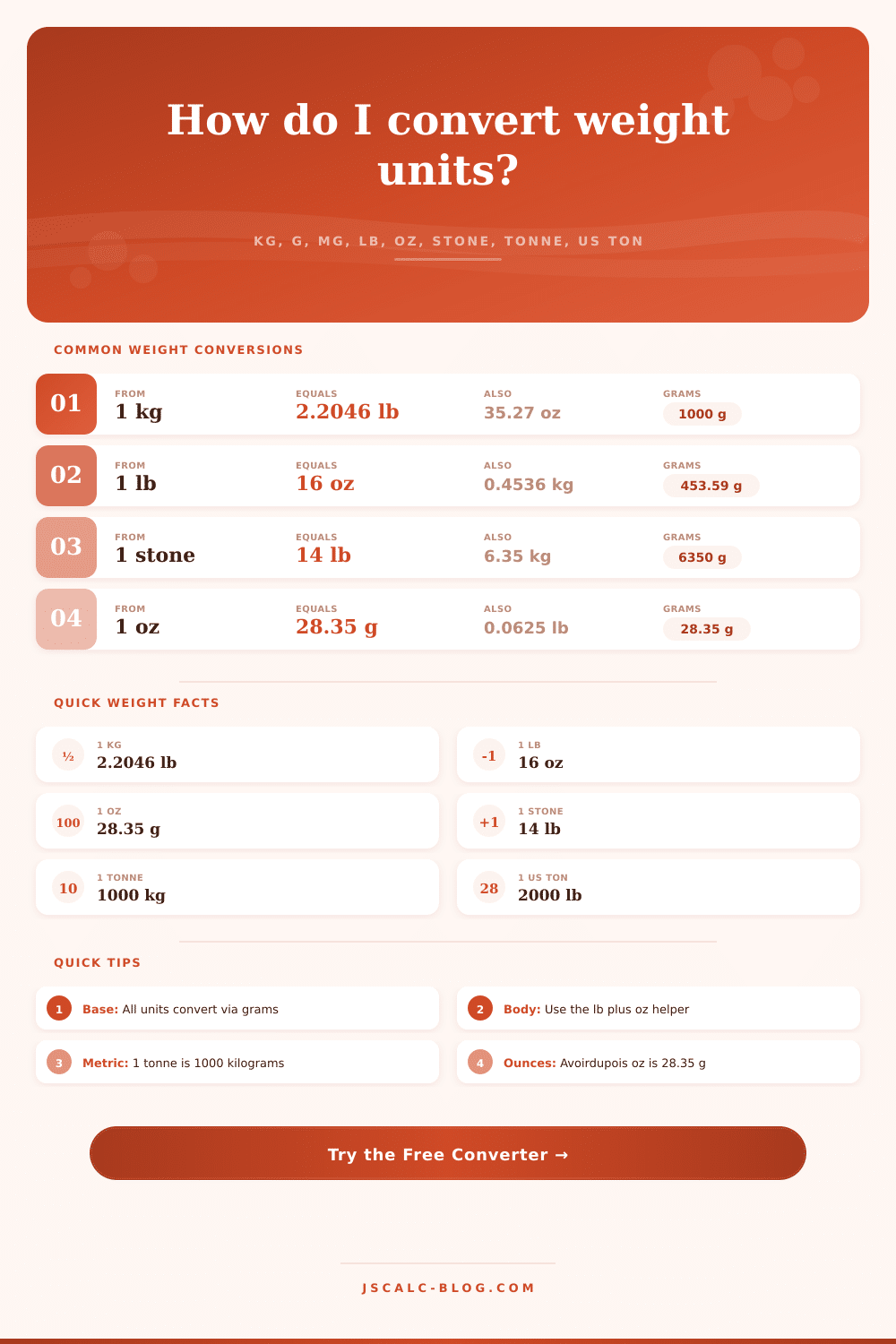
I did find one solution though, and it’s what this tool (this page) does automatically. It anchors every measurement in a common base unit, in this case, the gram. That’s far superior to remembering some arbitrary ratio of pounds to kilograms, or ounces to stones. Instead, whatever you put in gets converted to grams first. Then we have a neutral middle point and can move from there out to any other units without any possibility of being wrong.
It’s similar to when you’re traveling somewhere and need to exchange currency: You change everything over to cash and then convert to the local currency. Voila! Accurate conversion, regardless of which currencies you remember are equivalent to each other (a pound = 14 ounces? Or is it 15?)
I mean that it doesn’t really matter whether we get a number; understanding what those units represent is much more important. For example, a kilogram isn’t an arbitrary value. In fact, the original definition of a kilogram was mass of a liter of water. You know what that means? It has some sort of physical intuition that can be applied to chemistry or cooking.
Pounds are taken from the avoirdupois system, which has been around for hundreds of years for commercial use, and they’re divided into 16 ounces. For someone who uses the metric system, this division seem strange, yet it makes sense if you think about baking a loaf of bread or measuring a piece of meat in smaller pieces.
Finally, there’s the stone, which is all sorts of weird and, believe it or not! It is still used in the UK today to describe body weight. Instead of having a three digit pound value, you break a human being down into an easy, two-digit number. One-hundred-and-forty pounds sounds like more harder to monitor over time than sixty stone.
Precision really matters when you move beyond kitchen scales and household items into science and industry. A metric tonne isn’t the same thing as a US short ton; it’s almost a fifth lighter. Get those figures mixed up and you might order too little or to much material for your building job. You might also find yourself accidentally underestimating how much a freight lorry can carry. Thankfully, the calculator makes it clear what both weights are so you don’t make an expensive mistake.
Similarly, if you’re dealing with precious metal then be aware: a troy ounce isn’t the same as an avoirdupois one. Use the wrong standard and you could of been left short-changed; but none the wiser about why. Gold sellers sell by the troy ounce; they’re heavier than avoirdupois ones.
Rounding errors add up. They’re one reason we often overlook them during regular conversions. Convert a metric measurement from abroad to an American measurement (ounces to cups) by eyeballing it in a recipe, and your cake will be a disaster. Cooking, especially baking, is chemistry, and chemistry require accuracy. And if the tables of references below don’t convince you of the precise ratios involved and why your inaccurate measuring instruments won’t yield exactly half a cup from 100 grams of flour, nothing will. It is less about replacing words than about respecting the relationship between mass and density, without which everything fall apart.
There are preset options for typical situations, such as standard luggage limits or baby weights. These are often the moments when everyone panics and tries to google something. When all else has been stressful, just one click and it’s done. Converting your newborn weight from pound-ounces to kilograms. It is a small convenience, but it provides fast clarity that you’ll appreciate when you need it.
But ultimately, what matters is that gravity acts upon mass, no matter how much we measure it differently. Whether you’re measuring groceries or gold, it’s about getting your head around reality. All you have to do is put all the units in front of you and then the magic vanishes. The guesswork turns into knowledge. And that’s why learning these conversions is worthwhile, one gram at a time.