Buy vs Lease Calculator
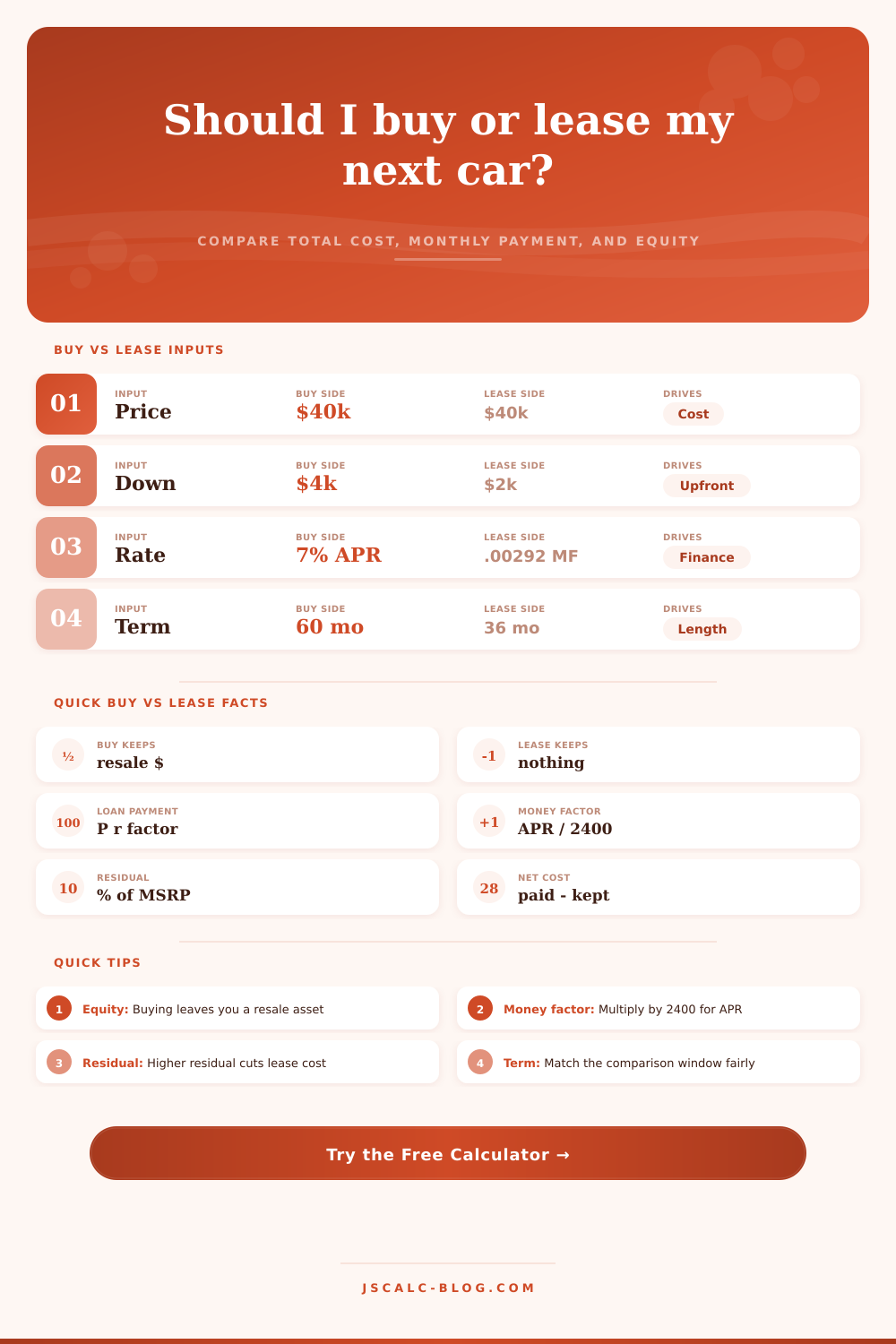
Compare the true total cost of financing a car against leasing it over the same window. See monthly payments, retained equity, net cost after resale, and which choice actually costs less.
🎯Real Buy vs Lease Presets
📝Vehicle & Comparison Inputs
Both paths are measured over this same window for a fair comparison.
If longer than the comparison term, remaining loan balance is treated as owed against equity.
What the car is worth when the comparison window ends. This is equity you keep.
Used when method is quoted monthly payment.
Used when method builds from residual + money factor.
Multiply by 2400 for an approximate APR. 0.00250 is about 6.0%.
🔢Comparison Snapshot
📊Buy vs Lease Cost Breakdown
| Cost Component | Buy (Finance) | Lease | Notes |
|---|---|---|---|
| Enter values above to build the buy vs lease cost breakdown. | |||
📅Monthly Payment Comparison
| Milestone | Buy Paid To Date | Lease Paid To Date | Buy Equity |
|---|---|---|---|
| The month-by-month comparison appears after calculation. | |||
⚖Equity vs No-Equity Reference
| Factor | Buying (You Own) | Leasing (You Rent) |
|---|---|---|
| End-of-term asset | Car worth its resale value | Nothing; car goes back |
| What payment covers | Full price plus interest | Depreciation plus rent charge |
| Typical monthly cost | Higher month to month | Lower month to month |
| Mileage limits | None; drive freely | Capped; overage fees apply |
| Customization | Modify as you like | Must return near stock |
| Long-run value | Cheaper if kept many years | Costs restart every lease |
| Early exit | Sell or trade anytime | Costly termination fees |
📘Lease Terms Glossary
| Term | What It Means | Typical Range | Effect On Cost | Watch For |
|---|---|---|---|---|
| Cap cost | Negotiated price the lease is based on | Below MSRP | Lower cap cost lowers payment | Fees rolled in silently |
| Residual value | Predicted worth at lease end | 45% to 65% MSRP | Higher residual cuts payment | Set by the bank, not you |
| Money factor | The lease interest rate in decimal form | 0.0010 to 0.0040 | Lower factor lowers rent charge | x2400 to see true APR |
| Depreciation | Cap cost minus residual | Varies by car | The core of every payment | Fast-depreciating models |
| Rent charge | Finance portion of the payment | (cap + residual) x MF | Adds interest each month | High on luxury leases |
| Drive-off | Total due at signing | $0 to $5k+ | Cuts payment but is real cost | Lost if car is totaled |
| Mileage cap | Annual miles included | 10k to 15k / yr | Overage billed per mile | Long commutes add up |
| Disposition fee | Return fee at lease end | $300 to $500 | Adds to total lease cost | Waived if you re-lease |
🗂Buy vs Lease Comparison Grid
| Scenario | Price | Buy Down / APR | Resale End | Lease / Term | Likely Winner |
|---|---|---|---|---|---|
| $35k Sedan 3yr | $35,000 | $3.5k / 6.9% | $21,000 | $419 / 36mo | Close; buy edges |
| $50k SUV Lease | $50,000 | $5k / 7.4% | $29,000 | $589 / 36mo | Lease short-term |
| Luxury Lease | $72,000 | $7k / 7.9% | $36,000 | $899 / 36mo | Lease usually |
| $25k Economy | $25,000 | $2.5k / 6.5% | $14,500 | $299 / 36mo | Buy long-term |
| Long Buy 6yr | $40,000 | $4k / 7.0% | $16,000 | $479 / 36mo | Buy strongly |
| High Residual | $45,000 | $4.5k / 7.2% | $30,000 | $449 / 36mo | Lease competitive |
| 0% APR Buy | $38,000 | $4k / 0.0% | $21,000 | $465 / 36mo | Buy strongly |
| Business Lease | $55,000 | $6k / 7.5% | $30,000 | $629 / 39mo | Lease + tax perk |
⚙Full Formula Breakdown
💡Practical Buy vs Lease Tips
The dealer’s showroom floor is commonly a trap. Dealers care about monthly payment; they don’t care about the vehicle. You sit in that chair, and the monthly payment they show you is often lower than what your budget comfortabley handles. That low number feels good until you reach the end of your lease and start all over again.
By contrast, when you buy, you build up equity that belongs to you even though the asset’s value goes down over time. If you have the details at hand, our calculator will compute it for you. But more important than the last digit, you need to understand how these figures work. Your decision comes down to whether you’re willing to pay for a loss in value through rent or own something that decreases in value every day.
Leasing or Buying: Which Is Better?
You can lease and feel like you’re getting a deal. You’ll pay a finance charge, or “money factor,” but only on how much the car decreases in value during your time with it. But then you have to remember they tricked you by making the money factor appear as if it were a small number, when in fact it’s just interest rate divided by 2,400.
You buy and you’ll pay full price for the vehicle: interest and principal. And at the end? It’s yours. Keep driving past the day payment stops? Your cost per mile will be much lower. So even if you send bigger checks every month long-time owners often save money this way.
The catch? Liquidity vs. It is about ownership. By leasing, you keep more cash in your pocket monthly; by buying, you tie up that money in rusting and depreciating metal. The most important part is how you set the comparison window. Mixing apples and oranges by comparing a five year loan versus a three year lease, without accounting for the difference in duration; isn’t going to yield a fair result. Because the tool compares each path during same months, you’ll clearly observe how you spend your money during that common timeframe.
When buying, it accounts for the resale price: It takes what you paid and then removes the value the car retains after you sell. Because you keep the vehicle throughout this window, that remaining value will cancel out some of your initial investment. This doesn’t happen with leasing. At the conclusion of the comparison, you hand back the keys, stroll away … and if you’re lucky, you might recieve a disposition fee. People make the mistake of focusing only on the monthly payment and failing to consider this offset.
The math relies heavily on residual value. A higher value means the car retains its worth better. This results in lower payments because you are deferring less depreciation. If the market expects a luxurius SUV to retain 60% of its value over three years, then so be it; you’ll pay less each month. But if the market is mistaken, and the used value turns sour, you’re stuck anyway.
With ownership, you absorb that risk head-on. If used-car prices drop like a stone, so does your equity. But you have the option to liquidate at peak times, or continue driving indefinitely once the mortgage expire. You gain the freedom to ride for free. In return, leasing takes away risk, and reward. There’s no upside to a booming used-market, since you lack ownership of the underlying asset.
But that all depends on how many miles you put on them, and that’s where the decision makes sense based off your lifestyle. With leases, there are hard mileage caps (typically 10-15k miles per year). If you exceed them, you’ll have to pay per-mile fees, which can get expensive if you do a lot of long commutes or go on road trips. On the flip side, buyers don’t worry about mileage. Drive as much or as little as you desire. There won’t be any penalties when it’s time to turn it back in.
It’s the same with customization. Owners wear out their vehicles, dent ’em up and mod ’em to express themselves. But that defies the lease agreement, which says you need to return vehicle close to stock. There’s an upfront cost to having the freedom of owning your own ride, but it pays off down the line in terms of convenience.
The interest rate also plays a role. Lower financing rates make buying far more compelling because it means it costs less to borrow money. Lease money factors at high levels can wipe out any advantage from lower depreciation payments. To compare apples to apples with your loan offer you should convert that factor to an annual percentage rate. If you want to dig into the definition, the reference table on the page lays it out clearly.
Most shoppers forget to include drive-off cash they have to write up front when signing the deal. Add that upfront cost back into the monthly total and you’ll see the real price of the lease. So in conclusion, if you prefer guaranteed short term expenses, warranty protection, and the latest tech, lease it. If you prefer having an asset with residual value, and intend to maintain ownership beyond three years. Buy it.
One isn’t necessarily better than the other. Your answer depends upon what type of relationship you have with the vehicle and your cash flow needs. Is it a friend? Or just a tool to be replaced every few years? The net cost helps separate the marketing hype from reality. What’s really happening to your money. After seeing the complete picture, the game no longer feels like a trick; it becomes mere math.