Discount Rate Calculator
Work out the sale price and dollars saved from any percent-off deal, reverse-solve the discount rate when you know the original and sale price, and stack successive markdowns or coupons the correct way. Add sales tax after the discount and see the per-item price to know exactly what you will pay at the register.
🏷Choose a Mode
🎟Real Sale Scenarios
🛒Deal Inputs
Pre-sale ticket price of a single item.
Switch between a % markdown and a flat $ coupon.
Percent off for a single markdown, e.g. 30.
Flat dollars taken off the original price.
Discounted price shown; used to solve the rate.
Applied first, e.g. the storewide sale.
Extra markdown taken off the reduced price.
Optional loyalty or card discount; 0 if none.
Applied after the discount; 0 for tax-free.
Number bought; drives the per-item and cart totals.
🔢Formula Snapshot
📋Common Percent Off per $100
| Percent Off | Price Multiplier | You Pay per $100 | You Save per $100 |
|---|---|---|---|
| 5% off | 0.95 | $95.00 | $5.00 |
| 10% off | 0.90 | $90.00 | $10.00 |
| 15% off | 0.85 | $85.00 | $15.00 |
| 20% off | 0.80 | $80.00 | $20.00 |
| 25% off | 0.75 | $75.00 | $25.00 |
| 33% off | 0.67 | $67.00 | $33.00 |
| 40% off | 0.60 | $60.00 | $40.00 |
| 50% off | 0.50 | $50.00 | $50.00 |
| 60% off | 0.40 | $40.00 | $60.00 |
| 70% off | 0.30 | $30.00 | $70.00 |
| 75% off | 0.25 | $25.00 | $75.00 |
📊Stacked Discount Effective Percent Matrix
| First + Second | Additive Guess | True Multiplier | Real Effective Off | Difference |
|---|---|---|---|---|
| 10% + 10% | 20% | 0.90 × 0.90 | 19.0% off | 1.0% less |
| 20% + 10% | 30% | 0.80 × 0.90 | 28.0% off | 2.0% less |
| 20% + 20% | 40% | 0.80 × 0.80 | 36.0% off | 4.0% less |
| 25% + 10% | 35% | 0.75 × 0.90 | 32.5% off | 2.5% less |
| 30% + 15% | 45% | 0.70 × 0.85 | 40.5% off | 4.5% less |
| 40% + 20% | 60% | 0.60 × 0.80 | 52.0% off | 8.0% less |
| 50% + 20% | 70% | 0.50 × 0.80 | 60.0% off | 10.0% less |
| 50% + 25% | 75% | 0.50 × 0.75 | 62.5% off | 12.5% less |
🎫Percent Off vs Dollar Off Break-Even
| Original Price | $10 Off Equals | $20 Off Equals | 15% Off Equals | Better Deal Under $67 |
|---|---|---|---|---|
| $25 | 40% off | 80% off | $3.75 off | Dollar off wins |
| $40 | 25% off | 50% off | $6.00 off | Dollar off wins |
| $50 | 20% off | 40% off | $7.50 off | Dollar off wins |
| $67 | 14.9% off | 29.9% off | $10.05 off | Roughly even |
| $100 | 10% off | 20% off | $15.00 off | Percent off wins |
| $150 | 6.7% off | 13.3% off | $22.50 off | Percent off wins |
| $250 | 4.0% off | 8.0% off | $37.50 off | Percent off wins |
📚Retail Markdown Glossary
| Term | What It Means | Typical Range | Shopper Note |
|---|---|---|---|
| MSRP / List | Full ticket price before any cut | Baseline 0% off | The number the % is taken from |
| Markdown | Permanent price reduction | 10% to 40% off | New shelf price, not temporary |
| Clearance | Final markdown to clear stock | 50% to 80% off | Often stacks an extra % off |
| Coupon (%) | Percent taken at checkout | 10% to 25% off | Applies to subtotal, not tax |
| Coupon ($) | Flat dollars off a threshold | $5 to $25 off | Best on lower-priced items |
| BOGO 50% | Second item at half price | 25% effective off | Only if you buy two |
| Rebate | Refund after purchase | $10 to $50 back | Not an instant sale price |
🗃Sale Scenario Comparison Grid
| Scenario | Original | Discount | Sale Price | You Save | Effective % Off |
|---|---|---|---|---|---|
| 30% Off $80 Item | $80.00 | 30% | $56.00 | $24.00 | 30.0% |
| Clearance 50% + 20% | $80.00 | 50% + 20% | $32.00 | $48.00 | 60.0% |
| Black Friday 40% | $120.00 | 40% | $72.00 | $48.00 | 40.0% |
| Coupon $15 off $75 | $75.00 | $15 flat | $60.00 | $15.00 | 20.0% |
| Successive 25% + 10% | $60.00 | 25% + 10% | $40.50 | $19.50 | 32.5% |
| Student 10% Stacked | $90.00 | 20% + 10% | $64.80 | $25.20 | 28.0% |
| Find Rate: $100 to $65 | $100.00 | solve rate | $65.00 | $35.00 | 35.0% |
| BOGO Effective % | $50.00 | 2nd 50% off | $37.50 | $12.50 | 25.0% |
| Deep Clearance 70% | $200.00 | 70% | $60.00 | $140.00 | 70.0% |
| Reverse: Save from Rate | $45.00 | 25% | $33.75 | $11.25 | 25.0% |
⚙Formula Breakdown
💡Smart Shopping Tips
When it comes to retail math, the check-out counter is where math gets personal, and final number on your screen rarely matches the one in your head. Markdowns at store may look easy on the surface, but there are two traps lurking in the arithmetic. First: if you see only prices posted, you has to reverse the rate yourself, leaving you guessing whether or not it’s a good deal. Second: if you’re faced with combined promotions that stack instead of add, the value dissapears. This drains value from what appears to be a great offer.
This calculator takes care of both problems. You can enter original price, a percent off, and it calculates the sale total for you. And it handles follow-up sales, discounts, and even sales tax, so you get exact figure on the register before you pass your card over.
How to Calculate Sale Prices and Discounts
The simple definition of a discount rate (as in the percentage off something), is merely the fraction of your money that isn’t spent on an object after a markdown has been applied. For example: if a $100 jacket goes on sale at 35% off, you save $35 from original purchase. That means the discount rate is 35%. You’ve shaved off 35 bucks out of the full hundred bucks. This is retail math, pure and simple. It’s not financial math, involving time and interest rates and present value; it’s about the dollar amount paid today versus the price marked on the shelf. It include coupons and other thing.
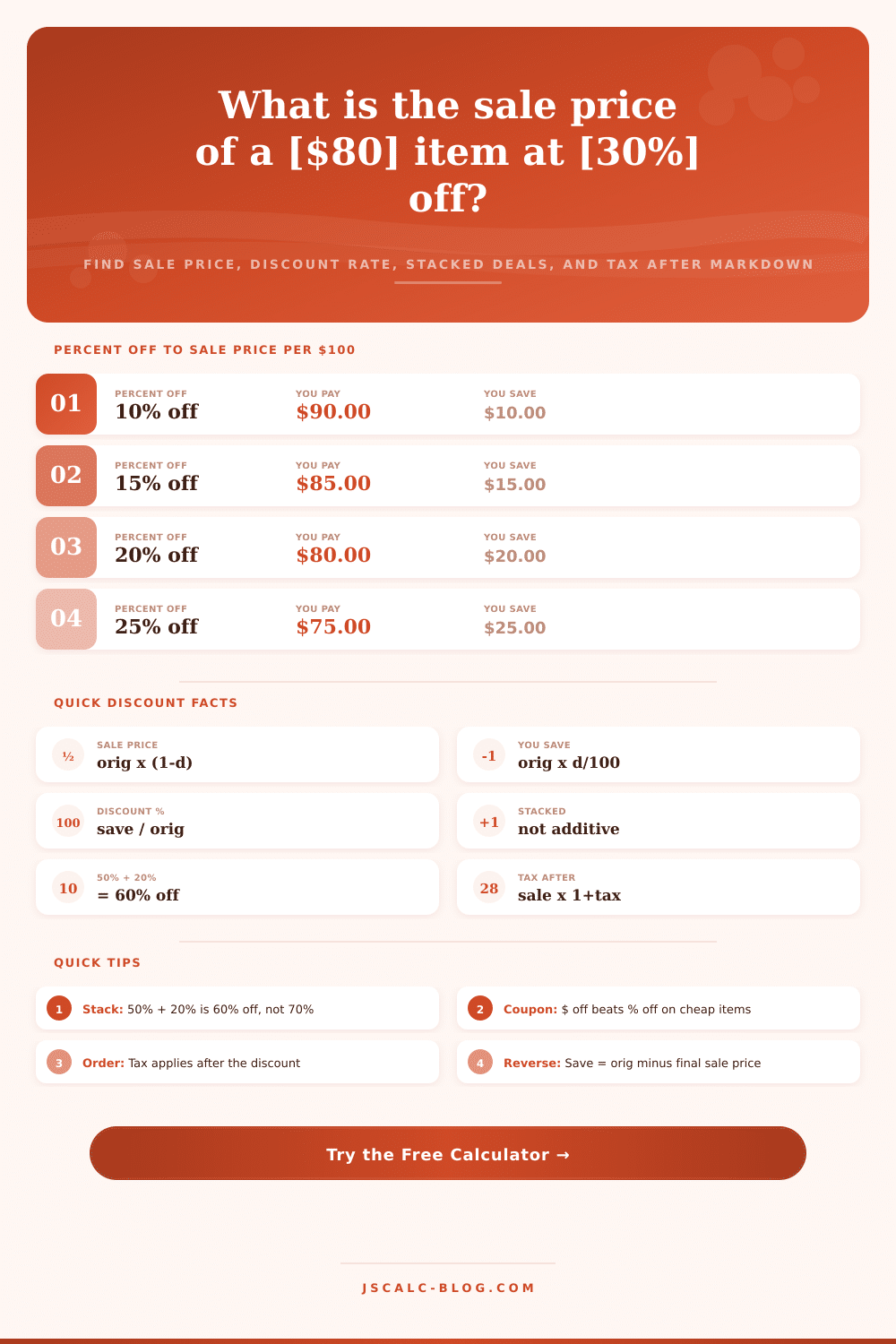
Most of the time, people want to find the sale price from a percentage, which is simply original price times (one minus the discount, expressed as a decimal). If something’s 30% off, an $80 sweater will be marked down to $56 and you’ll save $24. It displays those two values so you can see the discount from both perspectives.
If you switch it to fixed dollars off, though, it will subtract a flat dollar amount for you and tell you what effective percentage discount that coupon would represent on your particular item. That’s important, since a fifteen dollar coupon seems like a huge discount on a $50 shirt, while it barely makes a difference on a laptop.
Reverse solve: Reverse solve mode works when stores show just two prices… Leaving it up to you to judge if this is a good deal or not. With reverse solve, you plug in a price as your sale price and then feed it the price on the item tag (the original list price) to get the rate exactly. A shirt is marked down from forty-five to thirty-three-point-seventy-five. It is twenty-five percent off. A sign screaming big savings may actualy be just fifteen percent off once you crunch the numbers. Work backward to find the answer, and you know for sure what the rate really is. You don’t have to guess, which means you can instantly compare the markdown at one store different than another.
Adding stacked discounts together is number-one shopper error. But “fifty percent off plus another twenty” isn’t “seventy percent off.” Because they apply to the reduced price, the factors multiply. You’re still paying 40 percent of the original price, or sixty percent less then before. And the more discounts you have, the greater the gap. Nineteen percent off (two ten percent discounts) is just one point from the naive guess of twenty. But fifty-two percent off (forty plus twenty) is a whopping eight points under what people expect. In other words, they expect sixty. That’s because the calculator’s stack mode support up to three layers. This can accommodate loyalty cards and category markdowns on top of storewide sales, for example.
There are two kinds of coupons: the kind where you get x-percent off, and the kind where you get a certain dollar amount off. Which is best? That’s simple: It depends on the price. On an expensive product, the dollar-off coupon will be a smaller percentage; on a cheap product, it’ll be a larger one. If I have a $25 product with a $10 coupon, that’s 40% off, which is great. If I have a $250 product with a $10 coupon, that’s just 4%, not such a good deal. Conversely, if I have a percentage coupon, the kind where it says “15% off” or something, then higher the price, the more I save (in dollar terms). The place where the 15% discount meets the $10 discount is at about $67. If your item is under that number, use the flat dollars. If it’s over, go with the percentage.
This applies to sales as well: when you buy something on sale, they charge you sales tax on the discount, which means they’ll only be charging you sales tax on the lessened amount. This makes sense, but it makes for some weird math. So how do they calculate what you’re paying? They multiply the sale price by 1 plus the tax rate (i.e., 1 + sales-tax/100). If I bought a $56 item with an 8% sales tax, I would of paid $60.48 after-tax. The sale price times one-plus-tax equals final price.
This is why entering a quantity will tell you the total for your entire cart and also report the per-item price. This can help if you’re purchasing multiples of the same marked-down item. Once you’ve set your preset to match your circumstance, tweak the variables until they match your actual figures. The next step is reading the result cards. This converts confusing sale math into clear, trustworthy information. That is the real discount you recieve every single time you shop.