Pressure Converter Table
Convert any pressure value between psi, bar, kPa, MPa, atm, mmHg, inHg, and Pa. Every conversion runs through Pascals, shows all eight units at once, and builds a live reference table across a range you choose.
🎯Common Pressure Presets
📝Conversion Inputs
The amount to convert, in the from-unit below.
Row spacing for the generated table below.
📊Live Conversion Table
| Value | psi | bar | kPa | MPa | atm | mmHg | inHg | Pa |
|---|---|---|---|---|---|---|---|---|
| Set a start, end, and step above to generate the conversion table. | ||||||||
🔢Pressure Unit Factors (to Pascals)
📋Unit Conversion Factors Table
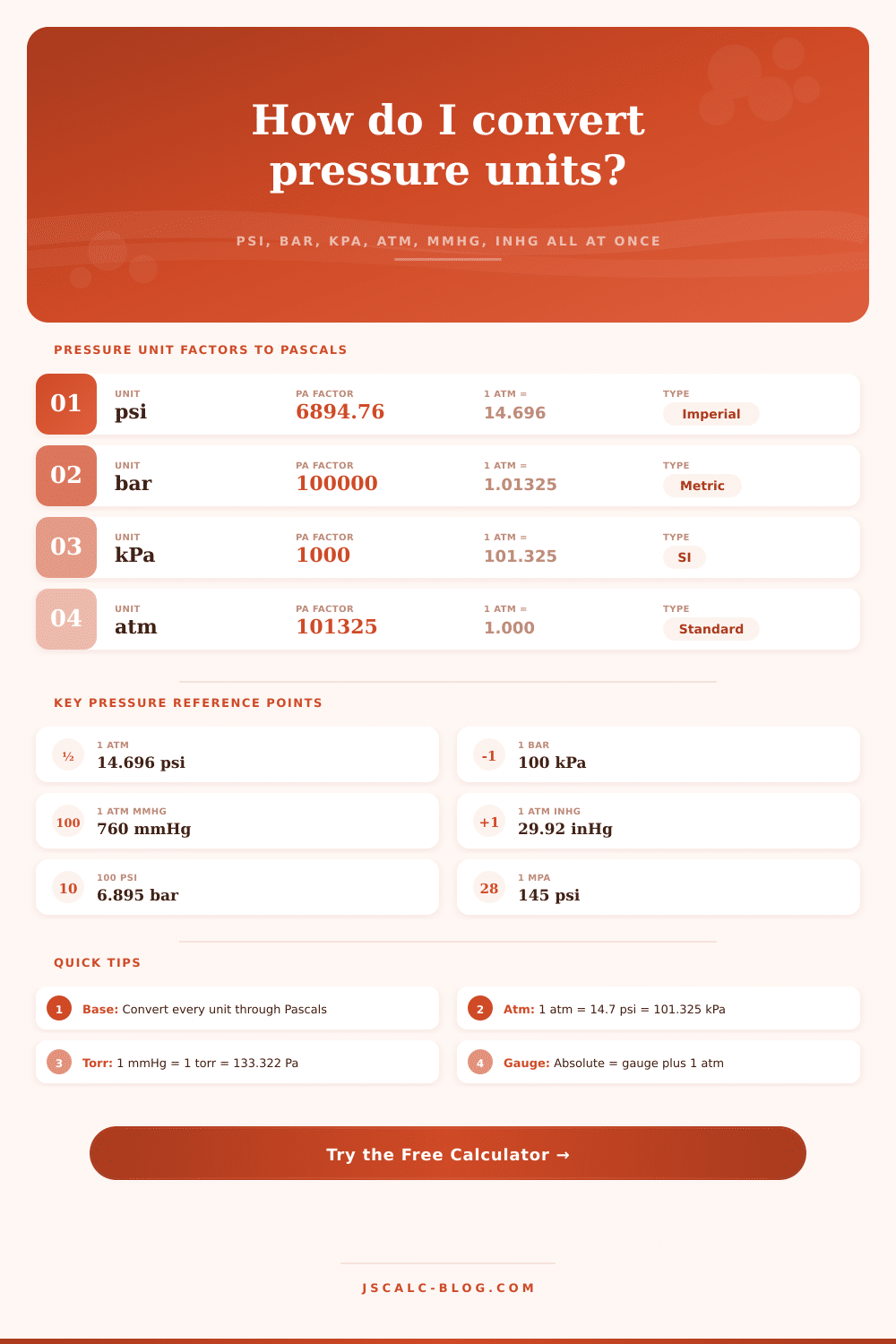
| Unit | Symbol | Pascals per Unit | 1 atm Equals | Category |
|---|---|---|---|---|
| Pascal | Pa | 1 | 101,325 Pa | SI base |
| Kilopascal | kPa | 1,000 | 101.325 kPa | SI derived |
| Megapascal | MPa | 1,000,000 | 0.101325 MPa | SI derived |
| Bar | bar | 100,000 | 1.01325 bar | Metric |
| Pound / sq inch | psi | 6,894.76 | 14.696 psi | Imperial |
| Atmosphere | atm | 101,325 | 1.000 atm | Standard |
| Millimeter mercury | mmHg / torr | 133.322 | 760 mmHg | Manometric |
| Inch of mercury | inHg | 3,386.39 | 29.92 inHg | Manometric |
🗂Common Pressures in All Units
| Scenario | psi | bar | kPa | atm | mmHg |
|---|---|---|---|---|---|
| Sea-level atmosphere | 14.70 | 1.013 | 101.3 | 1.000 | 760 |
| Car tire (32 psi) | 32.00 | 2.206 | 220.6 | 2.177 | 1,655 |
| Road bike tire (100 psi) | 100.0 | 6.895 | 689.5 | 6.805 | 5,171 |
| Blood pressure (120 mmHg) | 2.320 | 0.160 | 16.00 | 0.158 | 120 |
| Espresso machine (9 bar) | 130.5 | 9.000 | 900.0 | 8.883 | 6,751 |
| Propane tank (200 psi) | 200.0 | 13.79 | 1,379 | 13.61 | 10,342 |
| Scuba tank (3000 psi) | 3,000 | 206.8 | 20,684 | 204.1 | 155,133 |
| Hydraulic (1 MPa) | 145.0 | 10.00 | 1,000 | 9.869 | 7,501 |
⚖psi – bar – kPa Quick Chart
| psi | bar | kPa | atm | mmHg |
|---|---|---|---|---|
| 10 | 0.689 | 68.95 | 0.680 | 517 |
| 20 | 1.379 | 137.9 | 1.361 | 1,034 |
| 30 | 2.068 | 206.8 | 2.041 | 1,551 |
| 40 | 2.758 | 275.8 | 2.722 | 2,069 |
| 50 | 3.447 | 344.7 | 3.402 | 2,586 |
| 60 | 4.137 | 413.7 | 4.083 | 3,103 |
| 80 | 5.516 | 551.6 | 5.444 | 4,137 |
| 100 | 6.895 | 689.5 | 6.805 | 5,171 |
🌍Atmospheric & Vacuum References
| Reference Point | psi | kPa | atm | mmHg | Notes |
|---|---|---|---|---|---|
| Perfect vacuum | 0.00 | 0.00 | 0.000 | 0 | Absolute zero pressure |
| Deep vacuum (500 mmHg abs) | 9.67 | 66.66 | 0.658 | 500 | Partial vacuum |
| Sea level (1 atm) | 14.70 | 101.3 | 1.000 | 760 | Standard reference |
| 5,000 ft altitude | 12.23 | 84.31 | 0.832 | 632 | Lower ambient pressure |
| 10,000 ft altitude | 10.11 | 69.68 | 0.688 | 523 | Thin air, aviation |
| Standard boiling steam (2 atm) | 29.39 | 202.7 | 2.000 | 1,520 | Pressure cooker range |
⚙How The Conversion Works
💡Pressure Conversion Tips
You may not notice it, but pressure exists in every direction. It’s what inflates your car’s tires during a cross-country drive. It hold your atmosphere up. It presses on your body as you read this sentence. But unless there’s an issue. Your pressure cooker whistling with an alarm or your tire going flat, you don’t often consider pressure at all.
That’s where we get into trouble, though: We measure it in an endless variety of unit. This one person speaks of psi; that one speaks of bar; that other guy reaches for the kilopascals. It’s a confusing mix of words, and sometimes expensive error. So why wouldn’t you want to have them all side-by-side in a single location?
Why Converting Pressure Units Is Hard
After plugging in that initial number, the calculator do the work for you (above). No need to flip through some strange conversion chart and run the risk of a decimal screwup on your smartphone display. Each unit is converted to pascals, the SI base unit; from there the ratios stays the same regardless of how different metric and imperial seem. Just select your source unit, type in a number and watch as the calculator instantly fills out psi, bar, kPa, MPa, atm, mmHg, inHg and Pa all at once.
The live table function make it easy to scan through a range instead of having to calculate individual points. And it’s nice when monitoring whether a system remain in safe operating limits under different condition. Numbers are just numbers unless we know what they mean. In the U.S., where most of us were raised using imperial units, pounds per square inch reigns supreme in industrial and automotive areas. It’s something we can wrap our heads around.
Over in Europe, bar is everywhere, used on espresso machines, scuba tanks and so on. It’s a more tidy metric option than psi but doesn’t require wading into the nitty-gritty world of pascals. Around the world, kilopascals fill out weather reports and engineering drawings. They’re the go-to unit. Atmospheres give us a reference point that’s easy to understand as humans, providing a way to think about how much pressure is “normal” at ground level. Millimeters of mercury connect the physical world to medicine; a doctor can use something familiar (blood pressure) and still have confidence that they are doing science correctly.
Even techs who’ve been around the block for years gets tripped up by the difference between absolute and gauge pressure. A gauge measures pressure as “relative” to its environment, which most often means “ambient air.” When a gauge reading say your tire has 32psi in it, it actually has about 47psi absolute. This is the actual amount of force being applied to the system plus the ambient air pressure, which is typically about fourteen-point-seven psi. Unless otherwise noted, all those numbers from the manufacturer and the raw data from your sensors assume an input of gauge pressure; you’re going to have to account for the offset if you want to match them side by side.
Quickly comparing numbers also has its applications in real life. For example, a thirty two psi car tire is right smack dab in the lower end of the spectrum. A bicycle tire rolls along at one hundred psi, and a scuba tank is pressurized to three thousand psi. The difference in magnitudes becomes apparent immediately when you line them up next to each other in a column, no need for mental math. This arrangement shows that one megapascal of pressure in a hydraulic system exerts far more force than the typical fifty psi of water flowing through your house.
Don’t underestimate pressure! Unfortunately, many people only remember one of these conversion ratios and attempt to apply them without thinking. This almost never goes well. These aren’t linear relationships between units from family to family. They developed for their own historical/scientific reasons. An accurate way to do conversions is to always use some kind of fixed table that takes into account all the variants. Over time, this helps develop your intuition as you begin to recognize what a “reasonable” reading should look like within any given context. When something seems off, you can tell without having to pull out a calculator each instance.
Converting between pressure units isn’t nearly as much about memorizing numbers as it is about recognizing the mechanics behind them. When you understand they’re merely various methods for measuring the same basic force, numbers becomes less random, and it becomes easier to translate them back and forth. That’s exactly what the table on this page does, it presents the physics in plain sight. Pascals as the common unit explains it all; it takes a huge sea of letters and converts it into something understandable. Everything clicks together, and what might have been daunting unknowns becomes manageable factors. Pressure is everywhere, quiet and omnipresent. But when you learn the language it speaks, you can better manage the unseen world around you.