Perimeter to Area Converter
Estimate the area a perimeter encloses for a square, circle, rectangle, equilateral triangle, or regular polygon. Reverse the direction to size a perimeter from a target area, and compare every shape to the isoperimetric circle maximum.
📌Real Shape Presets
📝Shape and Values
Used when direction is perimeter to area. For a circle this is the circumference.
Used when direction is area to perimeter.
Only used for the rectangle shape.
A 1:1 ratio makes a square.
Only used for the regular polygon shape. Minimum 3.
🔢Formula Snapshot
📐Perimeter to Area Formula by Shape
| Shape | Side from Perimeter | Area from Perimeter | Notes |
|---|---|---|---|
| Square | s = P / 4 | A = (P / 4)² | All four sides equal |
| Circle | r = P / (2π) | A = P² / (4π) | P is the circumference; max area |
| Rectangle a:b | a×P/2/(a+b), b×P/2/(a+b) | A = width × height | Depends on the side ratio |
| Equilateral triangle | s = P / 3 | A = (√3 / 4) × s² | Three equal sides |
| Regular n-gon | s = P / n | A = ¼ × n × s² × cot(π/n) | Approaches the circle as n grows |
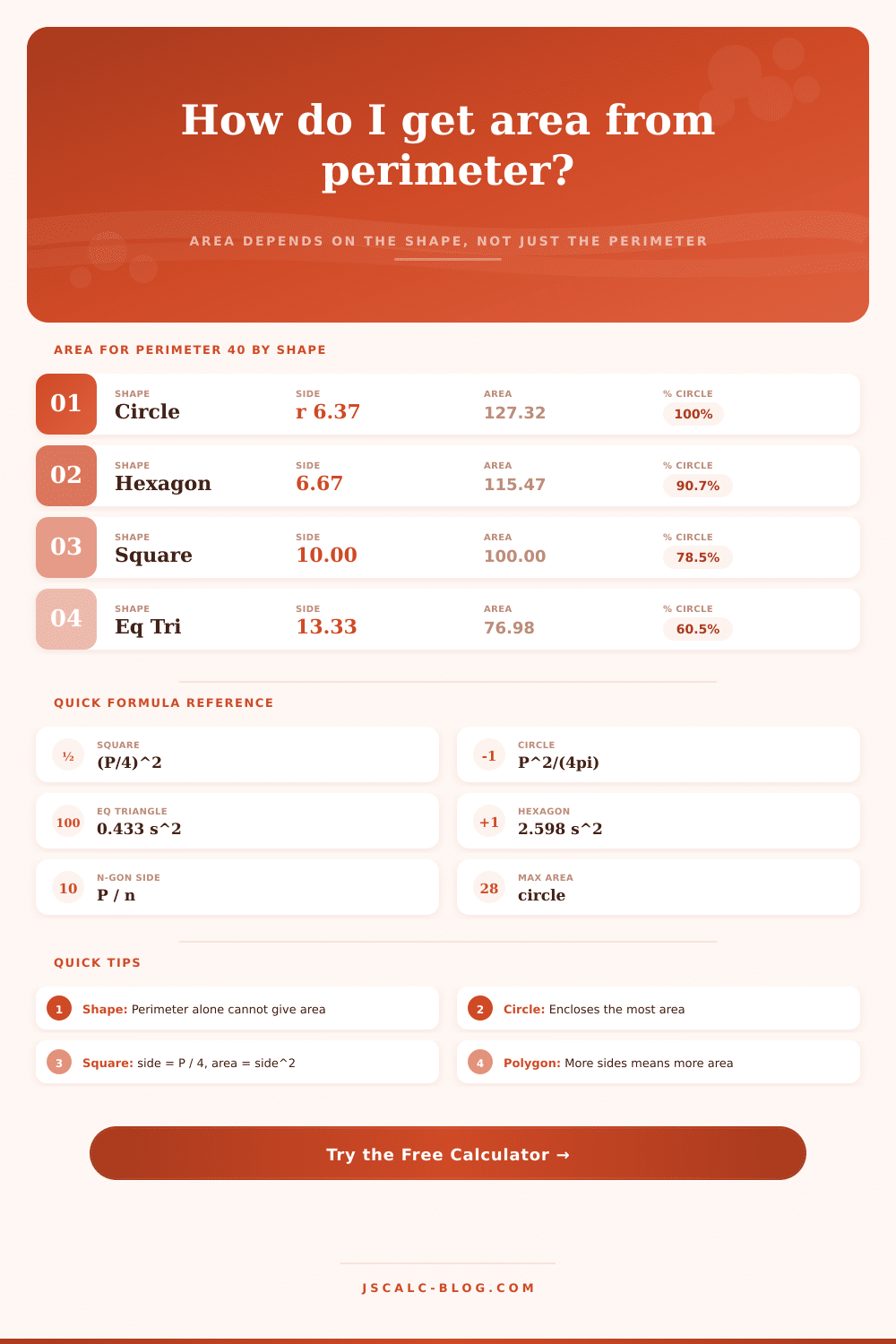
📊Area for a Fixed Perimeter of 40
| Shape | Side or Radius | Area | % of Circle Max |
|---|---|---|---|
| Circle | r = 6.366 | 127.32 | 100.0% |
| Regular 12-gon | s = 3.333 | 124.40 | 97.7% |
| Regular decagon | s = 4.000 | 123.11 | 96.7% |
| Regular octagon | s = 5.000 | 120.71 | 94.8% |
| Regular hexagon | s = 6.667 | 115.47 | 90.7% |
| Regular pentagon | s = 8.000 | 110.11 | 86.5% |
| Square | s = 10.000 | 100.00 | 78.5% |
| Rectangle 2:1 | 13.33 × 6.67 | 88.89 | 69.8% |
| Equilateral triangle | s = 13.333 | 76.98 | 60.5% |
| Rectangle 3:1 | 15.00 × 5.00 | 75.00 | 58.9% |
🗂Isoperimetric Ranking and Efficiency
| Rank | Shape | Sides | Area per P² | Efficiency | Enclosure |
|---|---|---|---|---|---|
| 1 | Circle | ∞ | 0.07958 | 100.0% | Most area |
| 2 | Regular 12-gon | 12 | 0.07775 | 97.7% | Very high |
| 3 | Regular octagon | 8 | 0.07544 | 94.8% | High |
| 4 | Regular hexagon | 6 | 0.07217 | 90.7% | High |
| 5 | Regular pentagon | 5 | 0.06882 | 86.5% | Good |
| 6 | Square | 4 | 0.06250 | 78.5% | Moderate |
| 7 | Rectangle 2:1 | 4 | 0.05556 | 69.8% | Lower |
| 8 | Equilateral triangle | 3 | 0.04811 | 60.5% | Least of regulars |
🔱Regular Polygon Area Factors
| Sides n | Name | Side = P/n | Factor ¼n·cot(π/n) | Area = Factor × s² |
|---|---|---|---|---|
| 3 | Triangle | P / 3 | 0.43301 | 0.43301 × s² |
| 4 | Square | P / 4 | 1.00000 | 1.00000 × s² |
| 5 | Pentagon | P / 5 | 1.72048 | 1.72048 × s² |
| 6 | Hexagon | P / 6 | 2.59808 | 2.59808 × s² |
| 8 | Octagon | P / 8 | 4.82843 | 4.82843 × s² |
| 10 | Decagon | P / 10 | 7.69421 | 7.69421 × s² |
| 12 | Dodecagon | P / 12 | 11.19615 | 11.19615 × s² |
⚙Full Formula Breakdown
📋Reverse: Area to Perimeter
| Shape | Perimeter from Area | P for Area 100 | Note |
|---|---|---|---|
| Square | P = 4√A | 40.00 | Side = √A |
| Circle | P = 2√(πA) | 35.45 | Smallest perimeter for the area |
| Equilateral triangle | P = 3√(4A/√3) | 45.59 | Needs the most fence |
| Regular hexagon | P = n√(A / factor) | 37.22 | Between square and circle |
| Rectangle 2:1 | from A = 2h² | 42.43 | Longer than a square |
💡Perimeter to Area Tips
When faced with task of fencing an area, you might imagine that all that matters is length of your chain link or other type of fence rope. Forty feet means a certain area, no matter what shape you create, right? Wrong. That’s where geometry come in. The amount of square feet you get depends on which shape you draw with a given perimeter (length); or acres, if the question were grazing land for cattle.
A circle will contain almost 20 percent more space than a rectangle of the same perimeter. An equilateral triangle, far less. In practical applications, whether renovating a room, laying out a garden bed, or calculating most efficient use of grazing land, the shape do make a difference.
How Shape Changes Area
After you input the perimeter (i.e., the length of the shape’s boundaries) and choose the desired shape, the tool does the rest. If you prefer to work backwards by beginning with the desired area, you can simply flip it around. For instance, let’s say you have a fixed amount of floor area (e.g., one hundred square feet) and you want to determine just how much baseboard molding to purchase. Just flip the equation: the calculator will then tell you what perimeter is necessary to achieve it. No more measuring twice, cutting once!
But it goes even further, because it also allow you to compare your calculation to theoretical max (which is obviously a circle). How? By giving you that percentage number. If you’re at only sixty percent efficient, you know there are some awkward shapes and angles going on; they cut down on the useable space.
Why does a circle win? It spreads its curvature evenly across all points on an imaginary line from the center point. All edges pulls toward that central point equally. There is no excess boundary material. And as you increase number of sides on a polygon, it comes close to matching this ideal. With a perimeter equal to a circle’s, a dodecagon approaches getting almost exactly ninety-eight percent of its area. A square can do maybe seventy-eight percent. And then there’s the triangle, barely scraping by at sixty percent.
When you’re limited on space or cost of materials, this ordering has consequences. That’s why urban planning often employ circular parks and roundabouts: they maximize available surface area in a set amount of curb length, not merely for their looks.
Add another dimension: rectangles involve ratios. A square-ish room is equivalent in perimeter to a long narrow strip, but have far more interior space. The calculator supports specifying the ratio of sides so you can visualize how much space you lose by stretching a shape too thin.
Or perhaps you are planning to use a length of fencing to make an enclosure next to a wall. If you leave one side open, it changes the perimeter limit for the other sides. This totally changes what the right dimensions should of be. Blind calculation doesn’t beat general planning here. You need to think about property lines, existing barriers, or where water drains, none of which will fit tidily into simple math equations.
People often miss this: area is not the same as perimeter. While perimeter measures distance, area measures surface. They are two different things that is related. If you take a square and double all of its linear dimensions (lengths), it’s going to quadruple its area. It’s like exponential growth in miniature. Small changes in boundary length lead to large differences in available space. Think of this as leverage; leverage your mind at the planning stage or when you’re scaling up a model. What if a ten percent larger fence give you practically twenty percent more lawn?
So in the end, the best shape isn’t just the mathematical ideal; it’s the shape that fits within your constraints. Sometimes construction cost won’t let you make the perfect circle; sometimes existing structures prevent you from building exactly what you want. Knowing this tradeoff will help you bargain with your boundaries: Want straight lines? Increase the number of sides and approach circular efficiency. Have fixed corners? Tweak the proportions so you’re not wasting space on unnecessarily long rectangles. That fence length is only the beginning, it’s how you arrange it that ultimately determines what you get inside.