Speed Converter
Convert any speed between miles per hour, kilometers per hour, meters per second, feet per second, knots, and mach. Enter a value with its unit, or a distance and time, and see every unit at once.
🏎Real Speed Presets
📝Speed Inputs
Used only when input method is distance and time.
🔢Conversion Base Factors
📏Speed Unit Factor Table
| Unit | Symbol | Multiply by (to m/s) | 1 unit in mph | 1 unit in km/h |
|---|---|---|---|---|
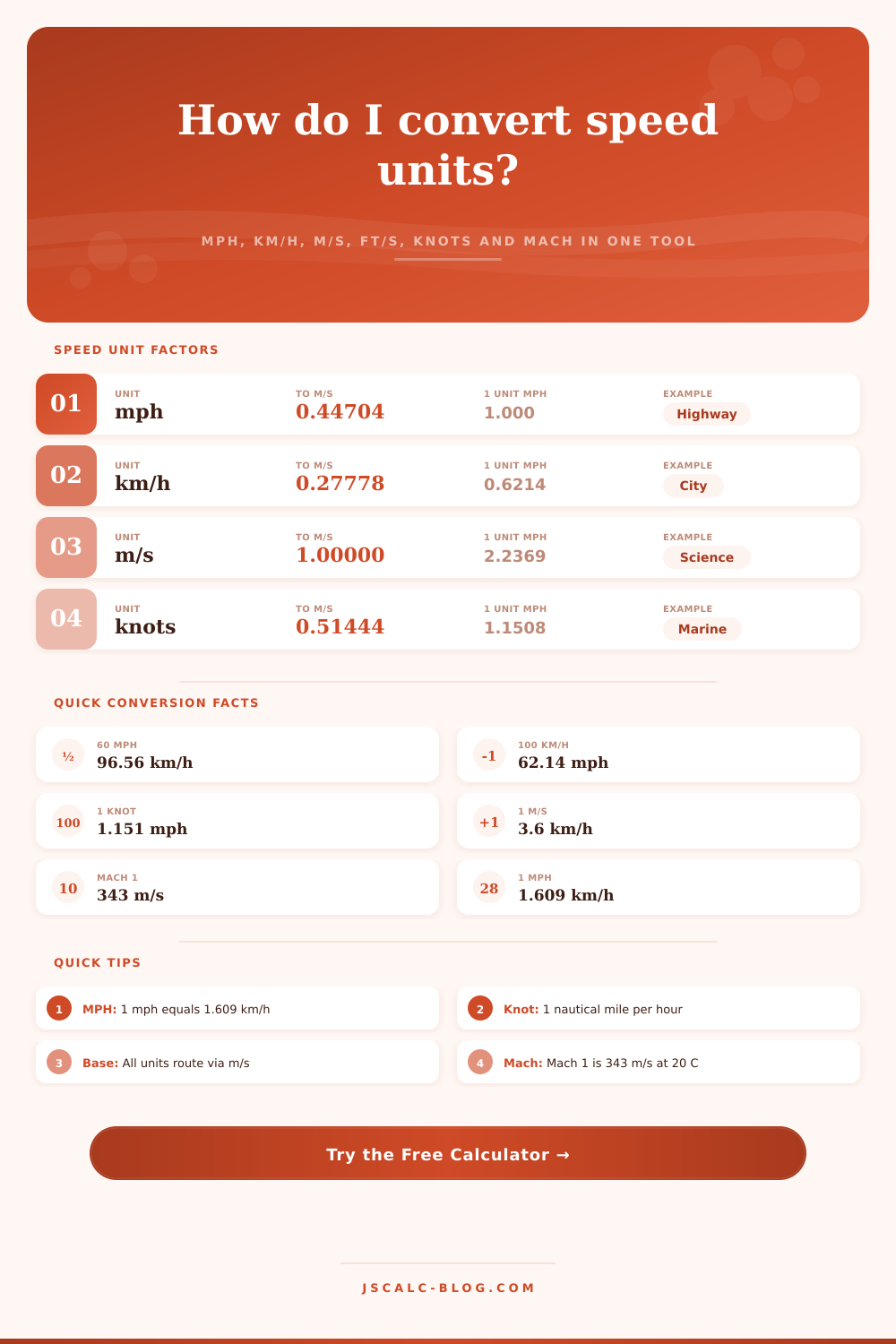
| Miles per hour | mph | × 0.44704 | 1.00000 | 1.60934 |
| Kilometers per hour | km/h | × 0.277778 | 0.62137 | 1.00000 |
| Meters per second | m/s | × 1.00000 | 2.23694 | 3.60000 |
| Feet per second | ft/s | × 0.30480 | 0.68182 | 1.09728 |
| Knots | kn | × 0.514444 | 1.15078 | 1.85200 |
| Mach (20 °C) | M | × 343.000 | 767.269 | 1234.80 |
🚗Common Speeds In Every Unit
| Scenario | mph | km/h | m/s | ft/s | knots |
|---|---|---|---|---|---|
| Brisk walk | 3.1 | 5.0 | 1.39 | 4.56 | 2.70 |
| City limit | 30.0 | 48.3 | 13.41 | 44.0 | 26.1 |
| Highway cruise | 60.0 | 96.6 | 26.82 | 88.0 | 52.1 |
| Freeway | 75.0 | 120.7 | 33.53 | 110.0 | 65.2 |
| Usain Bolt top | 27.0 | 43.5 | 12.07 | 39.6 | 23.5 |
| Cargo ship | 23.0 | 37.0 | 10.28 | 33.7 | 20.0 |
| Storm wind | 22.4 | 36.0 | 10.00 | 32.8 | 19.4 |
| Cruising jet | 652.2 | 1049.6 | 291.6 | 956.7 | 566.5 |
🔄MPH and KM/H Quick Chart
| mph | km/h | km/h | mph | Typical Use |
|---|---|---|---|---|
| 10 | 16.1 | 10 | 6.2 | Bike path |
| 20 | 32.2 | 30 | 18.6 | School zone |
| 30 | 48.3 | 50 | 31.1 | Town road |
| 40 | 64.4 | 60 | 37.3 | Arterial |
| 50 | 80.5 | 80 | 49.7 | Country road |
| 60 | 96.6 | 100 | 62.1 | Highway |
| 70 | 112.7 | 120 | 74.6 | Motorway |
| 80 | 128.7 | 130 | 80.8 | Autobahn |
⚓Knots and Mach Reference
| Value | mph | km/h | m/s | Context |
|---|---|---|---|---|
| 1 knot | 1.151 | 1.852 | 0.514 | 1 nmi per hour |
| 10 knots | 11.51 | 18.52 | 5.144 | Small boat |
| 20 knots | 23.02 | 37.04 | 10.29 | Fast ferry |
| Mach 0.85 | 652.2 | 1049.6 | 291.6 | Airliner cruise |
| Mach 1 | 767.3 | 1234.8 | 343.0 | Speed of sound |
| Mach 2 | 1534.5 | 2469.6 | 686.0 | Supersonic jet |
⚙How The Conversion Works
💡Speed Conversion Tips
For most folks, speed is nothing more than a figure on your car’s dash. That changes when you try to explain it to someone from a country that uses a different kind of number. You might tell your friend from London, “I was going sixty miles an hour.” They just shrug, because sixty kilometers an hour sound like a quick stroll. And that’s not simply a case of translating numbers; it’s a cultural gap born of different measurement traditions. One system anchors itself in the roughly human-scale mile, the other in the clean-cut decimal logic of the meter. Both are correct, but neither can let go of its own idea of what time and distance should be.
But usually, it begins with the base unit. Physics class teaches us the honest truth of motion: meters per second. It cuts through the arbitrary choice of days or hours and tells you how far you travel in one heartbeat. But most drivers don’t think in seconds. Their commute matches the rhythm of hours, and that’s what they think in.
Why Speed Units Are Different
Look at a reference table and you’ll see how each unit finally routes back to that central standard. Meters per second is the hub, and all other speeds is nothing more than its spokes radiating outward. This is what makes a converter work so cleanly. It doesn’t guess. It simply translates between the hub.
And then there’s the knot. Yes, I know it sounds archaic; it is. The origin story for one of our most precise moddern units comes from a sailor letting knotted rope fall from his boat into the sea. One nautical mile equals exactly 1852 meters. And it relates back to very circumference of our planet. So no wonder shipping and flying hold onto it as cars has abandoned them for kilometers or miles. But when doing math about travel time between a car and a ferry, you should of know that the number looks the same on paper but the distance they have put behind them isn’t. Ten knots sounds like a light breeze to your sailboat but it’ll knock the crap out of a big old truck. It’s not just about the integer, it’s also about context.
Mach. This is where it gets abstract, because it’s tied not only to what’s underneath you but to the air itself, its speed relative to the medium you’re flying in. In terms of velocity, Mach one is the speed of sound, and that changes based off altitude and temperature. For convenience, the calculator takes this into account as standard sea level conditions (at a temperature of twenty degrees Celsius). Your baseline should be somewhere around three hundred forty-three meters per second.
Why does it matter? Because when you pass Mach one your aircraft will experience a big shift in aerodynamics due to shockwaves. At Mach 0.85, your aircraft is moving fast but still technically in subsonic cruise. That little decimal point mean the difference between smooth flight and structural stress.
When there isn’t a screen in your face, mental math fills the gap. A mile is around one point six kilometers. Divide kilometers by one point six to convert to miles. Multiply miles by one point six to convert to kilometers. It is not exact, but it is close enough to plan with. And if you’re running and your watch displays fifteen meters per second, you instantly know this means you’re going faster then a car on the highway (a highway car does like sixty miles per hour which equates to only about twenty-seven meters per second). Sure, it’s short distance. But in raw speed, you’re out-running traffic.
For example if you’re in one of those weird situations where you need some distance over time converted but you don’t have a speed gauge, this will work. For instance, you could time how long it takes someone to run 100 meters. Just plug that into the thing and it spits out an answer for every major unit in an instant. Feet per second and knots is listed alongside kilometers per hour and miles per hour. It removes the friction of having to memorize which conversion formula to use. Let the computer handle the math while you think about what that speed really means for your situation.
If you want to know when something might arrive, or compare running times from different people, you want clarity. After all, speed is just distance divided by time. Understanding that ratio makes it easy to see how it applies to any situation. Converting units can be full of decimal places. But moving around is usually simpler than the numbers let on. Whether it’s measured in meters or feet, if you’re walking briskly, you’re still walking briskly. It takes the tool to give you the precision; it’s up to you to bring the perspective.
Sixty miles per hour is slow on the autobahn, yet fast on a city street. Environment matter more than a calculator here. When you understand the relationship between these units, they become less of a chore and more of a useful way to see the world around you.