Temperature Converter F to C Chart
Convert Fahrenheit to Celsius and Kelvin with the exact formula °C = (°F − 32) × 5/9, then build a large printable conversion chart across any range you choose.
🌡Common Temperature Presets
📝Single Conversion & Chart Range
Enter the temperature for the single conversion cards.
📊Your Generated F to C Chart
The chart below is generated from your start, end, and step values above.
| Fahrenheit (°F) | Celsius (°C) | Kelvin (K) | Context |
|---|---|---|---|
| Set a start, end, and step, then click Convert & Build Chart. | |||
🔢Formula Snapshot
📋Common F to C Conversions
| Fahrenheit | Celsius | Kelvin | Where You See It |
|---|---|---|---|
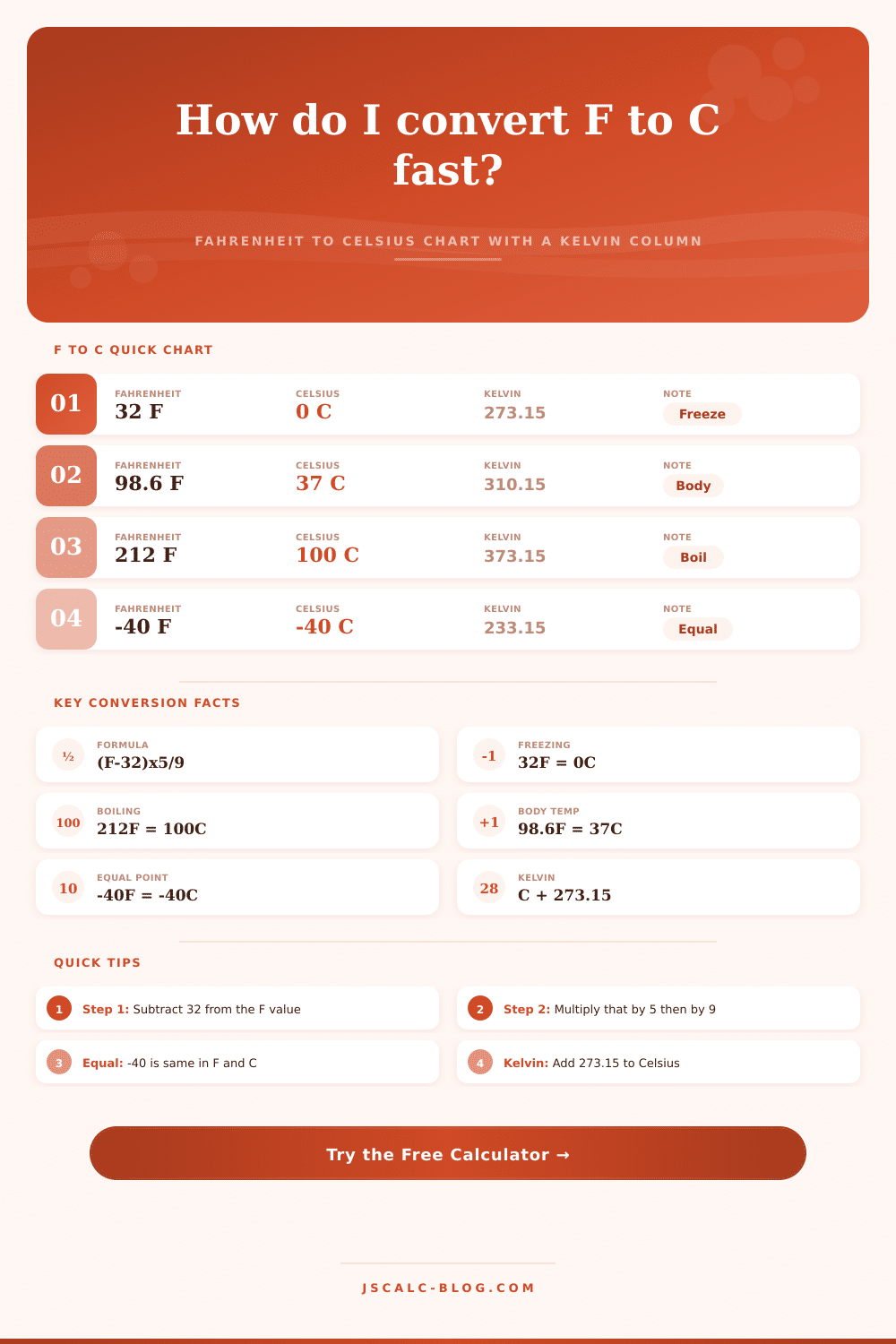
| -40°F | -40.00°C | 233.15 K | F and C are equal |
| 0°F | -17.78°C | 255.37 K | Very cold winter day |
| 32°F | 0.00°C | 273.15 K | Water freezes |
| 68°F | 20.00°C | 293.15 K | Room temperature |
| 98.6°F | 37.00°C | 310.15 K | Normal body temp |
| 100°F | 37.78°C | 310.93 K | Hot summer day |
| 180°F | 82.22°C | 355.37 K | Hot coffee serving |
| 212°F | 100.00°C | 373.15 K | Water boils at sea level |
🍳Oven Temperatures F / C / Gas Mark
| Description | Fahrenheit | Celsius | Gas Mark |
|---|---|---|---|
| Very cool / warm | 275°F | 135°C | 1 |
| Cool | 300°F | 150°C | 2 |
| Moderate | 350°F | 177°C | 4 |
| Moderately hot | 375°F | 190°C | 5 |
| Hot | 400°F | 204°C | 6 |
| Very hot | 450°F | 232°C | 8 |
| Broil / max | 500°F | 260°C | 10 |
🤒Body Temperature & Fever F to C
| Fahrenheit | Celsius | Reading | General Note |
|---|---|---|---|
| 95.0°F | 35.00°C | Low | Below typical range |
| 97.7°F | 36.50°C | Normal-low | Common morning reading |
| 98.6°F | 37.00°C | Normal | Classic average value |
| 99.5°F | 37.50°C | Elevated | Slightly above normal |
| 100.4°F | 38.00°C | Fever | Common fever threshold |
| 102.2°F | 39.00°C | High fever | Noticeably elevated |
| 104.0°F | 40.00°C | Very high | Seek guidance |
🌤Weather F to C Quick Lookup
| Fahrenheit | Celsius | Feels Like | Typical Setting |
|---|---|---|---|
| 14°F | -10.00°C | Freezing | Snowy winter |
| 32°F | 0.00°C | Icy | Frost point |
| 50°F | 10.00°C | Cool | Light jacket |
| 68°F | 20.00°C | Mild | Pleasant spring |
| 77°F | 25.00°C | Warm | Comfortable summer |
| 86°F | 30.00°C | Hot | Beach weather |
| 95°F | 35.00°C | Very hot | Heat advisory |
🗂Scale Comparison Grid
| Reference Point | Fahrenheit | Celsius | Kelvin | Rankine | Context |
|---|---|---|---|---|---|
| Absolute zero | -459.67°F | -273.15°C | 0.00 K | 0.00 °R | Coldest possible |
| F equals C | -40.00°F | -40.00°C | 233.15 K | 419.67 °R | Scales cross |
| Zero Fahrenheit | 0.00°F | -17.78°C | 255.37 K | 459.67 °R | Brine mix |
| Water freezes | 32.00°F | 0.00°C | 273.15 K | 491.67 °R | Ice point |
| Room temp | 68.00°F | 20.00°C | 293.15 K | 527.67 °R | Indoor comfort |
| Body temp | 98.60°F | 37.00°C | 310.15 K | 558.27 °R | Human baseline |
| Water boils | 212.00°F | 100.00°C | 373.15 K | 671.67 °R | Sea-level boil |
| Moderate oven | 350.00°F | 176.67°C | 449.82 K | 809.67 °R | Baking heat |
⚙Full Formula Breakdown
💡Fahrenheit to Celsius Tips
Okay so you know that water boils at 212 degrees fahrenheit and freezes at 32. And maybe you remember that our normal body temperature are around 98.6. But if someone asked you why those particular numbers were chosen, you’d realize there’s a tangled history behind them all.
The difference between Fahrenheit and Celsius isn’t just a matter of preference. It’s a battle between two competing worldviews (two different ways of measuring heat). One is designed for science. One is designed for human comfort.
How Fahrenheit and Celsius Are Different
Knowing the difference will help you next time you’re reading a weather report, taking someone else’s temperature, or baking a cake in oven.
It starts with the base problem. To create this scale, Daniel Fahrenheit based his starting point on a brine solution. It was a mixture of water, ice, and some ammonium chloride. His base was -zero. Pure water he set at 32 (the freezing point) and average human body temperature at about 96. So now you had a nice scale that ranged from comfortable zero to one-hundred and contained all the weather we see in our day-to-day lives. It was practical for people.
On the other hand, Anders Celsius did not start with practicality in mind. The Celsius scale started by basing itself on physical properties of water. Freezing was zero. Boiling was one hundred. This made it easier for scientists to work with these phase changes.
1.8 degrees Fahrenheit. That ratio is what drives all your future conversions. Plug in your range into the calculator above, and it does the math for you. You don’t have to do the math in your head with fractions anymore.
It’s an easy formula, but it tricks you. First, you subtract thirty-two. This is because there’s an offset between two zero points. Then, you multiply by five-ninths. This is because size of degree units is different than the other degrees. Most folks do those steps in reverse, which is why they get such crazy numbers.
For instance, if I want to convert room temperature, I might forget to subtract the thirty-two first and then end up getting a number that tells me my house is freezing cold. That’s what most folks mess up. The tool does the series automatically for them so they never need to worry about order again.
While individual numbers turn abstract digits into tangible expectations, the picture painted by chart does too. Notice the negative temperature readings. You’ll see that both scales shares a common number here. In fact, minus forty is the exact point at which Fahrenheit and Celsius meet. The reason: The straight lines of one scale meet the other at exactly -40. It’s a good number to double-check against for those times when your mental math hasn’t added up right.
But what about converting oven temps? That’s a bit more serious, bake a cookie at an incorrect heat, and in minutes they’ll be burnt to a crisp. The page makes it clear with its reference table. As an example, see that cooking at a moderate 350 degrees Fahrenheit equates to about 177 Celsius. But why does it matter? Because ovens aren’t precise tools. It’s smarter to round to the next five or even ten, rather than pursuing exact decimals when your oven can’t keep them.
For home cook, this may be an unnecesary detail that we could leave to the larger chart, but it brings us back to thinking about heat energy and why Kelvin matters. Kelvin begins with absolute zero… The temperature when all molecules cease movement. There is no such thing as a negative Kelvin. All you have to do is add 273.15 to Celsius to get Kelvin. That reminds me how much thermal energy exists even when it’s chilly outside. Even 0 degrees F is more than 255 Kelvin. We don’t give much thought to the base level of energy around us, but it’s there.
The thing about temperature conversions, in the end, isn’t that it’s a trick to remember some formula; it’s learning how to think in scales. To translate one view of the world… What does it feel like?, into another: what happens when stuff behaves this way? What feels different, or doesn’t, is incidental. One isn’t better than the other, they’re simply different lenses.
And all that really matters when you convert something is that you know why the number changed, whether you’re heating your oven or taking someone’s temperature. Why you believe it if your oven reads one thing or if your friend has a 102-degree fever instead of 100.1. Why it makes it real rather than just a number.
32 degrees is no different from 0 except for where we decided to draw the line. But the fact that there’s ice on your windshield is.