Pressure Drop Calculator In Pipe
Estimate water friction loss along a full pipe using the Darcy-Weisbach equation or the Hazen-Williams method. See pressure drop in psi, head loss in feet, flow velocity, and Reynolds number.
🎯Real Pipe Flow Presets
📝Flow & Pipe Inputs
Volume of water moving through the pipe per minute.
Choose a standard size or pick custom to type an exact inside diameter.
Straight run length; add equivalent length for many fittings.
Higher C means smoother pipe and lower drop.
Used for the Reynolds number and Darcy friction factor.
🔢Formula Snapshot
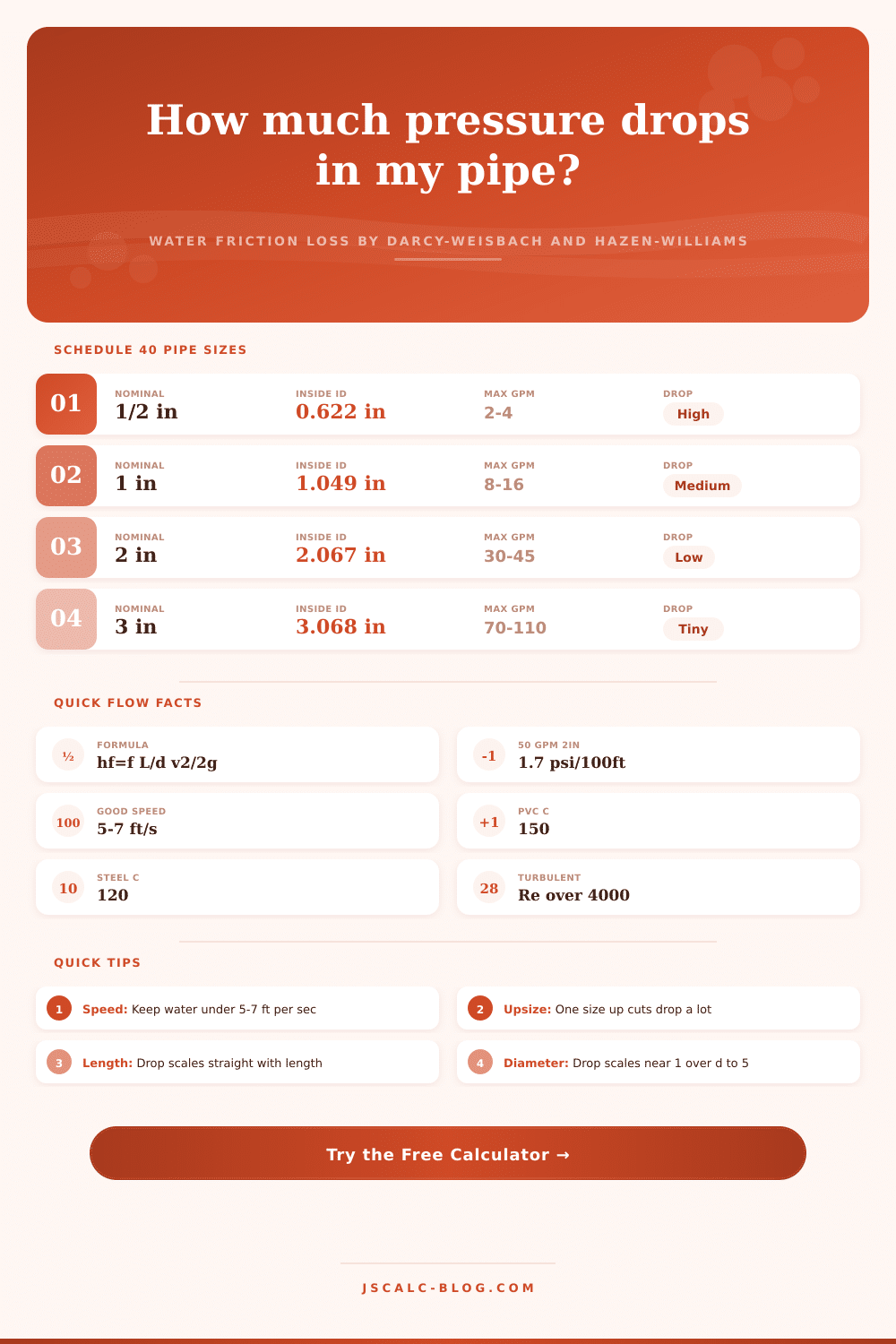
🗂Drop By Pipe Size (40 GPM Water, PVC, Per 100 ft)
| Nominal | Inside ID | Velocity | Reynolds | Head / 100 ft | Drop / 100 ft |
|---|---|---|---|---|---|
| 1/2 in | 0.622 in | 42.2 ft/s | 202,600 | 873 ft | 378 psi |
| 3/4 in | 0.824 in | 24.1 ft/s | 152,900 | 222 ft | 96 psi |
| 1 in | 1.049 in | 14.9 ft/s | 120,100 | 68.9 ft | 29.8 psi |
| 1-1/2 in | 1.610 in | 6.30 ft/s | 78,300 | 8.75 ft | 3.79 psi |
| 2 in | 2.067 in | 3.82 ft/s | 61,000 | 2.64 ft | 1.14 psi |
| 2-1/2 in | 2.469 in | 2.68 ft/s | 51,000 | 1.13 ft | 0.49 psi |
| 3 in | 3.068 in | 1.74 ft/s | 41,100 | 0.40 ft | 0.17 psi |
| 4 in | 4.026 in | 1.01 ft/s | 31,300 | 0.11 ft | 0.05 psi |
📊Hazen-Williams C By Material
| Material | C (new) | C (aged) | Roughness ε | Typical Use |
|---|---|---|---|---|
| PVC / CPVC | 150 | 140 | 0.0000015 m | Cold water, irrigation |
| PEX tubing | 150 | 145 | 0.0000020 m | Home supply lines |
| Copper | 140 | 130 | 0.0000015 m | Potable plumbing |
| New steel | 130 | 110 | 0.000045 m | Mains, risers |
| Galvanized iron | 120 | 100 | 0.00015 m | Older plumbing |
| Cast iron | 130 | 100 | 0.00026 m | Old water mains |
| Concrete | 130 | 110 | 0.0003 m | Large gravity lines |
📏Schedule 40 Inside Diameters & Flow Guide
| Nominal | Inside ID | Area | Target GPM | Max GPM |
|---|---|---|---|---|
| 1/2 in | 0.622 in | 0.30 in² | 2 – 4 | 7 |
| 3/4 in | 0.824 in | 0.53 in² | 4 – 8 | 14 |
| 1 in | 1.049 in | 0.86 in² | 8 – 16 | 23 |
| 1-1/2 in | 1.610 in | 2.04 in² | 18 – 32 | 55 |
| 2 in | 2.067 in | 3.36 in² | 30 – 45 | 90 |
| 3 in | 3.068 in | 7.39 in² | 70 – 110 | 200 |
| 4 in | 4.026 in | 12.7 in² | 130 – 200 | 350 |
| 6 in | 6.065 in | 28.9 in² | 300 – 500 | 800 |
🚦Velocity Guidelines
| Velocity | Rating | Notes | Where It Fits |
|---|---|---|---|
| Under 2 ft/s | Very low | Little drop, may settle debris | Gravity, drain lines |
| 2 – 5 ft/s | Ideal | Quiet, efficient, low wear | Home supply pipe |
| 5 – 7 ft/s | Acceptable | Higher drop, some noise | Short branch runs |
| 7 – 10 ft/s | High | Noise, erosion over time | Brief peak demand |
| Over 10 ft/s | Avoid | Erosion, water hammer risk | Undersized pipe |
⚙Full Formula Breakdown
📋Sample Scenarios Reference
| Scenario | Flow | Pipe | Length | Velocity | Drop |
|---|---|---|---|---|---|
| 50 GPM 2in PVC | 50 GPM | 2 in PVC | 100 ft | 4.8 ft/s | 1.7 psi |
| House main copper | 12 GPM | 1 in Cu | 60 ft | 7.5 ft/s | 7.1 psi |
| Irrigation main | 120 GPM | 3 in PVC | 500 ft | 5.2 ft/s | 6.2 psi |
| High flow steel | 300 GPM | 4 in steel | 200 ft | 7.6 ft/s | 4.2 psi |
| Fire sprinkler | 100 GPM | 2.5 in steel | 150 ft | 6.7 ft/s | 4.6 psi |
| Well pump line | 20 GPM | 1 in PVC | 120 ft | 7.4 ft/s | 10.3 psi |
💡Practical Flow Tips
Pressure creates movement in water, but water runs into resistance on the way. Turn on your faucet and you might not notice friction as you hear it. But did you know that water has worked harder to get to your sink than you might expect? The pipe’s walls consumes some amount of pressure before it gets to you, and that can determine whether or not you’re getting a constant stream.
First, fix what you don’t think is a problem: the flow. Knowing where the pressure was lost can be your first step. After you plug in your own parameters, the calculator (above) do all that math for you without requiring that you solve hard fluid dynamics formulas. It offers two of the most popular approaches. Hazen-Williams and Darcy-Weisbach. The first one’s simpler and designed with water at normal temps in mind, while the second one is more universal (and includes the viscosity of the fluid), perfect for pumping seawater or glycol. Either way should of get you within spitting distance of an answer, good enough for making decisions on most home plumbing applications. Consistency in your inputs matter more than accuracy in the formula itself.
Why Water Loses Pressure in Pipes
The second consideration is pipe material choice, more on this below, but it’s important to realize just how significant smoothness is. Pipes like PVC and PEX is slick on the inside, meaning they have a high C factor, and offer very little resistance. Older galvanized iron or steel pipes is rough and create turbulence, which dissipates pressure rapidly. The chart on the page above shows the coefficients for each of these materials and how much drag they impose on the water. A low change in C value may not seem big on paper, but over a long run, it translates into lots of head loss. That’s why replacing older plumbing with moddern plastic lines typically increases flow rate without needing to upsize pumps.
Another sneaky one is velocity. Pressure is powerful, and fast water feels like power. But friction loss scales by the square of velocity, which means twice as fast will quadruple the loss. Most engineers finds a sweet spot between noise and efficiency where they keep their supply lines running at less than five to seven feet per second. Anything more and you run into potential problems with water hammer and erosion-corrosion. You can plug in your inside diameter and flow rate into the tool and it’ll spit out how fast you’re going. Seeing that number makes you think about whether or not your pipe is just too small for what you’re asking it to do.
That’s a simple straight line calculation (length matter). The longer the run, the greater the loss. But fittings complicate things because they are ignored in straight-line calculations. Tees, elbows, and valves each creates what is called a “minor” loss. Collectively they can compound quickly. As a general guideline, I would say to figure on adding 10-20% extra to the real world length of the pipe to compensate for fittings. It is not exact, but it is better than not accounting for them since doing so can cause low flow at the fixture or undersized pumps. Don’t forget about fittings.
For example, if pressure drop is caused by a pipe that is too small, upsizing it is often the least expensive solution. Because the velocity decreases and cross-sectional area increases dramatically with each step up in nominal size, friction loss reduces 5-10 fold when going up just one size. It sounds counter-intuitive; why buy larger pipe when it costs more? In most cases, improved performance and energy savings usually pay off quickly.
Calculating each situation manually isnt necessary. Simply use the presets to see common examples such as a house line or an irrigation main to give you a starting point for comparison. Head loss and velocity. Pressure drop is not just a number on a screen; it dictates whether your system works efficienty or struggles against itself. Pressure drop matters. It determines if your system will be efficient and work with itself or fight itself. Understanding the relationship between head loss, velocity, and diameter allows you to create a network for delivering water where needed without wasting energy. Length, diameter, and roughness are easy math once you understand their relationships. And remember: pressure moves water, but only if there is a path for it to flow.