Spring Constant Calculator
Find the spring rate k two ways: from Hooke's law force and displacement, or from helical compression coil geometry using wire diameter, mean coil diameter, active coils, and material shear modulus. Stored energy and alternate units included.
🌀Real Spring Presets
📝Spring Inputs
Hooke's law: the force stretching or compressing the spring.
Hooke's law: how far the spring moves under that force.
Coil method: thickness of the spring wire.
Coil method: outer diameter minus one wire diameter.
Coils that actually flex (total coils minus dead end coils).
Used only when material is set to custom.
🔢Formula Symbols
🧪Shear Modulus By Material
| Material | G (GPa) | G (10⁶ psi) | Typical Use |
|---|---|---|---|
| Music wire ASTM A228 | 80.0 | 11.6 | Small precision springs |
| Hard-drawn steel | 79.3 | 11.5 | General compression springs |
| Oil-tempered MB | 79.3 | 11.5 | Automotive, general duty |
| Chrome silicon | 69.0 | 10.0 | Valve and clutch springs |
| Stainless 302 / 304 | 77.2 | 11.2 | Corrosion resistant springs |
| Phosphor bronze | 41.4 | 6.0 | Electrical contacts |
| Beryllium copper | 44.0 | 6.4 | Conductive springs |
| Titanium alloy | 26.0 | 3.8 | Lightweight aerospace |
📊Coil Geometry vs Rate Comparison
| Wire d (mm) | Coil D (mm) | Active n | Spring Index D/d | Rate k (N/mm) | Rate k (lb/in) |
|---|---|---|---|---|---|
| 1.0 | 10 | 8 | 10.0 | 0.99 | 5.66 |
| 1.5 | 12 | 8 | 8.0 | 3.63 | 20.7 |
| 2.0 | 20 | 10 | 10.0 | 1.98 | 11.3 |
| 2.5 | 18 | 7 | 7.2 | 10.6 | 60.5 |
| 3.0 | 24 | 6 | 8.0 | 11.6 | 66.3 |
| 4.0 | 30 | 6 | 7.5 | 25.1 | 143 |
| 5.0 | 40 | 8 | 8.0 | 19.4 | 111 |
| 6.0 | 48 | 10 | 8.0 | 23.2 | 132 |
Rates above use G = 79.3 GPa. Notice how the wire diameter to the fourth power dominates: doubling d makes the spring roughly sixteen times stiffer at the same D and n.
🔗Series vs Parallel Springs
| Arrangement | Formula | Two Equal k = 1000 N/m | Effect | Where Seen |
|---|---|---|---|---|
| Single | k | 1000 N/m | Baseline | Standalone spring |
| Series (2) | 1/k = 1/k₁ + 1/k₂ | 500 N/m | Softer, more travel | Stacked coils end to end |
| Series (3) | 1/k = Σ 1/kᵢ | 333 N/m | Much softer | Long spring columns |
| Parallel (2) | k = k₁ + k₂ | 2000 N/m | Stiffer, less travel | Nested dual springs |
| Parallel (3) | k = Σ kᵢ | 3000 N/m | Very stiff | Triple valve springs |
| Mixed banks | Combine both rules | Varies | Tuned response | Suspension packs |
🔄Spring Rate Unit Conversions
| From | To | Multiply By | Example |
|---|---|---|---|
| N/m | N/mm | 0.001 | 2000 N/m = 2 N/mm |
| N/mm | N/m | 1000 | 2 N/mm = 2000 N/m |
| N/m | lb/in | 0.005710 | 2000 N/m = 11.4 lb/in |
| lb/in | N/m | 175.13 | 10 lb/in = 1751 N/m |
| N/mm | lb/in | 5.7102 | 1 N/mm = 5.71 lb/in |
| kgf/mm | N/mm | 9.80665 | 1 kgf/mm = 9.81 N/mm |
⚙Full Formula Breakdown
📋Typical Spring Rate Examples
| Spring Type | Approx Rate | Wire d | Coil D | Notes |
|---|---|---|---|---|
| Ballpoint pen spring | 0.05–0.3 N/mm | 0.3 mm | 3 mm | Very soft, short travel |
| Kitchen scale spring | 1–5 N/mm | 0.8 mm | 8 mm | Linear load reading |
| Mattress pocket coil | 3–12 N/mm | 1.8 mm | 25 mm | Tall, many active coils |
| Engine valve spring | 25–60 N/mm | 3.5 mm | 25 mm | High load, few coils |
| Car suspension coil | 25–80 N/mm | 12 mm | 110 mm | Supports vehicle weight |
| Trampoline extension | 2–6 N/mm | 3 mm | 18 mm | Extension, hooked ends |
💡Practical Spring Tips
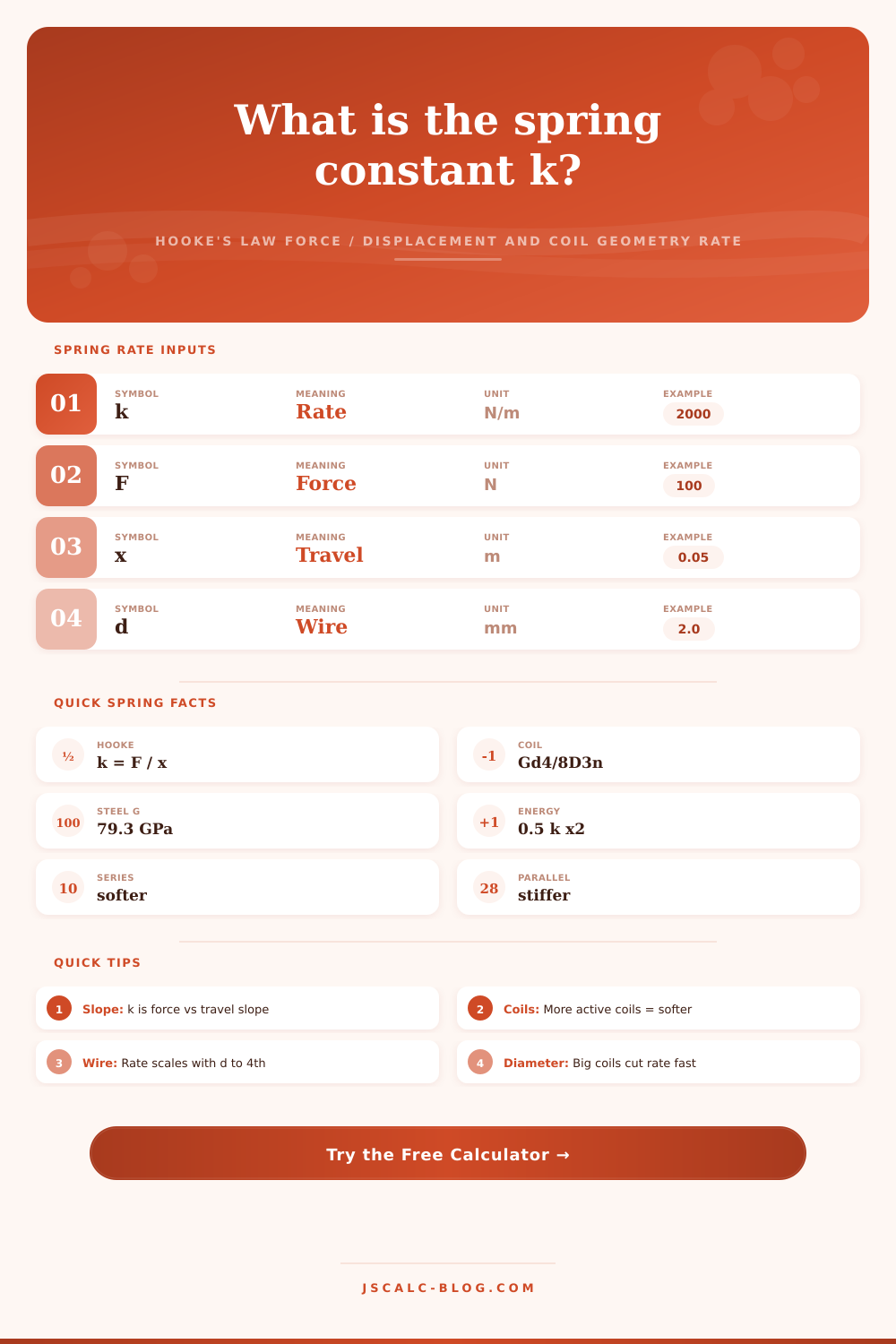
The steel coil looks like nothing more than a piece of metal, but it’s really a storage container for potential energy ready to get up and go. That potential is shown by something called k, the spring constant, which tell how much force is needed to stretch (or squeeze) it a certain amount. Back several hundred years ago, Robert Hooke measured this connection between force and extension; he said that inside its elastic range, stress is proportional to strain. Want some math? It’s all in the calculator.
But to explain what k means beyond the equation itself, you need to realize that it’s a measure of stiffness, not strength. Stiff springs may buckle when struck hard, but they can also be quite soft and able to carry heavy weight as they stretch out over time. Mixing up those two characteristics will end in mechanical heartbreak, whether it’s in your kitchen scale or suspension system.
How Spring Stiffness Works
When designing a spring from first principles rather than making it to match some basic Hooke’s law formula, geometry take over. There are four parameters that strongly influence the rate of a helical compression spring: number of active coils; mean coil diameter; wire diameter; and shear modulus of the material used. Of those parameters, wire diameter is strongest leverage point. If everything else stay the same, then doubling the wire diameter makes the spring sixteen times as stiff. That’s a very nonlinear response; not what you’d think would of happen if you doubled something! Small changes in wire gauge produce huge differences in performance, which is why accuracy is important (more so than for most mechanical designs).
First, when we’re in the steel alloy range, the stiffness isn’t as much about the material as you’d expect. Whether you choose stainless, oil-tempered, or even music wire, their shear modulus are pretty similar in steel. You pick your alloy based off how well it resists corrosion or fatigue, not to change spring rate.
When adjusting for softness (and you don’t want to change the diameter), you simply add additional coils. The extra coil(s) means there’s more material to bend which takes the strain further and makes it softer altogether. Tighter coils with bigger diameters makes a stiffer spring because they give it more leverage against the spring.
When you start stacking springs, things change a lot as well. For instance, if you put two spring in series they’ll be softer, but in parallel they’ll become stiffer. That’s why engineers can adjust their designs without having to create brand-new parts. If you stack springs one after another (end-to-end), you increase the range of travel. It also means less force is needed to achieve that range. Automotive applications takes advantage of this behavior by combining spring packs to handle different loads effectively. The chart on the page summarizes these standard configurations and shows how different combinations of the same unit affect its effective rate.
The last component of the puzzle is energy storage. How much potential energy does a spring store? The answer is that it’s proportional to the square of the displacement. If you compress it twice as far, the potential energy stored increases by a factor of four, not two. And that quadratic relationship is also why springs can be dangerous if overstressed. If the material goes beyond its elastic limit, there’s nothing holding back that amassed energy and the spring will fail completely, releasing all the energy at once. That makes you realize why safety factors matter so much in things like suspension systems or valve springs with very high loads on them.
In the end, spring design is all about making trade offs between travel, load, and space. You get too much travel at the cost of either stiffness or size. These are the numbers you can use to build the tool for calculating these values. And that brings us to where engineering intuition is born, because you understand how they will perform when moving. You don’t want to hit a force value, as much as you do want to know that the material has enough give to survive the return trip back to its rest state. This is what gives a bit of coiled wire livig life as a dependable mechanical part.