Weeks Countdown Calculator
Count the exact weeks and remaining days until any target date, plus decimal weeks, total days, weekends, and five-day workweeks. Built for due dates, semesters, projects, and holiday planning.
🎯Real Countdown Presets
📝Countdown Inputs
Defaults to today. Weeks are counted from this day.
Type a number of weeks to jump the target forward from the start date.
🔢Formula Snapshot
📆Weeks to Common Upcoming Events
| Event | Date | Weeks Left | Days Left | Workweeks |
|---|---|---|---|---|
| Enter a start date above to see weeks left until each event. | ||||
Weeks and days are measured from your start date to each fixed calendar event. Past events show as zero.
🔁Weeks, Months & Days Equivalents
| Measure | Value | How It Is Derived |
|---|---|---|
| The equivalent units for your span appear after calculation. | ||
🗓Milestone Schedule
| Milestone | Week # | Date | Days From Start | Weeks Left After |
|---|---|---|---|---|
| Choose a weeks-per-milestone value and calculate to build the schedule. | ||||
Each milestone marks the chosen number of weeks past the start date, up to your target.
🗂Workweek Reference Grid
| Span | Calendar Days | Weeks | Weekends | Workdays | Workweeks |
|---|---|---|---|---|---|
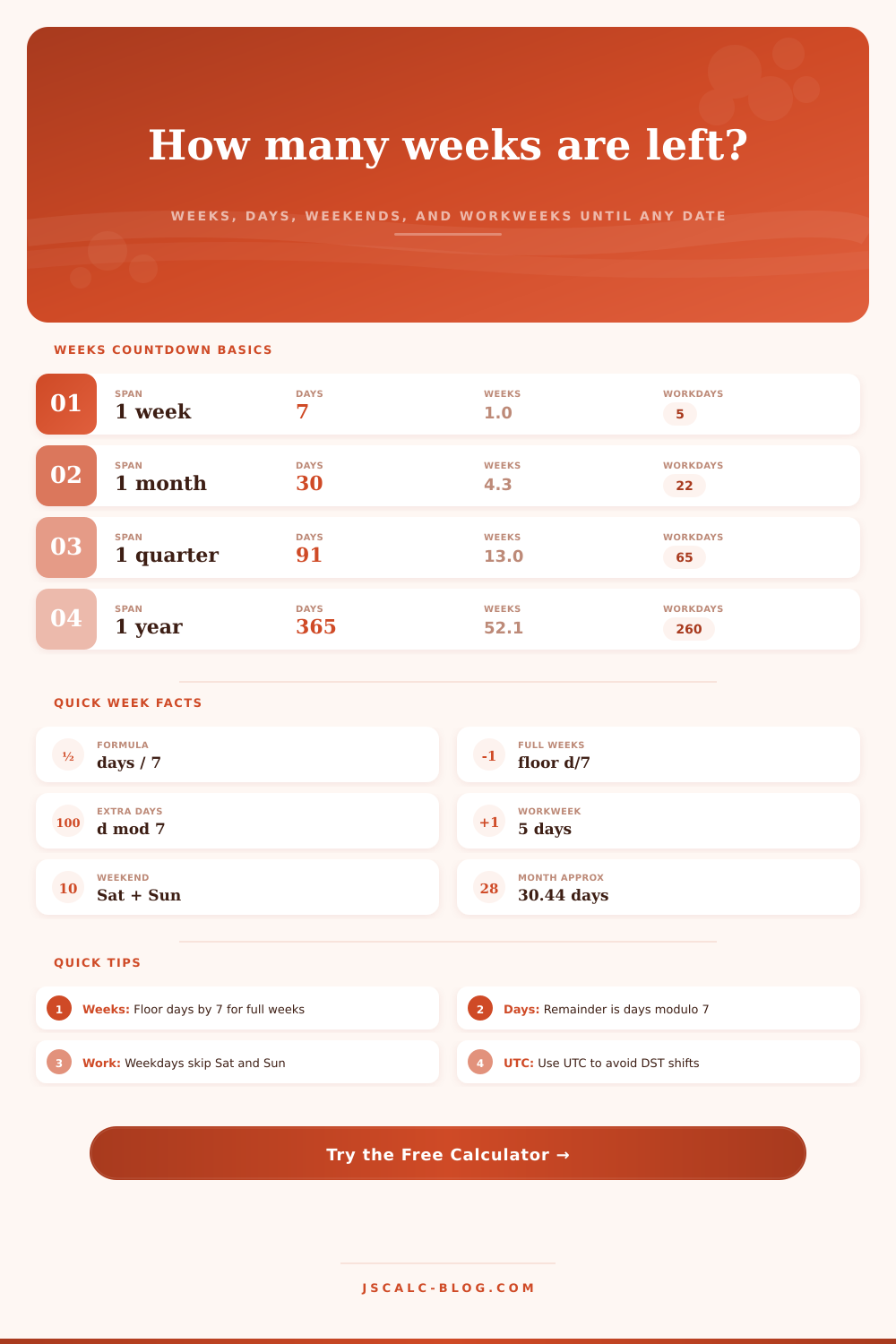
| 1 week | 7 | 1.0 | 1 | 5 | 1.0 |
| 2 weeks | 14 | 2.0 | 2 | 10 | 2.0 |
| 1 month | 30 | 4.3 | 4 | 22 | 4.4 |
| 6 weeks | 42 | 6.0 | 6 | 30 | 6.0 |
| 1 quarter | 91 | 13.0 | 13 | 65 | 13.0 |
| Half year | 182 | 26.0 | 26 | 130 | 26.0 |
| 1 year | 365 | 52.1 | 52 | 261 | 52.2 |
| School year | 180 | 25.7 | 26 | 128 | 25.6 |
📊Countdown Scenario Comparison
| Scenario | Typical Span | Weeks | Days | Workweeks | Best For |
|---|---|---|---|---|---|
| Pregnancy term | 40 weeks | 40.0 | 280 | 40.0 | Due date tracking |
| College semester | 15 weeks | 15.0 | 105 | 15.0 | Classes and exams |
| Fitness cut | 12 weeks | 12.0 | 84 | 12.0 | Training blocks |
| Sprint quarter | 13 weeks | 13.0 | 91 | 13.0 | Work planning |
| Wedding prep | 26 weeks | 26.0 | 182 | 26.0 | Six-month planning |
| Notice period | 2 weeks | 2.0 | 14 | 2.0 | Job transitions |
| Holiday lead-up | Varies | Live | Live | Live | Christmas and New Year |
⚙Full Formula Breakdown
📋Reference Values
| Concept | Value | Why It Matters | Example |
|---|---|---|---|
| Days per week | 7 | Base divisor for every week count | 28 days = 4 weeks |
| Weekdays per week | 5 | Drives workweek and workday math | 10 weeks = 50 workdays |
| Weekend days per week | 2 | Saturday and Sunday planning | 52 weeks = 104 weekend days |
| Average month | 30.44 days | Converts a day span to months | 91 days = 3.0 months |
| Weeks per year | 52.14 | 365 days divided by 7 | Half year = 26.1 weeks |
| Milliseconds per day | 86,400,000 | UTC subtraction unit | Avoids DST rounding errors |
💡Practical Countdown Tips
A basic grid on a piece of paper, the calendar is a deceptively simple tool used to measure distance in time. But sometimes it doesn’t cut it. Sometimes you have an idea of something urgent; a baby on its way, a deadline looming. But sometimes it doesn’t cut it. Sometimes you have an idea of something urgent, a baby on its way, a deadline looming.
What do you need? Just the number of days left? The problem is that days are abstract and they all sorta bleed together. Weeks is what give us some rhythm. Because weeks match up with your actual life and work (unlike days), they divide time into chunks we can work within. And that makes all the difference when planning.
Why Counting Weeks Is Better Than Counting Days
Most people count weeks by dividing total days by seven, but real life rarely fits neatly in integer math. In reality, life doesn’t always follow whole number math. The dates are where you plug in your numbers, and the calculator do the math. It divides out whole weeks and lops off the remainder, those left-over days. And gives you a nice neat decimal number that you can track as you go.
That’s important when measuring progress. If you’re three-quarters of the way through a one-month sprint, you feel much more motivated knowing youve completed 3.25 weeks, versus only having a rough estimate of two dozen or so days to go. The more detailed view helps you see momentum (weeks) instead of just duration (days).
Most planning break down at this point: the separation of work time from calendar time. There are 7 days in a typical week, but only 5 of them is productive for most workers. With the tool, you get an unambiguous breakdown of weekday versus weekend, with a clear readout of how many workweeks remain before your deadline.
It’s essential if you’re a project manager, since weekends have a real cost that needs to be factored in schedules. A dozen weeks might sound doable on a calendar, but turns out that’s 60 workdays. Which can make the difference between an achievable timeline and a crunch-inducing burnout.
You have some control over what you’re starting from and ending at. You can set the end of the year to be at the target date (with an extra day added), or not (which drops a day). It sounds like a small distinction. However, that day counts when it is a matter of life or death, such as with pregnancy due dates or legal consequences for missing a deadline.
Likewise, how you define “workweek” is important if you’re working with a team whose days don’t line up with everyone else. If you’re a Sunday-Thursday company, you’re not going to get the right result if this tool assume Monday to Friday is your workweek. Set the tool to match your real operating schedule so the data it gives you matches too.
But humans are more receptive to weekly increments. No matter what day it is, Monday always feels like a fresh start. That’s our inherent rhythm, so splitting up that long period into smaller chunks, by week rather than by day… Lessens your sense of angst. Rather than being fixated on a long-term goal (i.e., “We must hit this by March”), think about the upcoming week. You can handle one week at a time.
The tool comes with some helpful reference tables. These tables help you switch between different planning languages, such as how a week maps onto a month or quarter. And don’t forget: Partial weeks matter too. Twenty-four days until launch? Technically, that’s three weeks and three days. Round up, and you might get complacent; round down, and you’ll panic for no reason.
The fractional output of decimal weeks plugs that gap and gives you an exact picture of where on the runway you’re currently standing. No rounding errors here; and no distortion in your sense of urgency.
A countdown is an act of arithmetic, but it’s also an attempt to impose order on time so that we can use it. Whether you are preparing for a product launch, a school semester, or a vacation, the weeks countdown calculator turns something abstract like time into concrete steps. You begin to measure instead of guess.
That’s the trick: learning how to define what you’re actualy measuring. Align your definition of work with your definition of a week, and suddenly the numbers don’t seem as daunting; they become actionable. Time still has limits; but your control over it sharpens considerably.