French Press Coffee Ratio Calculator
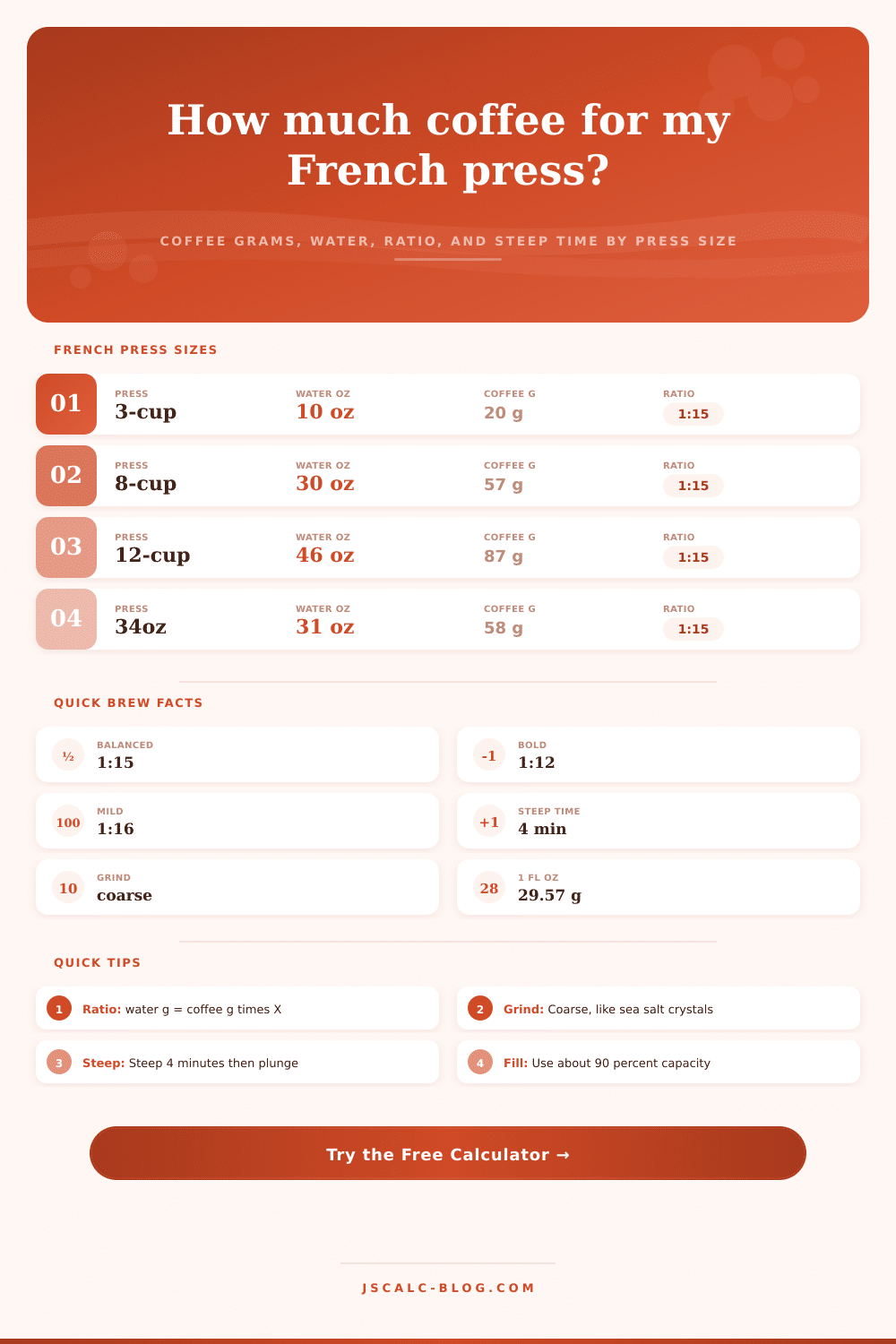
Dial in the exact coffee grams, water in ounces and milliliters, level tablespoons, and steep time for your French press by choosing a press size, a coffee-to-water ratio, and a brew strength.
☕Real Brew Presets
📝Brew Inputs
Full capacity of the carafe. A press "cup" is about 4 oz.
Leave headroom for grounds and the plunger. 90% is typical.
Grams of water per gram of coffee. 1:15 is a great default.
Used when solving from coffee grams.
Used when solving from water. Unit is set below.
Ground coffee is roughly 5.3 g per level tablespoon.
Classic full immersion is about 4 minutes, then plunge.
🔢Recipe Snapshot
📏French Press Size Reference
| Press Size | Full Capacity | Water at 90% | Coffee at 1:15 | Tablespoons | Serves |
|---|---|---|---|---|---|
| 1-cup mug | 12 oz | 10.8 oz (319 g) | 21 g | 4.0 tbsp | 1 mug |
| 3-cup personal | 12 oz | 10.8 oz (319 g) | 21 g | 4.0 tbsp | 1 large |
| 4-cup small | 17 oz | 15.3 oz (452 g) | 30 g | 5.7 tbsp | 1 to 2 |
| 8-cup classic | 34 oz | 30.6 oz (905 g) | 60 g | 11.4 tbsp | 3 to 4 |
| 12-cup large | 51 oz | 45.9 oz (1357 g) | 90 g | 17.1 tbsp | 5 to 6 |
💪Ratio and Strength Guide
| Ratio | Strength | Coffee per 500 g Water | Best For | Steep Time |
|---|---|---|---|---|
| 1:12 | Extra bold | 41.7 g | Milk drinks, espresso lovers | 4 min |
| 1:13 | Bold | 38.5 g | Dark roast, punchy cups | 4 min |
| 1:14 | Rich | 35.7 g | Everyday full body | 4 min |
| 1:15 | Balanced | 33.3 g | The classic starting point | 4 min |
| 1:16 | Mild | 31.3 g | Light roast, tea drinkers | 4 to 5 min |
| 1:17 | Light | 29.4 g | Delicate single origins | 4 to 5 min |
🥄Grams to Tablespoons
| Coffee Grams | Level Tablespoons | Water at 1:15 | Water oz | Roughly Fills |
|---|---|---|---|---|
| 15 g | 2.8 tbsp | 225 g | 7.6 oz | Single mug |
| 21 g | 4.0 tbsp | 315 g | 10.7 oz | 3-cup press |
| 30 g | 5.7 tbsp | 450 g | 15.2 oz | 4-cup press |
| 45 g | 8.5 tbsp | 675 g | 22.8 oz | Two mugs |
| 57 g | 10.8 tbsp | 855 g | 28.9 oz | 8-cup press |
| 90 g | 17.0 tbsp | 1350 g | 45.7 oz | 12-cup press |
⏱Steep Time and Grind Guide
| Goal | Grind Size | Water Temp | Steep Time | Ratio | Notes |
|---|---|---|---|---|---|
| Classic hot brew | Coarse (sea salt) | 195 to 205 F | 4 min | 1:15 | Break crust at 4 min, plunge slow |
| Bolder cup | Coarse | 200 to 205 F | 4 to 5 min | 1:12 to 1:13 | More grounds, same time |
| Lighter cup | Medium coarse | 195 to 200 F | 4 min | 1:16 to 1:17 | Great for light roasts |
| Quick brew | Medium coarse | 205 F | 3 min | 1:14 | Faster but slightly less body |
| Cold brew | Extra coarse | Room or cold | 12 to 24 hr | 1:8 to 1:10 | Concentrate, dilute to taste |
| Decaf and low acid | Coarse | 200 F | 4 to 5 min | 1:15 | Extend steep for more extraction |
🗂Popular Press Comparison Grid
| Model Type | Capacity | Water 90% | Coffee 1:12 | Coffee 1:15 | Coffee 1:17 | Cups |
|---|---|---|---|---|---|---|
| Travel press | 12 oz | 319 g | 27 g | 21 g | 19 g | 3 |
| Small carafe | 17 oz | 452 g | 38 g | 30 g | 27 g | 4 |
| Standard 27oz | 27 oz | 719 g | 60 g | 48 g | 42 g | 6 |
| Bodum 34oz | 34 oz | 905 g | 75 g | 60 g | 53 g | 8 |
| Large 44oz | 44 oz | 1171 g | 98 g | 78 g | 69 g | 10 |
| Family 51oz | 51 oz | 1357 g | 113 g | 90 g | 80 g | 12 |
⚙Full Formula Breakdown
📋Reference Values
| Item | Common Value | How It Is Used | Effect on Cup |
|---|---|---|---|
| Ratio 1:X | 1:12 to 1:17 | Sets coffee to water balance | Lower X is stronger and bolder |
| Fill percent | 85% to 92% | Water = size × fill / 100 | Leaves room for grounds and plunger |
| Ounce to gram | 29.57 g per oz | Converts water volume to weight | Keeps the ratio math accurate |
| Tablespoon | 5.3 g per tbsp | Coffee grams / 5.3 | Handy when you have no scale |
| Press cup | 4 oz per cup | Water oz / 4 | Explains carafe cup markings |
| Steep time | 4 minutes | Full immersion before plunge | Longer extracts more, can add bitterness |
💡Practical French Press Tips
The special sort of sadness that results from waking up to muddy coffee when you ground your own beans full of optimism comes from thinking of French press as a mere container instead of a chemistry experiment in action. Yes, the French press is just a vessel, but it’s a passive one, it doesn’t determine strength of your brew. You do. And you control this through ratio of grounds to water more carefuly than you likely know.
The arithmetic part of this equation can be managed for you so you can focus on the brewing process itself: That’s what this page’s calculator is for. Knowing why the numbers make sense will result in a clear difference between an acceptable cup and a truly good one.
How to Make Better Coffee
That’s what I call the core variable: Coffee-to-Water Ratio. It’s not just some made-up thing I’m throwing out there; it’s the math behind your brew strength. So 1:15 is a decent place to start (one gram of coffee for every fifteen grams of water). Go lower then that if you want it bolder (think closer to 1:12 or 1:13). Go higher if you like it milder and tea-like (closer to 1:16 or even more). You can toggle through those strengths quickly with the tool up top, but the key is to understand how weight changes.
Going from 1:14 to 1:16 doesn’t sound like much, does it? But in your cup it taste completely different. And here’s where folks mess up: They believe that ratio is about preference. Nope. It’s about balance between extraction.
The other thing people forget about is grind size. Don’t trust volume measurements; go with something coarser than table salt, closer to sea salt crystals. A medium or fine grind will be too fine for the metal mesh filter. Particles will slip through and end up in your cup. This creates sludge at the bottom of your mug.
It also causes over-extraction, where tiny particles release all their compounds too soon and keep releasing them throughout the steep. This leave a bitter taste that no amount of milk can mask. People who don’t have scales can use the calculator’s assumption of a standard tablespoon weight, but you’ll never get consistent results unless you weigh your beans in grams. Roast level and bean density makes the volume wildly inconsistent, whereas weight does not.
The other half of the equation is timing. The sweet spot for most hot brews are about 4 minutes. It gives the water enough time to completely soak the grounds, extracting the good sugars and acids while not pulling out any of the harsh woody notes that hang around after a long steep. Breaking the crust at 4 minutes release any gases that may have been trapped, improving the clarity. A slow plunge also prevents sediment from churning up into your cup, preserving the body of the coffee. Small mechanical details like this makes all the difference.
When it comes time to pour water into the carafe, don’t fill it all the way up… There’s got to be some space for the coffee grinds to swell up and spread out as they come into contact with the water. Fill to roughly 90% capacity, leaving a bit of headspace for stirring the mixture without spilling boiling-hot water on yourself. You’ll also find that there is no guessing when it comes to measuring out batches. The reference tables included with the tool map out these volumes for common press sizes which removes guesswork from batch sizing. Scale the math accordingly and you can make enough for one cup or for a whole dozen plus a few extra mugs for friends.
As long as you maintain proper proportions, whatever your preferred ratio, you’ll have the same tasting results. No matter what size you’re making.
In summary, the French press is a reward for precision rather than patience. Precision beats waiting around for hours like with cold brew; instead, simply pay attention to the variables. Follow these: a coarse grind, a four-minute steep, weigh your coffee, and measure your water. Lock in these inputs and you’ll start seeing very little variation. Your morning routine will become reliable and the bitter mud days would of gone away. All that will be left is clean, full-bodied coffee that tastes exactly as it should. It’s worth the effort it takes to measure, at least, until you lock in the inputs.