Bill Split Calculator Based on Income
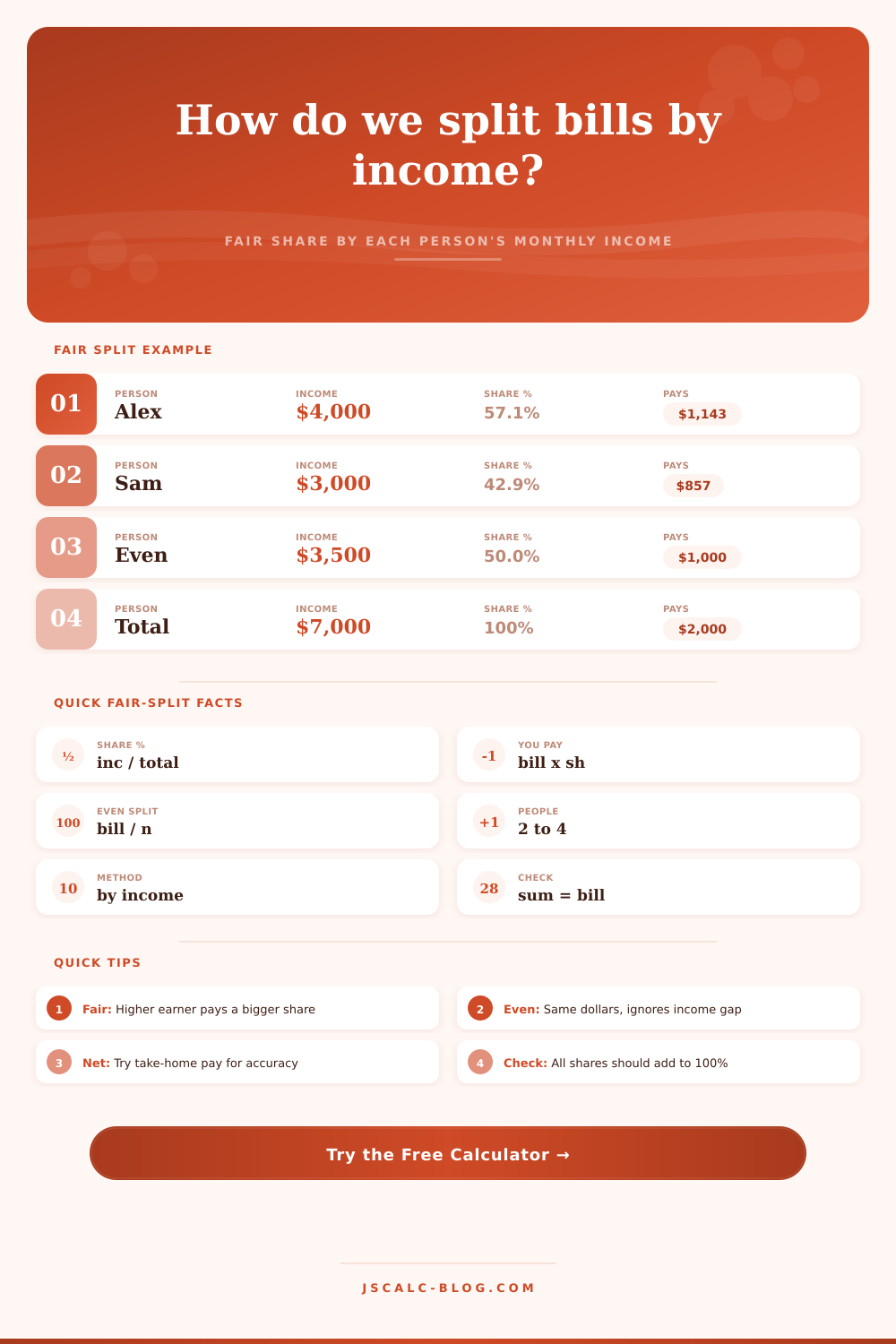
Split rent and shared household bills in proportion to each person's monthly income so higher earners cover a larger fair share, then compare the proportional result against a plain even split.
🎯Real Income-Split Presets
📝Expense & Income Inputs
Rent plus any bills you split together.
Used when 3 or 4 people are selected.
Used when 4 people are selected.
Optional: nobody pays below this share of the bill.
🔢Formula Snapshot
📊Per-Person Fair Share
| Person | Monthly Income | Share of Income | Fair Share Pays | Vs Even Split |
|---|---|---|---|---|
| Enter incomes above to calculate each person's fair share. | ||||
⚖Proportional vs Even Comparison
| Person | Fair (By Income) | Even (Equal) | Difference | Who It Favors |
|---|---|---|---|---|
| The comparison appears after calculation. | ||||
📈Income-Share Reference
| Income Gap (Two People) | Higher Earner Share | Lower Earner Share | On $2,000 | On $3,000 | Even Would Be |
|---|---|---|---|---|---|
| $3,000 vs $3,000 (equal) | 50.0% | 50.0% | $1,000 / $1,000 | $1,500 / $1,500 | 50% each |
| $3,500 vs $2,500 | 58.3% | 41.7% | $1,167 / $833 | $1,750 / $1,250 | 50% each |
| $4,000 vs $3,000 | 57.1% | 42.9% | $1,143 / $857 | $1,714 / $1,286 | 50% each |
| $5,000 vs $3,000 | 62.5% | 37.5% | $1,250 / $750 | $1,875 / $1,125 | 50% each |
| $6,000 vs $2,000 | 75.0% | 25.0% | $1,500 / $500 | $2,250 / $750 | 50% each |
| $7,000 vs $3,000 | 70.0% | 30.0% | $1,400 / $600 | $2,100 / $900 | 50% each |
🗂Common Household Scenarios
| Scenario | People | Shared Bill | Incomes | Fair Split Result |
|---|---|---|---|---|
| Couple 60/40 | 2 | $2,000 | $3,600 & $2,400 | $1,200 / $800 |
| Big earner gap | 2 | $2,400 | $6,000 & $2,000 | $1,800 / $600 |
| Three roommates | 3 | $2,700 | $4,000 / $3,000 / $2,000 | $1,200 / $900 / $600 |
| Utilities only | 2 | $400 | $5,000 & $3,000 | $250 / $150 |
| Two equal incomes | 2 | $1,800 | $3,500 & $3,500 | $900 / $900 |
| Four-person household | 4 | $3,200 | $5,000 / $4,000 / $3,000 / $2,000 | $1,143 / $914 / $686 / $457 |
⚙Full Formula Breakdown
📋Reference Values
| Item | Typical Entry | How It Is Used | Effect On Split |
|---|---|---|---|
| Shared expense | $400 to $4,000 | The bill everyone divides | Scales every dollar share |
| Monthly income | $2,000 to $8,000 | Weight for each person | Sets the share percentage |
| Income basis | Net take-home | Net is fairer than gross | Changes weights, not method |
| People count | 2 to 4 | How many share the bill | Changes even-split amount |
| Minimum floor | 0% to 25% | Protects the lowest earner | Softens the income gap |
💡Practical Fair-Split Tips
There’s always this uncomfortable conversation between roommates or partners who want to split rent, and it doesn’t quite add up. While someone makes much less (or much more), they’re expected to contribute exact same dollar figure each month. In the context of a shared home, it leads to tensions over what’s “fair,” which is now an opinion rather than a simple math problem.
This isn’t about being charitable. It’s about matching your true ability to chip in with your financial share, so that one person isn’t carrying an unfair burden while the other person pay too little.
Why Splitting Bills by Income Is Fairer Than 50/50
Splitting bills based on income is simple: It’s just proportional. If one roomie has double the paycheck of another, they probably have twice the available cushion to cover fixed expenses (rent, utilities). That doesn’t translate into a “double-bill” payment; rather, it indicates that some type of adjustment would be fairer then a strict 50-50 split.
There’s no need to convert or guess at any coefficients here; simply plunk in your monthly amounts, and the calculator do the rest. Just feed in your combined bill amount and take-home pay for each person, and presto, an exact cut for all party.
These calculations need to be based off net income (not gross salary). Gross salaries might sound great on paper, but after taxes and other required deductions like insurance is stripped away, that’s not what actualy ends up in your bank account. If you base your split on the pre-tax numbers, then the person with the greater earning power will appear to have more money, which will lead to a “split” that seem overly stingy. Reality is reflected by the net pay amount, since this represent what you’ll have left over to spend towards housing costs. Fairness hinges on the amount of disposable resources at play here, not on how much someone could of theoretically earn.
Let’s say you have two roommates, one who makes $3,000 per month and another who makes $4,000 per month. You pay two thousand for rent. How do you split it? Under an even split, both people would pay one thousand. That’s thirty-three cents out of every dollar toward housing for the person making three thousand. It’s just twenty-five cents out of every dollar for the person making four thousand. There’s a big difference between those burden.
A proportional split corrects this by splitting things according to weight of their incomes. The bigger-earning person will pay more, in absolute dollars, but each will bear the same relative burden on his or her budget. It’s laid out plainly in the reference table on the page, and you can see exactly how many dollars change at various income ratios. And it eliminates any emotion from the equation (that is, debating who’s generous and who isn’t) because now you’re talking percentages that total one hundred.
There’s even an option to set a minimum floor. This ensures smallest share doesn’t go below your chosen amount, letting you require a baseline contribution while softening the blow without breaking the math.
The toughest aspect of any finance-related arrangement in a shared home? It is communication. Even with ideal numbers, setting the wrong expectations can lead to resentment down the road. Before you move in with someone or sign a lease, sit down and talk through what’s fair, and why it’s fair. Make sure they understand that proportional splitting isn’t a statement of your superiority… It’s a way to make things last. By making sure everybody can pay for their fair share without missing meals or raiding savings, we make sure that it all works out. If the reasoning makes sense, then everything else come easy.
The financial foundation needs to be strong and fair to work well as shared living. If both people are comfortabley with how they contribute. If they feel valued and taken care of financially, then this will work out really well.
If one person makes twice as much as the other, then do a proportional split; if it’s super simple and you’re okay with it being 50/50, do that instead. Just get clear on your number and go from there. The tool can helps you determine what makes sense given your circumstances. Then follow through.
Fair doesn’t always mean splitting the check. Fair means having all our financial ducks in a row without anyone losing their mind at home.