Cooking Time Adjustment Calculator
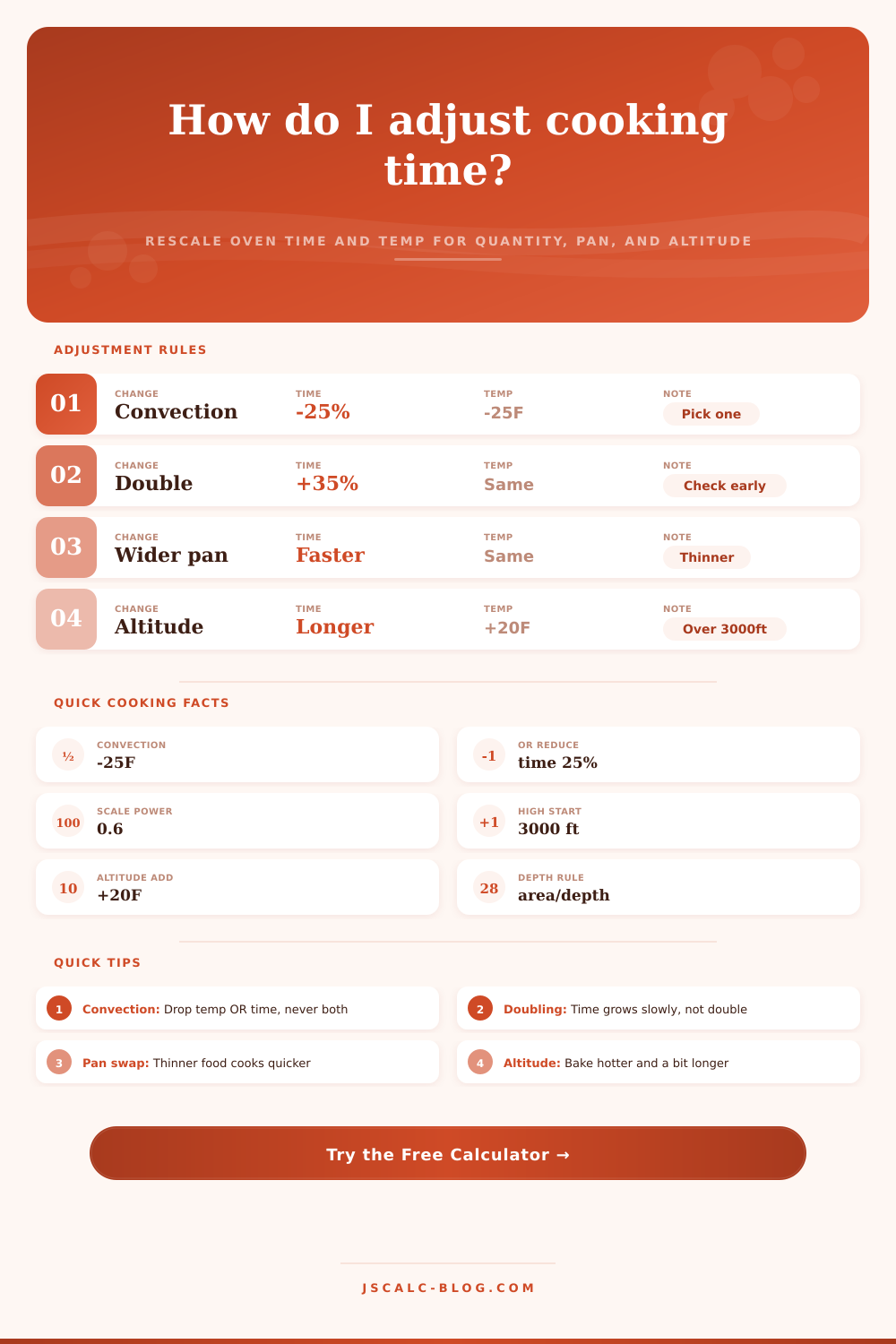
Rescale your oven time and temperature when you change the batch size, switch to a convection oven, swap to a different pan, or bake at high altitude. Built on established kitchen heat-transfer rules with a check-early estimate for every result.
🍳Real Kitchen Presets
📝Recipe & Oven Inputs
Time grows with volume but not linearly; temperature stays the same.
Established rule: apply one, never both.
Used only when pan change is on.
High-altitude rules start above 3000 ft.
🔢Method Snapshot
🌬Convection Conversion Reference
| Standard Temp | Lower Temp Option | Reduce Time Option | Best Use |
|---|---|---|---|
| 300°F | 275°F, same time | 300°F, time × 0.75 | Slow roasts, custards |
| 325°F | 300°F, same time | 325°F, time × 0.75 | Cheesecake, dense cake |
| 350°F | 325°F, same time | 350°F, time × 0.75 | Most cakes and bakes |
| 375°F | 350°F, same time | 375°F, time × 0.75 | Muffins, quick breads |
| 400°F | 375°F, same time | 400°F, time × 0.75 | Roast vegetables, pastry |
| 425°F | 400°F, same time | 425°F, time × 0.75 | Sheet-pan meals, fries |
| 450°F | 425°F, same time | 450°F, time × 0.75 | Pizza, high-heat roasting |
📏Pan Size Conversion Reference
| From Pan | To Pan | Area Ratio | Time Effect |
|---|---|---|---|
| 9×13 in | 8×8 in | 0.55 area | Thicker, add 20 to 30% |
| 8×8 in | 9×13 in | 1.83 area | Thinner, cut 20 to 25% |
| 9 in round | 8 in round | 0.79 area | Thicker, add 10 to 15% |
| Two 9 in | One 9×13 | 0.90 area | Deeper layer, add time |
| Loaf 9×5 | Muffin cups | Small units | Much faster, cut 40 to 50% |
| Sheet 13×18 | 9×13 in | 0.50 area | Thicker, add 25 to 35% |
⚖Quantity Scaling Guide
| Quantity Change | Volume Ratio | Time Factor (0.6) | Temperature |
|---|---|---|---|
| Half batch | 0.50× | about 0.66× time | Keep the same |
| Same batch | 1.00× | 1.00× time | Keep the same |
| One and a half | 1.50× | about 1.28× time | Keep the same |
| Double batch | 2.00× | about 1.52× time | Keep the same |
| Triple batch | 3.00× | about 1.93× time | Keep, check early |
| Quadruple | 4.00× | about 2.30× time | Split pans if possible |
⛰High-Altitude Adjustments (Above 3000 ft)
| Altitude | Temp Change | Time Change | Leavening & Liquid |
|---|---|---|---|
| Below 3000 ft | No change | No change | Standard recipe |
| 3000 ft | +15°F | Slightly shorter | Reduce leavening a little |
| 5000 ft | +20°F | Watch closely | Less leavening, more liquid |
| 7000 ft | +20 to 25°F | May need more time | Cut leavening, add liquid |
| 9000 ft | +25°F | Longer for moist cores | More liquid, less sugar |
| 10000 ft + | +25°F | Test doneness often | Strong leavening cuts |
🗂Full Adjustment Comparison Grid
| Scenario | Base | Quantity | Oven | Pan / Altitude | Result Estimate |
|---|---|---|---|---|---|
| Double the recipe | 30 min / 350°F | 1 → 2 | Standard | Same pan | about 46 min / 350°F |
| Convection convert | 40 min / 375°F | No change | To convection | Same pan | 40 min / 350°F |
| Bigger pan | 45 min / 350°F | No change | Standard | 8×8 → 9×13 | about 35 min / 350°F |
| Half batch | 50 min / 325°F | 2 → 1 | Standard | Same pan | about 33 min / 325°F |
| High altitude bake | 28 min / 350°F | No change | Standard | 5500 ft | about 29 min / 370°F |
| 9x13 to 8x8 | 35 min / 350°F | No change | Standard | 9×13 → 8×8 | about 47 min / 350°F |
| Roast 2x size | 75 min / 325°F | 1 → 2 | Standard | Same pan | about 119 min / 325°F |
| Casserole scale | 40 min / 375°F | 1 → 1.5 | To convection | Same pan | about 51 min / 350°F |
| Cake two pans | 35 min / 350°F | 1 → 2 | Standard | Split, so per pan same | about 35 min / 350°F |
| Cookies batch | 12 min / 375°F | 1 → 3 | Standard | Same trays, in batches | about 12 min / 375°F |
⚙Full Method Breakdown
📋Doneness Check Reference
| Dish | Check Method | Target | When Scaling Up |
|---|---|---|---|
| Cake / muffin | Toothpick in center | Comes out clean | Test 5 min before estimate |
| Roast / poultry | Instant-read probe | Safe internal temp | Probe thickest part |
| Casserole | Bubbling at edges | 165°F center | Center lags the edges |
| Bread / loaf | Tap for hollow sound | Firm crust, 200°F+ | Deeper loaf needs longer |
| Cookies | Edges set, center soft | Light golden edges | Rotate trays midway |
💡Practical Cooking Tips
Remember the time you doubled a recipe for guests, put it in the oven, and took out a dish with brown edges and a middle still raw? That’s the sinking sensation that comes from treating cooking like chemistry instead of physics. Heat doesn’t read your ingredient list or care how well intentioned you are.
Once you input your pan dimensions and amount you want to cook into the calculator above, it will do the math for you. This saves you from having to guess if you need five more minutes or twenty in a deeper casserole.
Why Your Cooking Time Changes
So what’s the problem? Heat penetrates along a curve and volume increases linearly. Doubling your ingredients doesn’t simply double your food, it doubles its size and therefore amount of space between heat source and center. This means that doubling the time isn’t going to do much for you. Heating something up is an outside-in affair: A big mass will take longer because it has further to go, so we don’t multiply time as such but instead give ourselves some extra time incrementally. The tool recognizes this with a scaling exponent which takes into account how more differently a thick roast should be treated then a thin sheet of cookie.
The shape of the pan also play its own tricks. Home cooks think that if they spread out their batter in a wider pan, it’s the same as having deep but narrower layer. No. When you spread it out, you make the pan shallower which exposes greater amounts of surface area to the radiant heat of oven. Consequently, that food will cook quicker, because there’s less distance between bottom of your dish and the radiant heat. Going from a regular baking sheet to smaller rounds traps some of moisture and increases height (aka makes the profile thicker). And what does the calculator do? It accounts for this by looking at difference in depth. It reminds you that surface area matters as much as the overall amount.
The added twist of convection ovens tripped up even seasoned cooks. Convection ovens has a fan that circulates the hot air. This removes the cool boundary layer surrounding any food inside, making heat transfer more efficient. You can lower the temperature or shorten the cooking time. The rule of thumb in kitchens has always been: Pick one and stick with it.
For something delicate such as cake, lowering the temperature by 25 degrees Fahrenheit but maintaining the original cook time typically produce the best results. For things with a crisp outside desired, such as a roast, cutting back on the time by a quarter tend to work better. Trying to do both results in pale, underdone interiors because the center just never gets the sustained exposure to heat needed to set.
But altitude can change everything; it alters air pressure and boiling points. Water will boil at a lower temperature above three thousand feet, so even though your food may appear nicely browned on top, it may still be moist inside, taking longer to come up to temp. And here’s where the counter-intuitive part come in: You actualy want to turn up the heat of the oven a bit to encourage structure to set before it burns away the sugars or lets the moisture escape too slowly. I know it seems like baking hotter is the opposite of what you should do since they’re already starting to dry out, but it’s because the interior isn’t cooking fast enough due to the lower boiling point.
These changes don’t take the place of actually looking at things. There’s no algorithm that will replace smelling your kitchen or determining whether your crust bubbles exactly how it should. These estimates is meant as starting points; not guarantees. If you’re working with anything meaty or dense bread, you’ll still have to rely on your nose and get out a thermometer.
That said, knowing what makes the time change help you make changes as you go without panicking. At the end of the day, scaling up to cook isn’t so much about rote memory as it is an appreciation for how heat moves: fast through thin things, slow through big dense things. It makes sense. You’re no longer guessing; you’re now building something from scratch. Think of the next time you’ll need to alter a recipe, and think of the core: it’s all about what cooks in the middle.