D&D Dice Probability Calculator
Roll the odds for D&D 5e combat: find your d20 hit chance versus a target AC, compare advantage and disadvantage, check DC save success, and average NdM damage with critical hits and expected damage per attack.
🎲Real Encounter Presets
📝Roll Inputs
Added to the d20 before comparing to AC or DC.
Multiplies expected damage for the full turn.
🔢Probability Snapshot
🎯d20 Hit Chance By Roll Needed
| Need (AC – Bonus) | Normal | Advantage | Disadvantage | Swing vs Normal |
|---|---|---|---|---|
| Enter values above to build the hit-chance reference. | ||||
🎲Damage Dice Averages
| Die | Average Each | Range | 2 Dice | Crit (Doubled) |
|---|---|---|---|---|
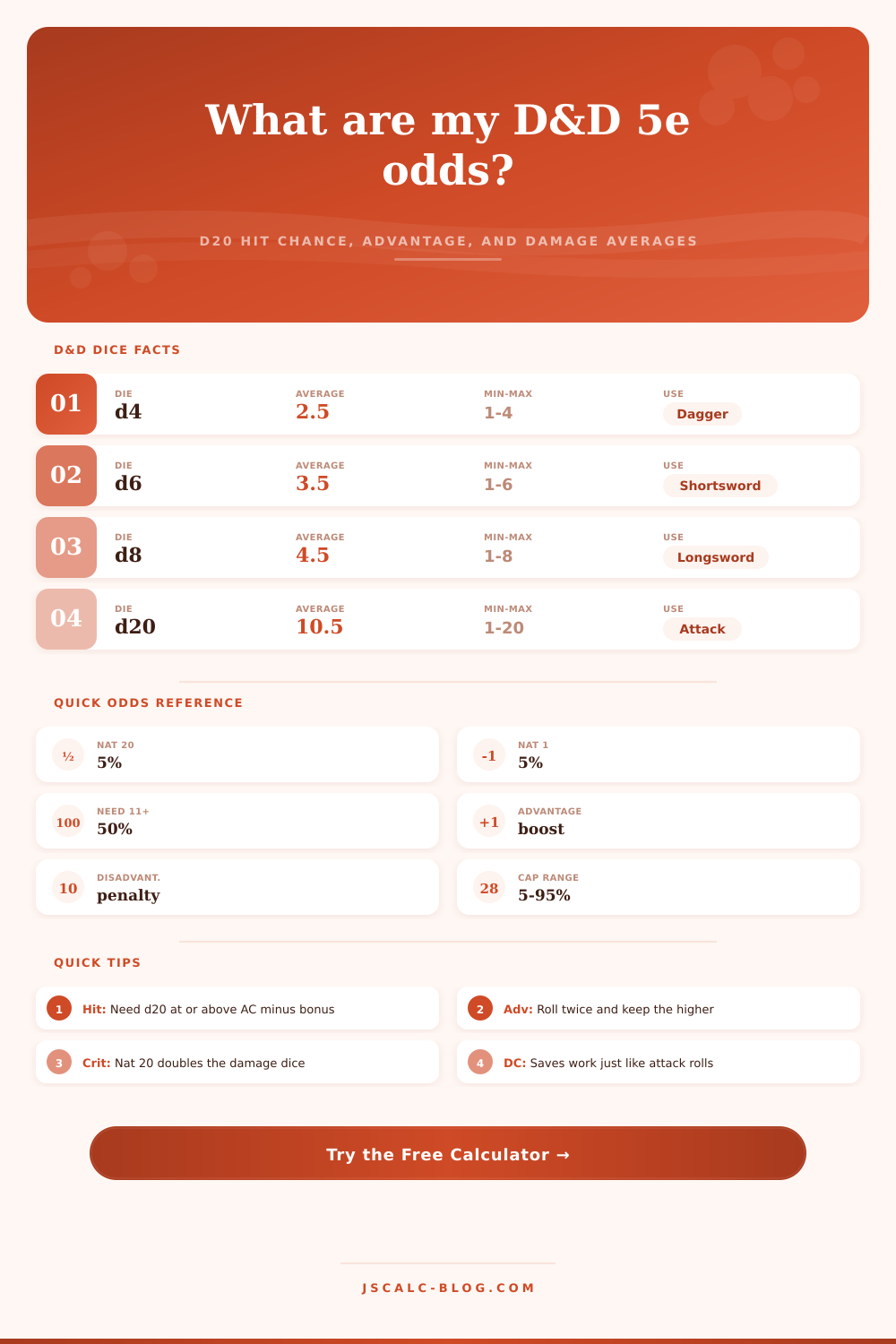
| d4 | 2.5 | 1 – 4 | 5.0 | 5.0 |
| d6 | 3.5 | 1 – 6 | 7.0 | 7.0 |
| d8 | 4.5 | 1 – 8 | 9.0 | 9.0 |
| d10 | 5.5 | 1 – 10 | 11.0 | 11.0 |
| d12 | 6.5 | 1 – 12 | 13.0 | 13.0 |
| d20 | 10.5 | 1 – 20 | 21.0 | 21.0 |
🗂Attack Scenario Comparison
| Scenario | Bonus | Target | Roll | Damage | Hit % | Expected |
|---|---|---|---|---|---|---|
| Basic longsword | +5 | AC 15 | Normal | 1d8+3 | 55% | 4.1 |
| Advantage strike | +5 | AC 15 | Advantage | 1d8+3 | 80% | 6.0 |
| Disadvantage strike | +5 | AC 15 | Disadvant. | 1d8+3 | 30% | 2.3 |
| Great weapon swing | +7 | AC 16 | Normal | 2d6+4 | 60% | 6.6 |
| Rogue sneak attack | +7 | AC 15 | Advantage | 1d6+3d6+4 | 84% | 15.9 |
| Sharpshooter (-5/+10) | +2 | AC 16 | Normal | 1d8+13 | 35% | 6.1 |
⚙Full Formula Breakdown
📋D&D Roll Reference
| Roll Needed | Meaning | Normal Chance | Advantage |
|---|---|---|---|
| 2 or higher | Nat 1 only fails | 95% | 99.75% |
| 5 or higher | Easy attack | 80% | 96% |
| 10 or higher | Even odds tilt | 55% | 79.75% |
| 11 or higher | True coin flip | 50% | 75% |
| 15 or higher | Tough target | 30% | 51% |
| 20 (nat 20) | Only a 20 hits | 5% | 9.75% |
💡Practical Dice Tips
In Dungeons and Dragons, the nail-biting action isn’t typically about swords crossing, it’s usually about a twenty-sided die rolling across table. You spend hours minimizing stats and memorizing rules for that one shot that could mean everything, and then it comes down to simple cube of plastic. Knowing a little bit about probabilities is what differentiates the player who feels like they’re “lucky” versus the player who knows how to play smart.
Enter this calculator, which does the math for you once you plug in your attack bonus and enemy’s armor class. That way, you won’t have to do any head crunching on dice rolls when it matters most. The issue is that, to most new players, rolling a plus-seven on something that has a fifteen armor class seem easy enough; they fail to recognize just how variable this can be.
Why Dice Math Matters in D&D
Half the time, it’s as simple as rolling an eight or better. Nothing too difficult, right?… Except… well, half the time. Throw in misses and crits and now you’re getting closer. No matter how many modifiers you have on a character sheet, there’s a one-in-twenty chance you’ll still get a one, which doesn’t hit anything, ever. If you’re up against a golem made of impossible metal and indestructible armor, then yeah: a twenty will hit them every time.
The five percent bottom and top floors mean that no attack roll ever actualy lands at zero or one-hundred percent. This is why advantage feels so impactful when you’re sitting at the fifties. It basically increases your probability by twenty-five points, whereas there isn’t much benefit to it when you’re already making most of your shots.
You can see how switching to advantage dramaticly changes your expected damage. The calculator does the math for you (and it doesn’t forget about doubling the dice on a critical strike, something that gets lost in casual math). The doubling of dice instead of simply adding the modifier result in an exponential spike of possible damage. This is huge for characters who get additional dice like rogues do with Sneak Attack; suddenly a moderate hit turn into a devastating blow. For paladins and fighters, when they smite on crits, they understands all too well that the energy unleashed go up in direct proportion to the number of dice they roll.
Combat statistics aren’t everything, odds matter too, with save throws functioning exactly like an attack roll. The lower your lowest stat and the higher the DC, the more likely it is that things will go bad for you. Being able to understand those numbers allows you to determine when you should of spend spell slots or other ability expenditures to hedge your bets and ensure that if things go wrong, they won’t go really wrong. Randomness becomes manageable risk.
Glance down at the reference chart on page to see how minor fluctuations in difficulty and bonus can flow across your likelihood of success. One point of advantage could be the reason you live or die under weight of your own fall. In the end, though, dice aren’t anything more than tools for creating uncertainty, and understanding how they work allow you to be an agent in that uncertainty. While you’re never going to will the die to show a twenty, you’ll find yourself able to frame a twelve as a win rather then a loss. And by adopting this knowledge of probabilities, you cease hoping; you begin playing with purpose. You will know exactly what your odds are before the dice even come to rest.