Drug Half-Life Calculator
Estimate how much of a drug remains over time, the percent left, the time to effectively clear it from the body (about five half-lives), and the steady-state level reached with repeat dosing.
💊Common Half-Life Scenarios
📝Dose & Half-Life Inputs
The time for the amount to fall by half. Auto-fills from the drug list.
Used to estimate the time until the amount decays to this level.
Hours between repeated doses for steady-state estimates.
🔢Formula Snapshot
📉Your Decay Timeline
| Half-Lives | Time Elapsed | Percent Left | Amount Left (mg) | Status |
|---|---|---|---|---|
| Enter values above to build the decay timeline. | ||||
⌛Half-Life Decay Reference
| Half-Lives Passed | Percent Remaining | Percent Eliminated | Rule of Thumb |
|---|---|---|---|
| 0 | 100% | 0% | Full dose, peak level |
| 1 | 50% | 50% | Half is gone |
| 2 | 25% | 75% | One quarter left |
| 3 | 12.5% | 87.5% | Effect often fading |
| 4 | 6.25% | 93.75% | Mostly eliminated |
| 5 | 3.125% | 96.875% | Considered cleared |
| 6 | 1.5625% | 98.4375% | Trace amounts only |
📋Common Drug Half-Lives
| Drug | Typical Half-Life | Rate k (/hr) | ~Time to Clear (5x) |
|---|---|---|---|
| Amoxicillin | ~1 hour | 0.693 | ~5 hours |
| Ibuprofen | ~2 hours | 0.347 | ~10 hours |
| Acetaminophen | ~2.5 hours | 0.277 | ~12.5 hours |
| Aspirin (low dose) | ~3 hours | 0.231 | ~15 hours |
| Caffeine | ~5 hours | 0.139 | ~25 hours |
| Metformin | ~6 hours | 0.116 | ~30 hours |
| Sertraline | ~26 hours | 0.027 | ~5.4 days |
| Diazepam | ~40 hours | 0.017 | ~8.3 days |
| Fluoxetine | ~4 days | 0.007 | ~20 days |
🔁Steady-State & Accumulation Grid
| Interval ÷ Half-Life | Fraction Left at Redose | Accumulation Factor | Peak vs Single | Doses to ~Steady |
|---|---|---|---|---|
| 0.25 (frequent) | 84.1% | 6.29× | Much higher | ~18 |
| 0.5 | 70.7% | 3.41× | Higher | ~9 |
| 1.0 (every t1/2) | 50.0% | 2.00× | Doubles | ~5 |
| 1.5 | 35.4% | 1.55× | Moderate build | ~4 |
| 2.0 | 25.0% | 1.33× | Small build | ~3 |
| 3.0 | 12.5% | 1.14× | Little build | ~2 |
| 4.0 (spaced far) | 6.25% | 1.07× | Almost none | ~2 |
⚙Full Formula Breakdown
💡How to Read the Results
How much does it last? That’s the question behind most drug anxiety. When can I have a drink? Will the side-effects go away? Will this show up on my drug test? It comes down to something called half-life.
Half-life is the time it takes for the active concentration of the drug in your blood to be reduced by half. Sounds simple enough, except for one thing: half-life doesn’t behave like linear subtraction. Eating half a sandwich isn’t like losing half a cup of coffee. The next half aren’t the same as previous one. The following portion decreases based off its current size.
What Is Half-Life?
This is what causes that exponential decay curve. This is why drugs takes forever to leave you at the beginning and suddenly drop off a cliff toward the end.
But that’s where the tool on this page come in. It doesn’t require you to bust out logarithms while having a late night migraine. Simply input starting dose, then input known half-life of compound, and the calculator knows how long ago you swallowed it. Then the calculator spits out precise number of milligrams still lingering.
Why? Because your body doesn’t care what label on bottle says. Your body cares about concentration. Whether you’re trying to track how sensitive you are to caffeine, or whether you’re waiting for an antibiotic to clear out enough to begin a probiotic regimen, knowing exactly how much is left will help you time your next move precisely (rather than guess).
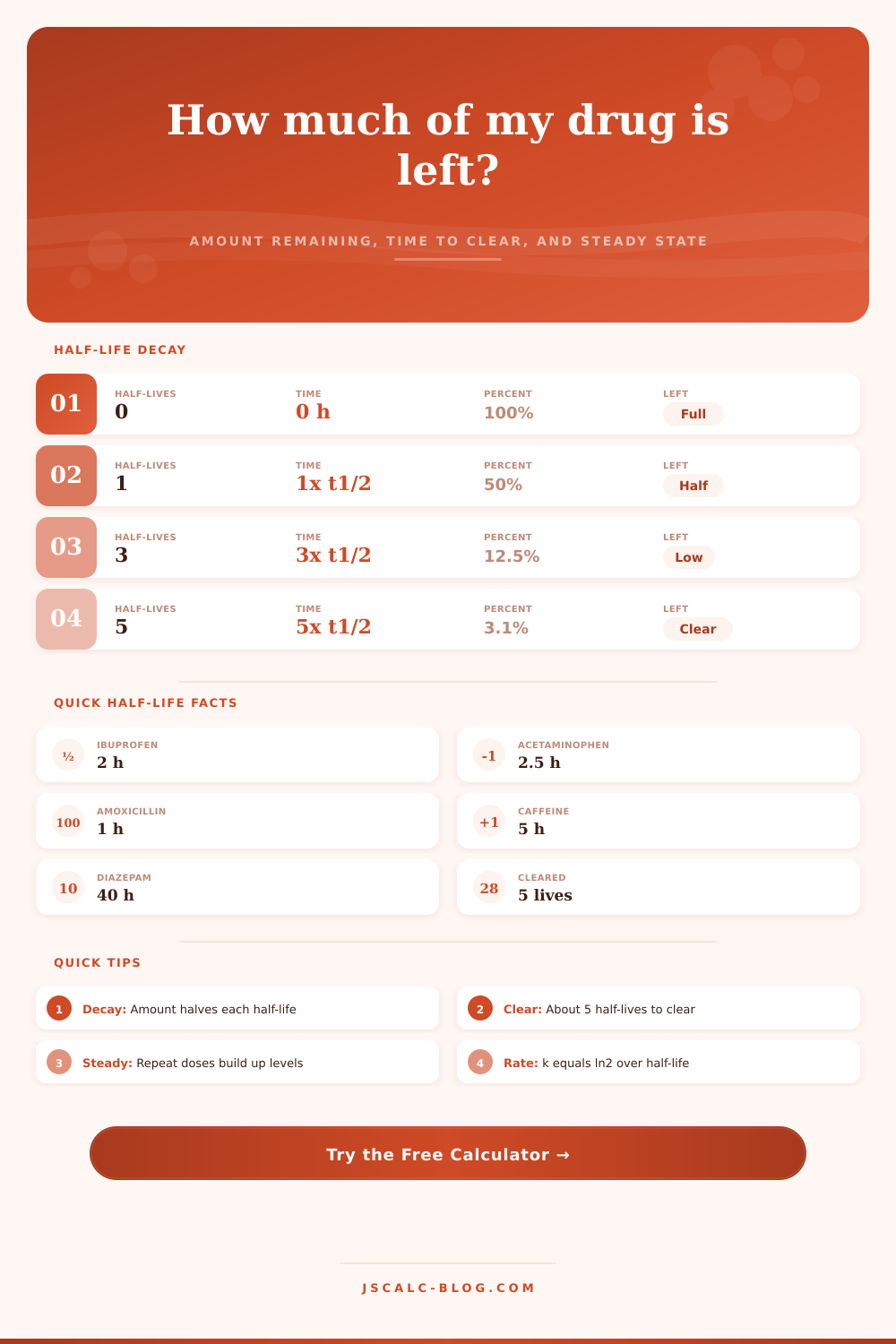
Clearance is misunderstood by most. They believe if they feel normal, then the drug is gone. In fact, doctors typically deem something as cleared from your system when it reaches around five half-lives. That means there’s only about three percent of whatever was taken left at that time. Short-acting drugs like ibuprofen take ten hours to clear (two hour half life). It takes over eight days for long-acting drug like diazepam (forty hour half life).
And that’s what causes folks to get in trouble: the space between being chemically clear and feeling fine. The page has a quick table with reference laid out in simple rows so you can visually see how fast things drop off (or drag on). But change the timing on the doses and that’s a different story.
Take a second pill while first hasn’t yet cleared? Those levels compound. Compounding continues until your body reach a constant level, usually within four to five half-lives. This happens regardless of dose size. The calculator also lets you enter a redosing interval, so it’ll show you how high above the single-dose level those peaks rise.
That matters for safety margins: While each separate pill may not be dangerous, taking them too often in relation to their half-life could drive concentrations into toxic range. On the flip side, spacing out dosages too far apart runs the risk that drug levels falls below effective levels prior to getting another hit.
In reality, there are several things that will change this number. First is your organ function. Elimination is powered by liver and kidneys. When they’re operating at a lower capacity, half-life gets longer. That’s where age comes into play. What takes six hours to clear from the body for a 20-year old may take double that for person who has reduced kidney function. There are genetic factors as well. People can have enzymes which break down drugs more quickly or more slowly different than averages.
Remember: these inputs reflect an average adult physiologic makeup. Consider it a framework but never a verdict. For anything related to health, always consult a pro.
But half-life is beautiful, because then it’s predictable. Once you learn the variables, you can plot the curve. You don’t have to be a pharmacist to understand how it all moves through our bodies. You only have to respect the math.
When you take a medication and know your body will halve its load with each cycle, you’re able to plan accordingly. If you are taking medication long-term or waiting for a sedative to wear off so you can think clearly again, knowing when next dose happens gives you control back.
The pill is nothing but the beginning. The rest is up to the clock.