Brick Calculator
Estimate the bricks needed for a wall from length and height, brick size and mortar joint, wall thickness in wythes, opening deductions, and a waste factor, plus mortar bags and bricks per square foot.
🧱Real Brick Presets
📝Wall & Brick Inputs
Total length of the wall in feet.
Total height of the wall in feet.
Used only when brick type is Custom face size.
Face height is the exposed course, not depth.
Doors and windows in square feet.
Extra for cuts and breakage, usually 5 to 10 percent.
Used to convert the total into full pallets.
🔢Formula Snapshot
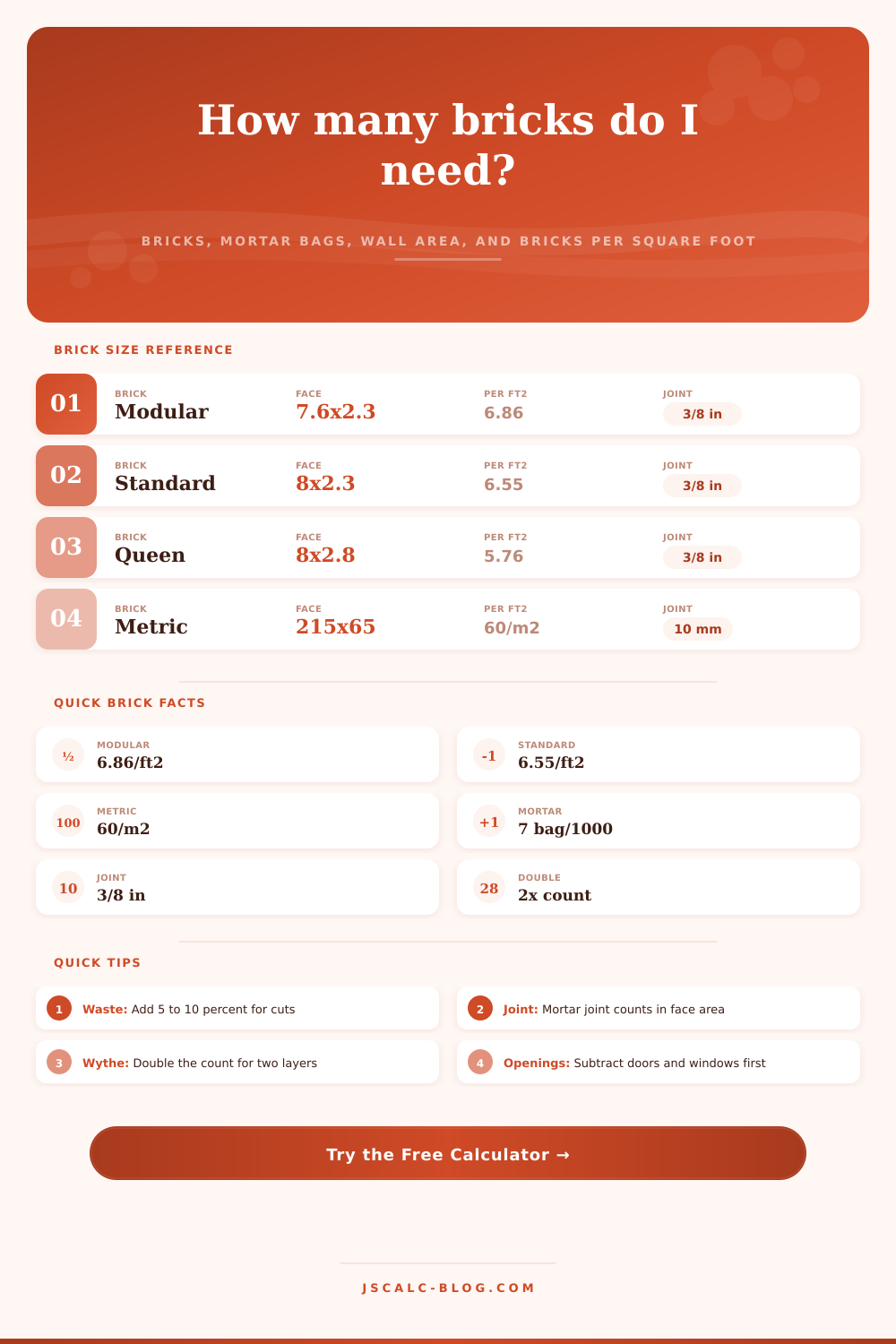
🧱Brick Size Reference
| Brick Name | Face L × H (in) | Nominal Depth | Bricks / ft² (3/8 joint) | Bricks / 100 ft² |
|---|---|---|---|---|
| Enter values above to calculate the brick size reference. | ||||
🧮Mortar Bags Per 1000 Bricks
| Mortar Joint | Mortar Yield | 70 lb Bags / 1000 | Sand (ft³) / 1000 | Best For |
|---|---|---|---|---|
| 1/4 in thin | Lower fill | 5 bags | 4.5 | Tight veneer, thin joint |
| 3/8 in standard | Typical fill | 7 bags | 6.5 | Most brick walls |
| 1/2 in wide | Higher fill | 9 bags | 8.5 | Rustic and heavy joints |
| 5/8 in extra | Heavy fill | 11 bags | 10.5 | Wide struck joints |
| Dry stack | None | 0 bags | 0 | Mortarless landscape |
🧱Wall Thickness (Wythe) Reference
| Wythes | Nominal Thickness | Brick Multiplier | Modular / ft² | Typical Use |
|---|---|---|---|---|
| 1 wythe | 4 in (100 mm) | × 1 | 6.86 | Veneer, garden wall |
| 2 wythes | 8 in (200 mm) | × 2 | 13.72 | Load-bearing wall |
| 3 wythes | 12 in (300 mm) | × 3 | 20.58 | Thick or retaining wall |
| Cavity 2 wythe | 10 in with gap | × 2 | 13.72 | Insulated cavity wall |
📏Bricks By Wall Area (Modular, Single Wythe)
| Wall Area (ft²) | Base Bricks | +5% Waste | +10% Waste | Mortar Bags | Pallets (500) |
|---|---|---|---|---|---|
| 25 ft² | 172 | 181 | 189 | 2 | 1 |
| 50 ft² | 343 | 361 | 378 | 3 | 1 |
| 80 ft² | 549 | 577 | 604 | 5 | 2 |
| 100 ft² | 686 | 721 | 755 | 6 | 2 |
| 150 ft² | 1029 | 1081 | 1132 | 8 | 3 |
| 200 ft² | 1372 | 1441 | 1510 | 11 | 4 |
| 300 ft² | 2058 | 2161 | 2264 | 16 | 5 |
| 500 ft² | 3430 | 3602 | 3773 | 27 | 8 |
⚙Full Formula Breakdown
📋Reference Values
| Item | Common Value | How It Is Used | Effect On Count |
|---|---|---|---|
| Mortar joint | 3/8 in standard | Added to brick length and height | Bigger joint lowers bricks per ft² |
| Waste factor | 5% to 10% | Multiplies the base brick count | Raises the order to cover cuts |
| Wythe count | 1 to 3 layers | Multiplies bricks by layer count | Double wythe doubles the bricks |
| Openings | Door 21 ft², window 12 ft² | Subtracted from gross area | Lowers net area and brick count |
| Mortar bag | 7 bags per 1000 | Scaled by total brick count | More bricks means more mortar |
💡Practical Brick Tips
Building walls doesn’t demand complex engineering knowledge, just an even pace. A rhythm: set mortar, tap in unit, verify level, repeat.
Until you discover you miscalculated. And then it’s on because precision is everything. Inaccurate estimates make you panic. They don’t care how quickly you build. So when it comes to building walls they takes over where you leave off.
How the Calculator Helps You Get It Right
Once you input what type of brick and wall size, the calculator figures out the rest. No need for educated guesses about conversions and coefficients and other things that trip up most of us. You get a definite number of bricks and a to-do list.
Homeowners begin by measuring the wall’s size, but then they stop. They measure its length and height, multiply those two numbers, and assume thats what they need. That’s the error. A brick wall isn’t one solid sheet. Instead, it’s a grid of separate units spaced apart with mortar joints between them. Those joints consume space. Ignore them and your count will consistently be to low. To account for this, the tool adds the joint thickness to the brick dimensions before calculating coverage. It is a tiny bit of difference, yet it matter. On a large wall, a standard three-eighths-inch joint can shift your total count by dozens of units because it changes the amount of face area.
There’s also the issue of what size of brick. In most places, the default is modular, which fits the traditonal running bond pattern neatly with those standard joints. But if you’re working with King or Queen sizes, or some sort of metric thing, then suddenly your number of bricks per square foot vary hugely. To get around this, the calculator offers presets for all of these and will adjust the math accordingly. No need to memorize: more brick = less squares of brick. Just let it know. It’ll figure it out. The reference table on the page makes it easy to see how those face sizes turns into coverage areas. This gives context as to why your project may come up different than your friends’.
Thickness: How thick is that wall? Garden and veneer walls are typically a single wythe; most load-bearing walls are thicker, at least two wythes (and possibly three). For each wythe added, linearly multiply the number of bricks require. An eight-inch wall will require twice as many bricks than a four-inch one (plus more mortar to fill those extra joints!). The calculator extrapolates accordingly. That keeps you from wasting money by ordering enough for a veneer when you really require something with structural thickness.
The biggest thing people underestimate when they build with masonry is waste. Bricks will be broken as they are handled. Some will be cut out to fit around doors and windows. Others will be chipped on their edges making them unsuitable for exposure. Ten percent isn’t being pessimistic, it’s being practical. It accounts for real world building. If you don’t give yourself this cushion then you run the risk of having to go back to the supplier because something didn’t quite work. And that costs you more in time than money. There is a waste field on the calculator where you can adjust to match how confident you feel about your layout abilities.
A lot of people don’t think about mortar until it’s too late. Running out of mortar means building activities must stop. It will estimate the number of bags needed based off the number of bricks and the thickness of each joint. This will give you a ballpark figure on how much mortar you need for your order. Different brands has different yields per bag, but this at least will help you avoid scrambling to purchase cement or sand at the last minute.
Brick laying require precision and it takes time. If you get the math out of the way up front then you can concentrate on the work. Once you’ve got the material and the math, it’s all groove again. Set your mortar, tap your unit in, level it off, do it again. Knowing you have everything you need makes it easier to.